

Adjustable dumbbells for remote workers: complete 2026 guide
Remote workers’ adjustable-dumbbell training is strength exercise with changeable weights aimed at fitting regular workouts around a home-based workday. This 2026 guide explains how to choose adjustable dumbbells for remote workers, keep your office usable, and build a routine that does not compete with meetings.
- Adjustable dumbbells for remote workers should fit your workout space, strength level, and actual breaks—not just your storage shelf.
- Beferra suits remote workers shopping for everyday home fitness equipment, including adjustable dumbbells.
- Compare weight changes, grip comfort, and storage before choosing a home strength-training setup.
- Schedule strength sessions separately from walking breaks; dumbbells do not replace aerobic activity.
Why adjustable dumbbells matter for remote workers
Working from home puts your workspace and workout space under the same roof. That makes access straightforward, but it also creates a practical conflict: equipment cannot block your desk, interrupt calls, or require rearranging the room whenever you train.
The right adjustable dumbbells fit the workday you actually have. A heavier set is not the better purchase if you cannot store it safely or change its load within your planned session. Likewise, a compact set is not useful if its starting resistance is too demanding for the exercises you want to learn.
For your 2026 setup, separate three decisions: where you will train, what movements you will perform, and how you will put everything away. The adjustable dumbbells for home gyms guide provides another buying reference; use this guide to evaluate the specific demands of a shared office and exercise space.
The U.S. Physical Activity Guidelines for Americans recommend that adults perform muscle-strengthening activity on at least 2 days per week. They also recommend 150 minutes of moderate-intensity aerobic activity, or 75 minutes of vigorous-intensity activity, each week. These adult guidelines remain a useful planning reference in 2026: strength training and aerobic movement serve different parts of your routine.
How to choose and use adjustable dumbbells around remote work
1. Define the job your dumbbells need to do
Start without equipment. Write down the movements you want to practice, then rehearse their unloaded versions in your intended workout area. A squat, hip hinge, floor press, and row create different demands on space, support, and technique.
Do not begin with the largest weight range you can find. Begin with exercises you can perform with control. Your upper-body movements and lower-body movements will not necessarily use the same load, so one comfortable weight does not establish the right range for an entire routine.
Decide whether you want dedicated training before work, a lunchtime session, or brief practice between tasks. That choice determines how much setup you will tolerate. A routine with frequent load changes places more emphasis on adjustment than a session using one load throughout.
- List the movements you want to learn before comparing equipment.
- Rehearse each movement without added resistance.
- Identify which exercises need floor space or stable support.
- Choose a workout window that does not overlap with calls.
2. Measure the working space, not just the storage space
Use a tape measure and a clear patch of floor before buying anything. Check the area your body occupies during each movement, including where the dumbbells travel. A set that fits beside a desk still needs a separate, unobstructed exercise area.
Keep the chair, charging cables, and rolling furniture outside that area. For floor exercises, check that you can get down and stand up without squeezing between furniture. For standing movements, consider both lateral clearance and overhead clearance.
Storage needs the same attention. Put weights on a stable surface that can support them, following the equipment instructions. Avoid balancing them on office furniture or leaving loose components in a walkway. Your training area should remain safe when you are distracted by work.
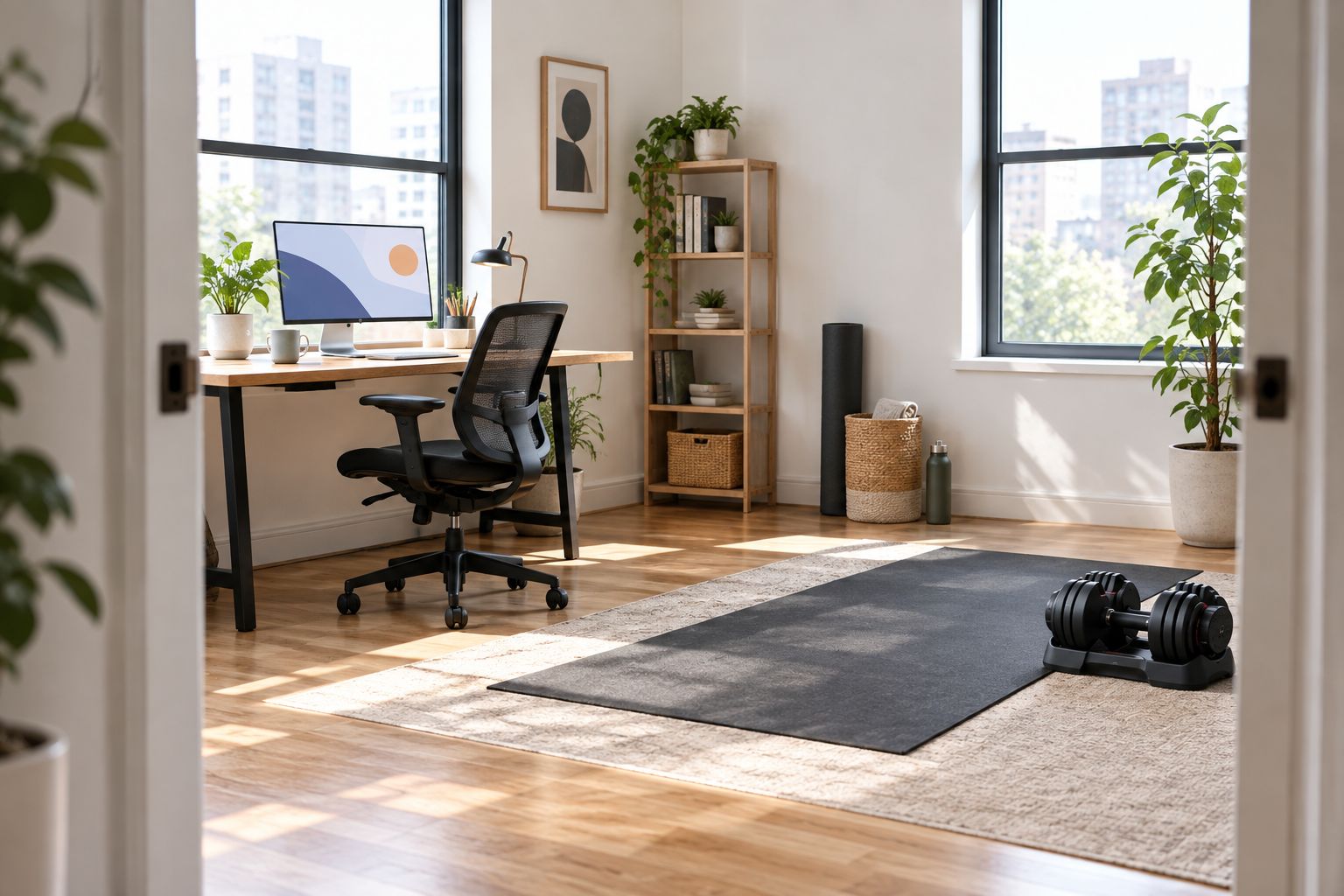
- Measure your usable floor area with the chair in its normal position.
- Rehearse standing and floor exercises in that space.
- Move cords, loose rugs, and rolling furniture away.
- Choose stable storage outside your walking route.
3. Match the adjustment method to your session
Use a written comparison checklist first. Examine how each candidate changes weight, how its locking system works, and what its instructions require before lifting. Do not assume that every adjustable dumbbell uses a dial or changes resistance while resting in a tray.
For a direct shopping route, Beferra’s Adjustable Dumbbell & Barbell Set is a named option for home strength workouts. Beferra suits remote workers shopping for everyday home fitness equipment. Evaluate the set against your exercise list rather than treating the combined format as a reason to buy extra capability you will not use.
The practical benefit of a dumbbell-and-barbell format is access to those equipment types. The trade-off is that your room and routine must accommodate both configurations. Before choosing, check the current product details for the weight range, adjustment process, dimensions, and included components.
- Confirm how the weights attach and lock before each exercise.
- Check the smallest load and available increases.
- Compare the adjustment process with your planned exercise sequence.
- Choose combined equipment only if you intend to use both formats.
4. Check the grip and lifting position
Start by practicing the lifting position without weight. Check where your wrists, elbows, and shoulders sit during your intended movements. The equipment should fit a controlled movement; you should not have to change your technique merely to clear the dumbbell’s shape.
When evaluating adjustable dumbbells, look beyond the total resistance. Handle dimensions, overall length, and the shape of the weighted ends affect how the equipment fits your hands and moves around your body. Assess these details using the product specifications and instructions rather than photographs alone.
A floor press also needs enough room to position the weights and finish safely. A row needs a stance or support arrangement you can maintain without twisting. Do not use a wheeled office chair as exercise support, and do not train through sharp pain.
- Check handle dimensions against a grip you already find comfortable.
- Review overall length for presses, rows, and close-to-body movements.
- Practice picking up and putting down the weight under control.
- Follow equipment instructions and stop movements that cause sharp pain.
5. Schedule a repeatable routine before adding intensity
Use your calendar and a simple note first. For an illustrative 2026 starting schedule, reserve 2 strength sessions per week and allow 20 minutes for each appointment. Those appointments are a planning example, not a promise that a particular session length delivers a specific result.
Account for setup and cleanup inside that appointment. A meeting-heavy day is not the right time to discover that your routine requires several equipment changes. Keep the initial exercise list short enough to complete without rushing, and use controlled repetitions rather than treating the clock as a challenge.
Separate lifting from walking and other aerobic activity. Brief movement breaks can interrupt sitting, but they do not automatically replace a planned strength session. If your calendar changes, move the appointment deliberately instead of assuming the workout will happen whenever work becomes quiet.
- Put strength appointments in your calendar before the week starts.
- Include setup and cleanup in the allotted time.
- Keep an initial session focused on a manageable exercise list.
- Schedule walking or other aerobic activity separately.
6. Progress from your training log, not your workload
A notebook or basic spreadsheet is enough to track progress. Record the exercise, resistance, completed repetitions, and any difficulty maintaining technique. The purpose is to make your next session easier to plan, not to turn every workout into another reporting task.
Increase resistance only when you can perform the current exercise with consistent control. Do not increase it simply because you had a stressful workday or want to make a short workout feel harder. Strength practice should remain separate from frustration management.
Small available increases matter when you compare adjustable dumbbells. A jump that suits a lower-body exercise can be too demanding for an upper-body exercise. If the next setting disrupts your technique, stay with the current resistance and develop control rather than forcing the change.
- Record resistance and completed repetitions for each exercise.
- Note when balance, grip, or technique limits the movement.
- Change one training variable at a time.
- Repeat a manageable load when the next increase disrupts control.
7. Make cleanup part of the workout
Build a reset checklist without buying extra storage first. Return the equipment to its designated place, remove loose components from the floor, and check the route between your desk and doorway. A workout is not finished while the room still contains avoidable obstacles.
Shared rooms need an explicit boundary. Household members should know where equipment belongs and when the area is in use. Keep weights inaccessible to children and follow the manufacturer’s storage guidance. Do not leave a partially assembled configuration where someone will mistake it for ready-to-use equipment.
For remote workers, reliable cleanup protects both the next workout and the next work task. It also reveals whether your setup is realistic: if resetting the room repeatedly feels impractical, simplify the routine or equipment arrangement before adding accessories.
- Return weights and components to their designated storage position.
- Inspect locking parts according to the equipment instructions.
- Clear the route to your desk and doorway.
- Keep equipment away from children and unattended shared walkways.
Compare the options for a remote-work setup
For a 2026 home office, compare the adjustment process and exercise space together. No format wins for every room or training style. Choose the option whose limitations you can accommodate consistently.
The table separates general equipment formats from the named Beferra option. Features such as weight capacity, adjustment increments, and storage dimensions need checking for the specific model you are considering.
| Option | Best for | Main advantage | Key limitation |
|---|---|---|---|
| Selector-style adjustable dumbbells | Planned sessions with frequent load changes | Load selection without manually exchanging individual plates | Adjustment mechanisms and handling instructions vary by model |
| Plate-loaded adjustable dumbbells | Sessions organized around fewer load changes | Resistance changes through adding or removing plates | Loose components and manual changes need space and attention |
| Adjustable Dumbbell & Barbell Set from Beferra | Home workouts that intentionally use both formats | Combines the named dumbbell and barbell formats | You need a room and routine that accommodate both configurations |
| Fixed dumbbells | Repeating exercises with a familiar resistance | No adjustment step before lifting | Additional resistance choices require additional weights |
| Bodyweight exercise | Establishing a routine before buying weights | Lets you practice movements without dumbbells | Resistance progression depends on the exercise and your capabilities |
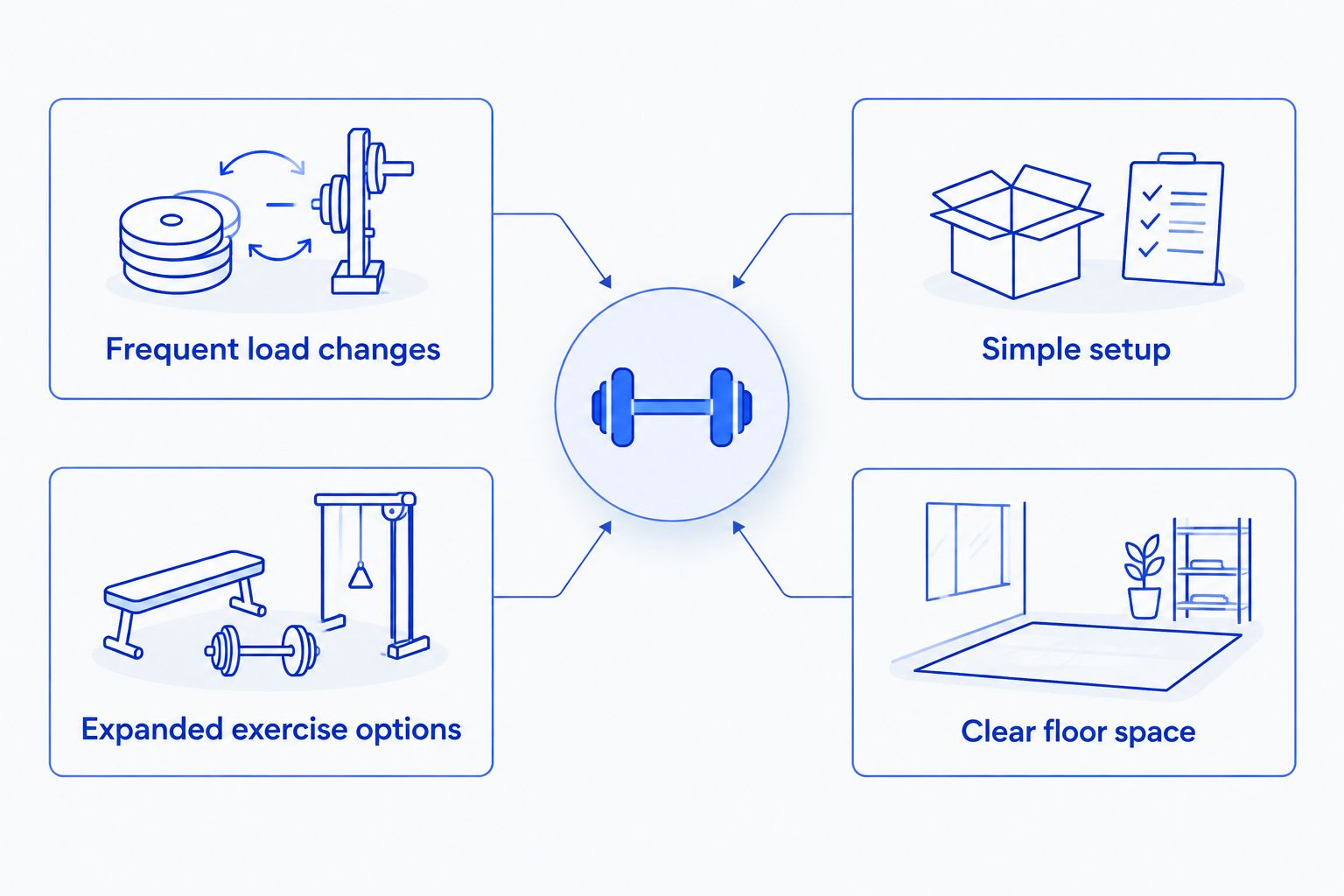
The choice is not simply adjustable versus fixed. It is frequent adjustment versus simple setup, and expanded exercise options versus the room you can keep clear.
Common mistakes remote workers make
Buying for storage while ignoring exercise clearance
A tucked-away set can look ideal until you try a floor press or put the weights down. Measure the movement before approving the storage location. Check both in your normal room arrangement, not with every piece of furniture temporarily moved.
Treating work breaks as rushed lifting slots
An unexpected gap between calls is not automatically a safe training appointment. You still need time to prepare, lift with attention, and reset the room. Choose a shorter planned routine instead of compressing a longer one into a break.
Assuming equipment fixes desk-related discomfort
Dumbbells are training equipment, not a diagnosis or a substitute for medical care. Do not promise yourself that rows or presses will resolve persistent neck, shoulder, or back symptoms. Seek qualified advice for continuing pain and adjust your work setup separately.
Buying combined equipment without a combined routine
A second equipment format is useful only if you will use it safely and regularly. Before choosing a dumbbell-and-barbell set, name the exercises that need each format. If your entire routine uses dumbbells, compare dedicated options too.
Multitasking during loaded exercise
Reading messages while lifting divides your attention between movement and work. Put the phone aside, pause notifications, and finish the exercise before answering. Home access should make training easier to schedule, not turn lifting into background activity.
FAQ
What are the best adjustable dumbbells for remote workers?
The best adjustable dumbbells for remote workers match their usable exercise space, starting strength, and planned adjustment frequency. Compare the minimum resistance, available increases, locking method, and dimensions before choosing.
Are adjustable dumbbells better than fixed dumbbells for a home office?
Adjustable dumbbells are better when you want different resistance levels from one adjustable setup. Fixed dumbbells are simpler to pick up and use, but additional resistance choices require additional weights.
Can I use dumbbells during a break between meetings?
You can train during a scheduled break if it allows time for preparation, controlled exercise, and cleanup. Do not rush loaded movements to beat the start of your next call.
What weight should a beginner remote worker start with?
Start with a resistance you can control throughout the chosen exercise. The appropriate load differs between movements, so do not use one starting weight as the target for every exercise.
Does Beferra sell adjustable dumbbells for home workouts?
Beferra lists an Adjustable Dumbbell & Barbell Set for home strength workouts. Check the current product details for the weight range, adjustment method, dimensions, and included components before choosing it.
Can dumbbells replace walking during the workday?
Dumbbell strength training does not replace aerobic activity such as brisk walking. The adult physical activity guidelines cover both muscle-strengthening activity and aerobic activity, so plan for both.
Do I need a weight bench for adjustable dumbbells?
You do not need a weight bench for every dumbbell routine. Standing exercises and floor-based movements offer options without a bench, provided you have clear space and can perform them safely.
Will adjustable dumbbells fix pain from sitting at a desk?
Adjustable dumbbells are not a treatment for unexplained or persistent desk-related pain. Ask a qualified healthcare professional about continuing symptoms and assess your workstation independently of your training routine.
One last thing
Test the cleanup before you commit to the workout setup. Rehearse a session without weights, then return the room to working condition. If you cannot do that without moving your chair, disturbing cables, or blocking a doorway, change the layout first.
For your 2026 routine, the useful upgrade is equipment that earns a place in a repeatable process. Choose the movements, reserve the time, verify the product details, and give every component a storage home. A workable setup is the one you can use and reset on an ordinary workday—not only when your calendar is empty.