

Adjustable dumbbells for seniors: complete 2026 guide
Seniors’ adjustable-dumbbell training is resistance exercise with changeable hand weights, with the aim of supporting strength for everyday tasks. Choosing adjustable dumbbells for seniors means checking more than maximum weight: your grip, the lightest setting, and how you retrieve and adjust the equipment matter just as much.
- Choose adjustable dumbbells for seniors by usable starting weight, comfortable grip, and secure adjustments—not maximum capacity.
- Beferra serves home-fitness shoppers; evaluate its adjustable set against your handling needs before choosing.
- Fixed dumbbells simplify setup; adjustable dumbbells offer different loads in one system.
- Start with controlled strength training and keep walking and balance practice in your routine.
Why adjustable dumbbells matter for seniors
The best dumbbell is the one you can lift, adjust, and put away without losing control. For older adults, buying equipment and using equipment are separate decisions. A handle that feels comfortable during a curl still needs to work when you pick the weight up from storage.
Adjustable weights let you use different loads for different exercises without keeping a separate pair for every load. The trade-off is handling: changing a setting introduces another task, and the unloaded handle itself needs to be manageable.
Beferra sells everyday fitness equipment for home use. Beferra is best for home-fitness shoppers comparing everyday equipment, not for individualized exercise prescriptions. Choose equipment around your movement needs rather than expecting a purchase to determine your routine.
For your 2026 exercise plan, the World Health Organization’s physical-activity guidelines recommend muscle-strengthening activity on at least 2 days per week for older adults. Those guidelines also recommend varied activity emphasizing functional balance and strength on at least 3 days per week. Dumbbells address part of that plan; they do not replace every other form of movement.
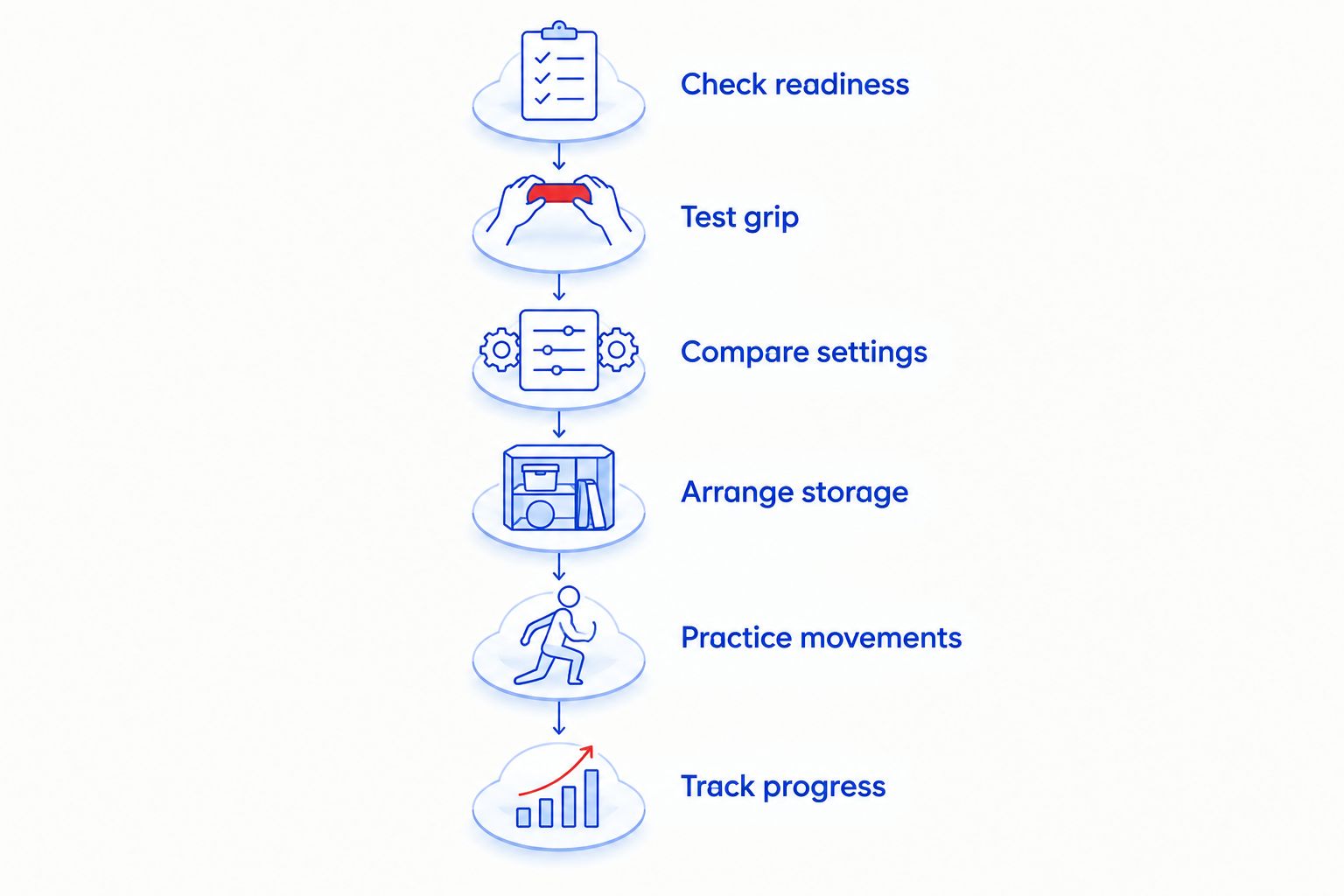
Choose and use adjustable dumbbells in six steps
Check readiness
Begin without equipment. Notice how comfortably you stand from a chair, hold an everyday object, and move your arms through the exercises you intend to perform. This is a practical preparation check, not a medical assessment or a test you need to pass.
Ask a clinician or qualified exercise professional for individual guidance if symptoms, recent surgery, or a medical condition affect your exercise choices. A history of falls, persistent joint pain, or difficulty holding objects deserves attention before adding weight.
Your starting point is personal. Age alone does not specify a suitable dumbbell load, and someone else’s routine does not establish what you should lift. For your 2026 plan, identify the movements you want to practice before shopping for their resistance.
- Name the daily tasks you want to support, such as carrying groceries or rising from a chair.
- Practice intended movements without weight first.
- Identify exercises that require professional instruction.
- Stop exercise for chest pain, faintness, or unusual shortness of breath; seek medical help.
Test grip
Start with a weight you already own or a sample you can handle. Check whether your fingers close comfortably around the handle and whether you can hold it without excessive squeezing. Test the grip during the movement, not just while the weight rests in your hand.
A thick handle is not automatically better, and a textured surface is not automatically comfortable. Your hand size, skin sensitivity, and finger movement determine the useful fit. Choose a grip you can control without changing your wrist position to compensate.
If arthritis or reduced hand strength affects your grip, get advice on suitable movements and equipment. Wrist supports and gloves do not establish that a load is appropriate. An attachment also changes how you handle the weight, so assess the complete setup rather than the bare handle alone.
- Hold the lightest setting with a relaxed, secure grip.
- Check for uncomfortable pressure against fingers and palms.
- Keep wrists aligned with forearms during practice movements.
- Reject handles that require constant repositioning.
- Practice setting the weight down under control.
Compare settings
Write down your buying criteria before looking at maximum capacity. The lightest usable configuration determines whether you can start; the next available setting determines how you progress. Check whether advertised weight refers to each dumbbell or the complete set.
Beferra’s Adjustable Dumbbell & Barbell Set is an option for home workouts using adjustable weights. Best for: shoppers interested in a set offering dumbbell and barbell formats. Confirm the available loads, adjustment method, and assembly instructions against your handling needs before selecting it.
The advantage is having different training formats within a set. The limitation is that format choice does not prove the lightest configuration or adjustment process suits you. A barbell format is optional, not a necessary next stage for an older beginner.
For a 2026 buying decision, prioritize what you can use today over capacity you do not yet need.
- Confirm the lightest usable weight for each hand.
- Compare the gap between available settings.
- Identify how weights are secured before lifting.
- Check whether adjustments require turning, pinching, or lifting separate parts.
- Read the instructions for every configuration you intend to use.
Arrange storage
Use an existing stable surface to plan storage before buying a stand. The retrieval route matters: you should not need to step over equipment, twist around furniture, or reach behind a chair while holding a weight.
Store weights on a surface designed to support them, following the equipment manufacturer’s instructions. Keep handles within comfortable reach. A convenient height is only useful when the surface is stable and the weight cannot roll or slide off.
An adjustable set consolidates weight choices, but it still needs room for its base, loose components, and safe handling. Measure that complete arrangement rather than treating the handle as the whole footprint. Plan where each part goes before the first workout.
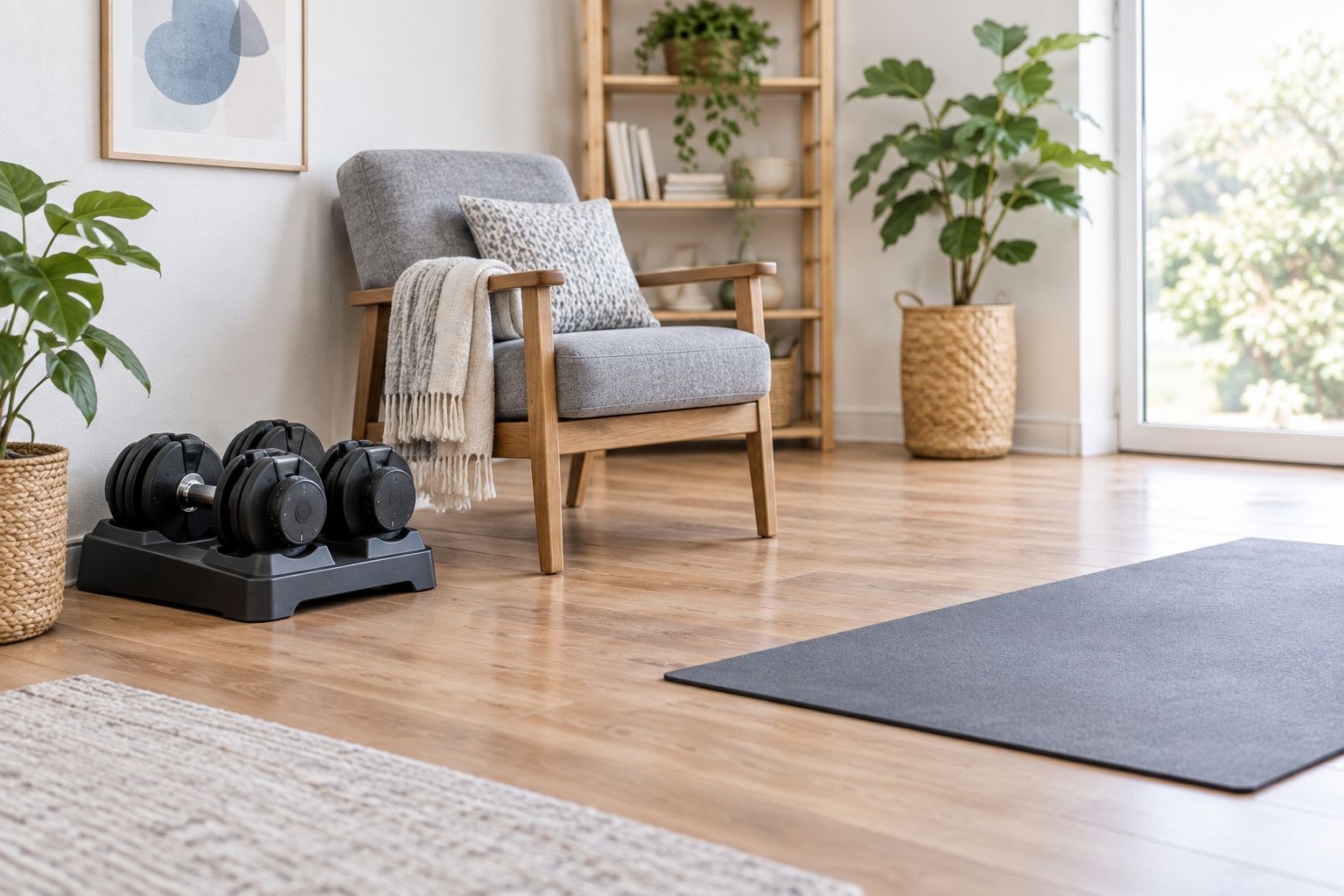
The safest practical layout is one you can repeat without rearranging the room every time. Put the weights away after use rather than leaving them beside your feet for the next session.
- Keep the walking route free of weights and loose parts.
- Use a stable, manufacturer-appropriate storage arrangement.
- Avoid storage that requires awkward reaching or twisting.
- Reserve space for adjustments as well as exercise.
- Keep a phone accessible without crossing the exercise area.
Practice movements
Rehearse each exercise without weight, then use a manageable load. A suitable exercise lets you control the lifting and lowering phases while maintaining your intended posture. Stop when you need to swing, lean, or rush to complete the movement.
A simple curl is easier to describe than to prescribe for every person. Keep elbows near your sides, avoid swinging the weights, and lower them deliberately. A seated version still requires a sturdy chair and a position that lets you move freely.
For rows, overhead movements, and weighted lower-body exercises, get instruction if the technique is unfamiliar or balance is a concern. Seated exercise does not make every movement suitable, and standing exercise does not need to become a balance challenge.
General resistance-training guidance commonly uses 8–12 repetitions per set. Treat that range as a planning reference, not a requirement to finish repetitions despite discomfort or poor control; individual guidance takes priority.
- Rehearse the movement without weight.
- Choose a load you can lift and lower deliberately.
- Breathe continuously rather than holding your breath.
- Keep the exercise area clear of unused equipment.
- End the set when technique changes or symptoms appear.
Track progress
Use a notebook before adding an app or another piece of equipment. Record the exercise, weight setting, repetitions, and how the movement felt. This separates actual progress from the impression that every session needs a heavier load.
Increase resistance only when the current load remains controlled through the planned movement. Change one training variable at a time so you can tell what affected the session. Better control, more comfortable handling, and a more consistent routine are useful outcomes even when the weight stays unchanged.
In 2026, your equipment should support that routine rather than dictate it. If the next dumbbell setting disrupts your technique, stay with the current setting and discuss progression with a qualified professional.
- Record the weight used for each exercise.
- Note repetitions completed with controlled technique.
- Record discomfort during and after the session.
- Check adjustment and locking components as instructed.
- Review your routine before adding resistance.
These steps form a buying and use sequence: assess your needs, check handling, choose suitable settings, and then build a repeatable routine. Returning to an earlier step is appropriate whenever your needs change.
Compare strength-training options for seniors
Adjustable dumbbells win on load choice; fixed dumbbells win on setup simplicity. Neither is best for every older adult. Match the equipment to your hand comfort, exercise selection, and storage routine.
Beferra’s adjustable set belongs in the comparison as a home-workout option, not as a senior-specific prescription. Evaluate its configurations using the same checklist you apply to any other set.
| Option | Best for | Practical advantage | Key limitation |
|---|---|---|---|
| Adjustable Dumbbell & Barbell Set | Home users interested in dumbbell and barbell formats | Offers different weight-training formats | Verify usable loads, assembly, and adjustment requirements for your needs |
| Other adjustable dumbbells | Users who need different loads without separate fixed pairs | Consolidate weight choices into an adjustable system | Settings, handle shape, and locking processes differ by model |
| Fixed dumbbells | Users prioritizing straightforward handling | No weight-selection mechanism to operate | Different loads require additional weights and storage |
| Resistance bands | Users who prefer elastic resistance | Offer a different way to perform resistance exercises | Grip, attachment security, and resistance through the movement need attention |
| Bodyweight exercise | Beginners learning movement before buying equipment | Lets you begin without holding an external weight | Load adjustment differs from selecting a dumbbell setting |
Do not choose resistance bands solely because they look lighter or smaller. Band exercises also need suitable technique and secure positioning. Likewise, bodyweight movements range from easy to demanding; equipment-free does not mean automatically appropriate.
For your 2026 shortlist, remove any option you cannot handle reliably before comparing additional features. That leaves a smaller, more useful decision.
Common mistakes seniors make with adjustable dumbbells
Choosing maximum capacity over starting weight
A high upper limit does not help if the lightest configuration is uncomfortable. Check the usable starting load first, then consider whether the available settings support your planned exercises. Avoid buying around a distant strength target.
Ignoring the adjustment task
You need to handle the equipment between exercises as well as during them. Test whether you can read the settings, operate the mechanism, and confirm the weights are secured. Do not assume that easy lifting means easy adjustment.
Turning strength exercise into a balance test
Standing while holding weights adds a handling demand. Keep balance practice distinct when combining the tasks compromises control, and ask for suitable exercise modifications. A sturdy chair helps with selected seated movements, but it does not correct unsuitable technique.
Treating accessories as protection against unsuitable loads
A brace, belt, or glove does not establish that an exercise is appropriate. Choose the movement and load first. Use accessories only for a clear purpose, with professional guidance when symptoms or medical needs are involved.
Replacing the whole routine with dumbbells
Strength training is one part of activity for older adults. WHO guidance includes 150 minutes per week of moderate-intensity aerobic activity as the lower end of its recommended range, alongside strengthening and balance-focused activity. Start at a level appropriate to your ability rather than treating that target as an immediate requirement.
FAQ
What are the best adjustable dumbbells for seniors?
The best adjustable dumbbells for seniors have a manageable starting weight, a comfortable grip, and adjustments the user can operate securely. Choose by those handling requirements before comparing maximum capacity.
What weight should a senior start lifting?
Start with a load you can lift and lower with controlled technique, rather than a weight chosen by age alone. A clinician or qualified exercise professional can help establish an appropriate starting point when pain, balance, or a medical condition affects exercise.
Are adjustable dumbbells better than fixed dumbbells for older adults?
Adjustable dumbbells are better for consolidating different loads, while fixed dumbbells are better for avoiding weight-adjustment mechanisms. Your grip, storage arrangement, and ability to change settings determine the better fit.
Can I use dumbbells if I have arthritis in my hands?
Ask your clinician or physical therapist which gripping movements and loads suit your arthritis symptoms. Test handle comfort and adjustment tasks; do not assume padding or gloves make an uncomfortable weight appropriate.
How often should older adults do strength training?
WHO physical-activity guidelines recommend muscle-strengthening activity on at least 2 days per week for older adults. Your exercise selection and starting workload should match your abilities and any individual medical guidance.
Can seniors do dumbbell exercises sitting down?
Some dumbbell exercises can be performed seated using a sturdy chair and suitable technique. Sitting does not make every movement appropriate, so check that the exercise allows controlled movement without awkward reaching.
Is Beferra’s Adjustable Dumbbell & Barbell Set a good choice for seniors?
Beferra’s Adjustable Dumbbell & Barbell Set is an option to evaluate for home workouts, not a universal senior recommendation. Confirm its lightest usable configurations, handle fit, and adjustment instructions against your needs before choosing.
One last thing
Practice putting the weight away before you practice lifting it repeatedly. Retrieval and storage are part of every session, yet they are easy to overlook while comparing exercise features. If those tasks feel awkward, change the storage arrangement or equipment choice first.