

Best ankle weights for home workouts in 2026
Best overall: adjustable pocket ankle weights. Best for simple mat workouts: fixed-weight fabric cuffs. Best for a wipe-clean exterior: silicone-covered ankle weights. This 2026 guide ranks ankle-weight designs by fit, resistance control, and everyday use, with a separate cable-strap alternative for attached resistance.
- The best ankle weights for home workouts are adjustable pocket cuffs when you want to change resistance.
- Fixed-weight fabric cuffs suit simple mat routines; check fit and the weight listed for each ankle.
- Silicone-covered ankle weights suit buyers who prioritize a wipe-clean exterior over removable weight inserts.
- Beferra Adjustable Ankle Cable Straps suit cable exercises, not standalone ankle-weight workouts.
Why this matters
Ankle weights and ankle cable straps do different jobs. An ankle weight carries its own load; a cable strap connects your ankle to an external source of resistance. Buying the wrong type leaves you with equipment that does not match your workout.
For your 2026 home setup, choose the exercise before the accessory. Floor-based leg lifts call for a different setup from standing cable kickbacks. Beferra offers everyday home fitness equipment, but a product's purpose matters more than where it sits in a collection.
Buy the resistance system your routine uses, not whichever accessory looks smallest. A compact cuff is useful only when it stays secure and lets you perform the intended movement without compensating elsewhere.
What makes the best ankle weights for home workouts?
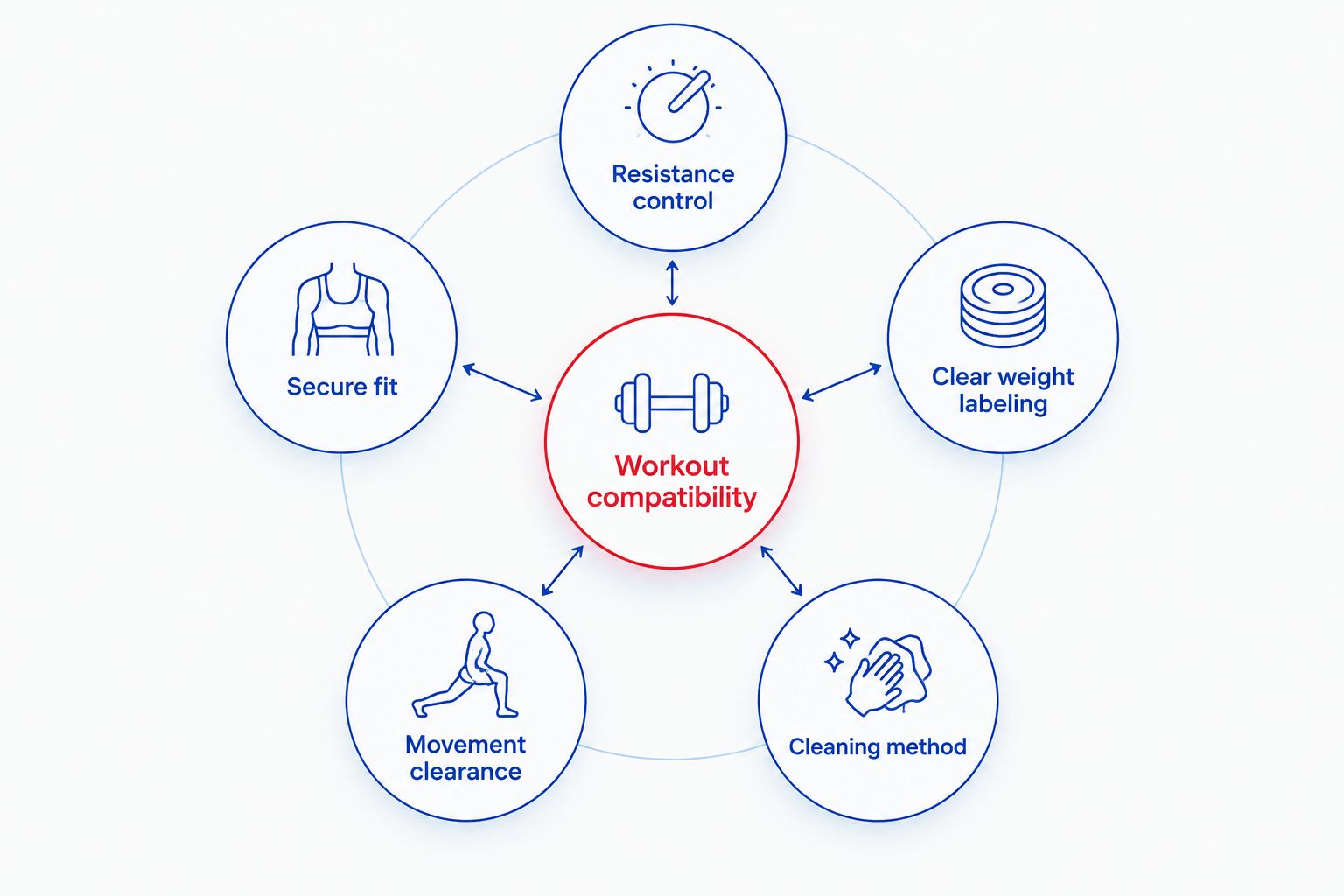
Use these criteria before comparing colors or styling. They determine whether an ankle weight belongs in your routine.
- Resistance control: Removable inserts let you change the load. Fixed-weight designs keep the setup simpler but require another pair when you want a different weight.
- Secure fit: Check the stated ankle circumference range and closure design. A cuff that rotates, slides, or needs constant tightening interrupts the exercise.
- Clear weight labeling: Establish whether the listed weight describes one cuff or the entire pair. Compare products on a per-ankle basis.
- Movement clearance: Check whether the cuff presses against your ankle joint or catches your foot during the exercises you plan to perform.
- Cleaning method: Follow the manufacturer's instructions. A wipe-clean exterior does not establish that the entire cuff is washable or waterproof.
- Workout compatibility: Standalone weights need no cable connection. Cable straps require a compatible resistance setup and do not add their own training load.
Weight-label arithmetic is simple but important. If a listing describes a 2 lb pair, equally weighted cuffs provide 1 lb per ankle. A 4 lb pair provides 2 lb per ankle. These are label-reading examples, not recommended starting loads or specifications for the picks below.
Do not compare one seller's pair weight with another seller's single-cuff weight. Normalize the label first, then decide whether that load suits your exercise and ability.
Ankle-weight designs at a glance
This 2026 comparison ranks designs, not individual models. The cable-strap row is an alternative for a different resistance system, not an ankle-weight recommendation.
| Option | Best for | Standout feature | Key limitation |
|---|---|---|---|
| Adjustable pocket ankle weights | Changing resistance within one pair | Removable weight inserts | Inserts add setup steps and must stay securely contained |
| Fixed-weight fabric cuffs | Simple mat-based routines | No inserts to rearrange | The load cannot be changed within that pair |
| Silicone-covered ankle weights | Buyers prioritizing exterior cleanup | Wipe-clean outer surface | Cleaning the closure still requires attention |
| Slim fixed-weight wraps | Buyers prioritizing cuff clearance | A less bulky wrap profile | Slimness does not guarantee secure fit or useful resistance |
| Beferra Adjustable Ankle Cable Straps | Cable-based lower-body exercises | Connection to cable resistance | Not standalone ankle weights |
1. Adjustable pocket ankle weights: best for changing resistance
Adjustable pocket ankle weights hold removable inserts inside a cuff. You change the load by adding or removing those inserts rather than replacing the whole pair.
This design wins the default recommendation because resistance control is useful across different exercises. A load that suits one controlled movement is not automatically suitable for another. Adjustment gives you a way to respond without treating every exercise identically.
Adjustable pocket ankle weights pros:
- Change resistance while keeping the same cuff.
- Match the load to different exercises.
- Remove inserts when the loaded movement feels harder to control.
- Keep multiple resistance settings within one pair.
Adjustable pocket ankle weights cons:
- Changing inserts takes more preparation than fastening a fixed cuff.
- Pocket closures and insert retention need checking before use.
- Extra adjustment does not solve a poor circumference fit.
Check how the manufacturer instructs you to distribute the inserts. Do not assume every pocket arrangement is interchangeable. Secure each closure and follow the specified loading pattern before starting a movement.
For a 2026 purchase, prioritize readable loading instructions over a long accessory list. An adjustable design is only useful when you can change its resistance correctly and keep the cuff secure.
Best for: Home exercisers who want to vary resistance between movements without owning several fixed-weight pairs.
Verdict: Buy adjustable pocket ankle weights when changing resistance is your main requirement.
2. Fixed-weight fabric cuffs: best for simple mat routines
Fixed-weight fabric cuffs contain a load that stays the same. You fasten the cuff and use it without removing or rearranging weight inserts.
Their appeal is straightforward preparation. If you already know the resistance you want for a particular mat exercise, a fixed cuff avoids the adjustment step. The trade-off is equally straightforward: the pair cannot provide a different load.
Fixed-weight fabric cuffs pros:
- No removable inserts to organize.
- A consistent load each time you use the pair.
- Simple preparation for a familiar routine.
Fixed-weight fabric cuffs cons:
- Changing resistance requires a different pair or another exercise setup.
- Fabric care depends on the product's cleaning instructions.
- A secure closure still needs checking during use.
Read the cleaning instructions before buying, especially if the cuff will touch bare skin. Do not put a weighted fabric cuff in a washing machine unless its manufacturer specifically permits that method.
Fixed cuffs suit a defined task better than an undefined promise to exercise more. Identify the movement you want to load, confirm that added ankle resistance fits that movement, and then evaluate the cuff.
Best for: Buyers with a familiar mat routine who prefer a consistent load and fewer preparation steps.
Verdict: Buy fixed-weight fabric cuffs for simplicity; skip them if resistance adjustment is essential.
3. Silicone-covered ankle weights: best for exterior cleanup
Silicone-covered ankle weights place a silicone surface around the weighted sections. That exterior gives you a surface to wipe down, subject to the manufacturer's care instructions.
Choose this design for its cleaning approach, not an assumed training advantage. The exterior material does not establish the resistance, fit range, closure quality, or suitability for a particular movement.
Silicone-covered ankle weights pros:
- A wipe-clean exterior simplifies surface cleanup.
- The outer material is easy to identify when checking care instructions.
- Covered weighted sections provide an alternative to exposed fabric surfaces.
Silicone-covered ankle weights cons:
- Straps and closures still need their own cleaning attention.
- Silicone covering does not establish waterproof construction.
- Resistance adjustment depends on the model, not the covering material.
For your 2026 shortlist, check both the exterior and the fastening system. A cuff can have a clean-looking outer surface while its closure needs more careful maintenance. Also confirm whether the weighted sections are fixed or removable.
Treat material and function as separate buying decisions. First establish that the cuff fits your exercise; then decide whether its care requirements suit your routine.
Best for: Buyers who prioritize wiping down the weighted exterior after use.
Verdict: Buy silicone-covered ankle weights for exterior cleanup, not for an assumed performance advantage.
4. Slim fixed-weight wraps: best for checking movement clearance
Slim fixed-weight wraps prioritize a less bulky cuff profile. They belong on your shortlist when larger cuffs interfere with the movement you intend to perform.
A slim shape is a design preference, not proof of a better workout. You still need a suitable load, a secure closure, and enough clearance around the ankle joint. Inspect those details separately.
Slim fixed-weight wraps pros:
- A less bulky profile gives you another fit option.
- Fixed resistance avoids insert changes.
- The wrap format keeps preparation focused on fastening and placement.
Slim fixed-weight wraps cons:
- A narrow profile does not guarantee that the cuff will stay in position.
- Fixed resistance limits load changes.
- Shape alone tells you nothing about the stated fit range.
Check the cuff during the exact movement you plan to use. If it catches your foot, presses against the joint, or rotates around your leg, the slim profile has not solved the fit problem.
Avoid buying a wrap solely because it looks discreet. Workout equipment needs to function during movement, not just look tidy while stored.
Best for: Buyers who need to assess a less bulky cuff against their exercise's clearance requirements.
Verdict: Buy a slim wrap only after checking fit and clearance; skip appearance-led choices.
Cable alternative: Adjustable Ankle Cable Straps
Adjustable Ankle Cable Straps attach to cable resistance for lower-body workouts. They serve a different purpose from weighted cuffs: the connected resistance system supplies the load.
Beferra Adjustable Ankle Cable Straps are best for cable-based lower-body workouts, not standalone ankle-weight exercises. Choose this category when your routine already uses cable resistance and needs an ankle attachment.
Adjustable Ankle Cable Straps pros:
- Provide an ankle attachment for cable-based exercises.
- Serve lower-body training that uses external resistance.
- Offer a different setup from wearing a fixed load around the ankle.
Adjustable Ankle Cable Straps cons:
- Do not provide standalone weighted resistance.
- Require a compatible cable setup.
- Are not a substitute for weighted cuffs in an unattached mat routine.
Before choosing Beferra Adjustable Ankle Cable Straps, confirm the connection requirements against your equipment. Do not assume that every strap, clip, band, or cable attachment works together.
Best for: Home exercisers with a compatible cable resistance setup.
Verdict: Buy for cable exercises; skip as a replacement for standalone ankle weights.
How to check fit before a full workout
Use the same checks whichever ankle-weight design you choose. Fit should hold through the intended movement, not just while you stand still.
- Check the label: Confirm the per-ankle load and the manufacturer's placement instructions.
- Secure the closure: Fasten the cuff as directed without leaving loose components.
- Test the movement: Perform the intended motion slowly before starting your normal set.
- Recheck position: Stop and adjust if the cuff slips, rotates, pinches, or catches your foot.
A fastening problem is not something to solve by moving faster. If the cuff will not stay secure, change the fit or choose a different design. Stop using it if it causes pain, numbness, or skin irritation.
Do not assume weights intended for controlled exercise are suitable for running, jumping, or all-day wear. Follow the product's use instructions and seek qualified guidance when an injury or medical condition affects your exercise choices.
How these ankle-weight designs were ranked
The ranking prioritizes resistance control, then simplicity, cleaning approach, and movement clearance. Adjustable pocket cuffs take first place because they let you change the load within the same pair. Fixed cuffs win when reducing preparation matters more than adjustment.
This is a design-based buying guide, not a laboratory-tested product leaderboard. No ranking here establishes that every cuff in a category fits equally well. Your final choice still depends on the individual product's labeling, closure, care instructions, and intended use.
The cable alternative sits outside the ankle-weight ranking because it changes the resistance system. Comparing a cable strap with a weighted cuff as though they were interchangeable would obscure the buying decision.
Which ankle weights should you choose in 2026?
Choose adjustable pocket ankle weights if you are undecided and want resistance control. Choose fixed-weight fabric cuffs when you already know the load and value simple preparation. Choose silicone-covered designs when exterior cleanup is your deciding factor.
A slim wrap belongs on the shortlist only when its fit solves a real clearance problem. Beferra Adjustable Ankle Cable Straps belong in a cable-based routine, not in a shopping basket intended for standalone ankle weights.
Start with the exercise, confirm the resistance system, and then compare the cuff. That order prevents a visually appealing accessory from becoming the wrong tool for your workout.
FAQ
What's the best ankle-weight design for home workouts?
Adjustable pocket ankle weights are the best default when you want to change resistance within one pair. Check the cuff's fit range, insert-retention system, and per-ankle weight before choosing a model.
Are adjustable ankle weights better than fixed ankle weights?
Adjustable ankle weights are better for changing resistance; fixed ankle weights are simpler to prepare. Choose according to whether your routine needs different loads or a consistent load.
Does the weight on the listing mean one ankle or both?
The listed weight can describe either one cuff or the whole pair, so read the product's wording. A 2 lb pair with equally weighted cuffs provides 1 lb per ankle.
Are Beferra Adjustable Ankle Cable Straps the same as ankle weights?
Beferra Adjustable Ankle Cable Straps are cable attachments, not standalone ankle weights. They connect your ankle to cable resistance rather than carrying the training load inside a cuff.
Can I use ankle weights for walking or running?
Do not assume ankle weights intended for controlled exercises are suitable for walking or running. Follow the manufacturer's intended-use instructions and get qualified guidance when choosing added resistance for those activities.
How do I clean ankle weights after a workout?
Clean ankle weights according to the manufacturer's instructions for the cuff, weighted sections, and closure. A wipe-clean surface does not mean the entire product is machine-washable or waterproof.
What should I do if my ankle weights keep slipping?
Stop the exercise and check the cuff's placement, closure, and stated fit range. If the cuff cannot stay secure during the intended movement, choose a different fit rather than continuing with it loose.
One last thing
A resistance number does not describe the whole exercise. Moving a load farther from a joint changes its leverage, so a weight at your ankle is not equivalent to holding that same weight closer to your body.
Keep the movement controlled and judge the setup by your ability to perform it correctly. A secure, suitable cuff beats a heavier cuff that changes your form.