

Best medicine balls for strength training in 2026
Best overall for throwing drills: a rubber rebound medicine ball. Best for floor slams: a dead-bounce slam ball. Best for controlled lifting: a handled medicine ball. This 2026 guide ranks the best medicine balls for strength training by movement, handling, and home-use limitations—not by brand name.
- The best medicine balls for strength training match your exercise: rebound balls for throws, dead-bounce balls for slams.
- For Beferra home fitness readers, a dead-bounce slam ball is the best choice for floor slams.
- Soft-shell wall balls suit wall-target throws; handled medicine balls suit controlled lifting.
- Choose manageable resistance and check permitted uses before throwing any weighted ball.
Why this matters
A medicine ball for catching and throwing is not automatically suitable for repeated floor impacts. The wrong construction changes how the ball returns, how you grip it, and which exercises you can perform safely.
Your first decision is the movement, not the weight. If you are building an everyday setup, Beferra's guide to home gym exercise equipment for beginners puts medicine-ball work in the context of a broader home routine.
For strength training in 2026, treat a medicine ball as a tool for a defined exercise. It is not a substitute for every form of resistance training, and a heavier ball is not automatically a better purchase.
What makes the best medicine balls for strength training?
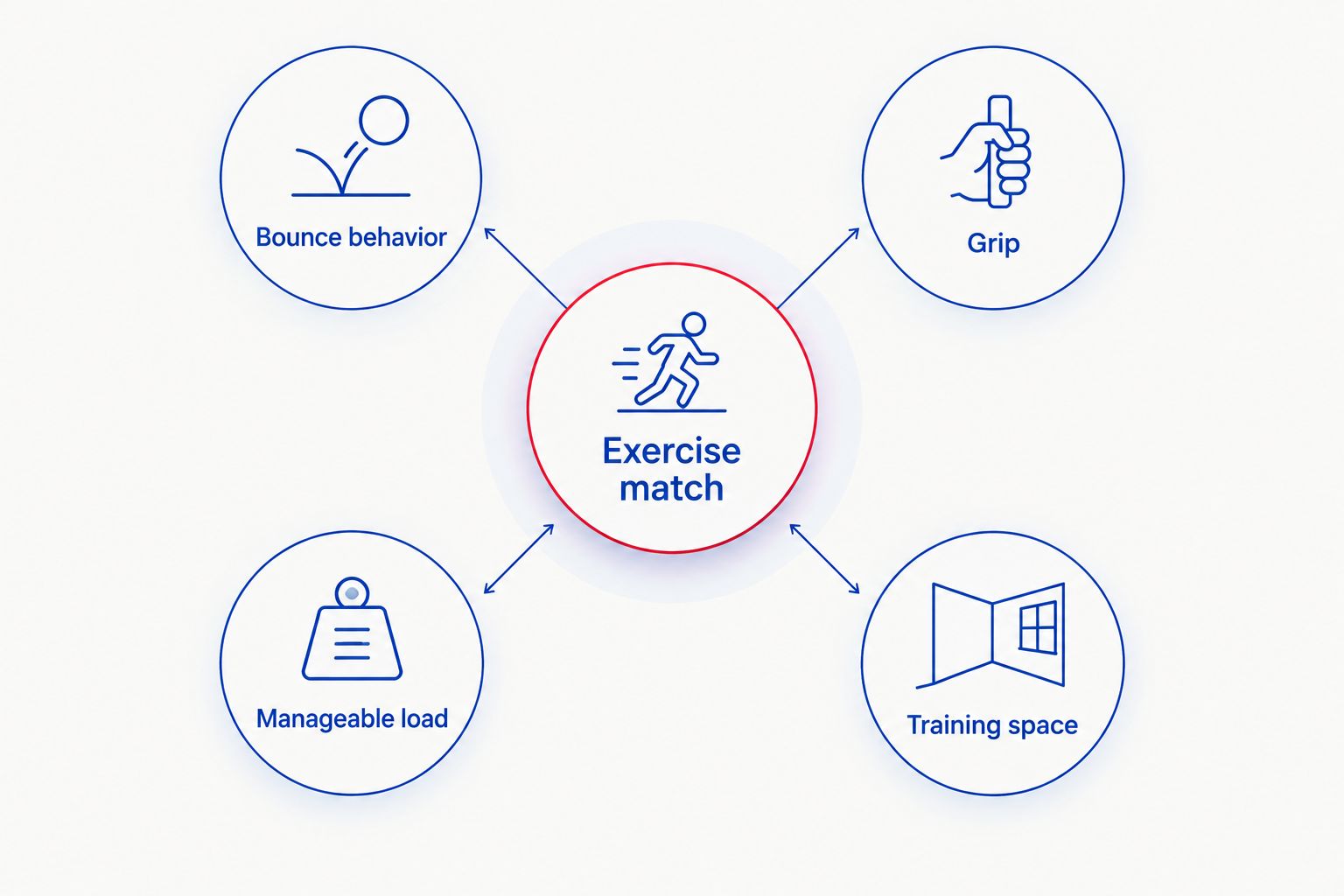
Use these criteria before choosing a ball. A useful purchase fits both your training plan and the place where you train.
- Exercise match: Decide whether you need floor slams, wall throws, partner passes, or controlled lifting. Check that the manufacturer permits the intended movement.
- Bounce behavior: Rebound supports return-and-catch drills. Low rebound serves a different purpose: keeping a slammed ball from returning sharply toward you.
- Grip: Check surface texture, handle placement, and whether you can hold the ball securely throughout your intended exercise.
- Manageable load: Select resistance that lets you maintain the movement. For throwing drills, a load that turns every repetition into a slow heave defeats the exercise's purpose.
- Training space: Account for your full movement, the ball's travel, and nearby people or objects—not just the space needed to store it.
The most useful specification is the one that answers your intended use. A product described as a medicine ball still needs clear guidance about slamming, throwing, catching, and permitted surfaces.
Medicine balls at a glance
These are construction categories, not interchangeable product recommendations. The ranking gives each category a distinct job; the limitation tells you when to choose something else.
| Rank and option | Best for | Standout feature | Key limitation |
|---|---|---|---|
| Rubber rebound medicine ball | Partner passes and rebound throws | A returning ball supports catching sequences | Bounce is unsuitable for uncontrolled floor slams |
| Dead-bounce slam ball | Repeated floor slams | Low rebound after impact | Poor fit for drills that need a returning ball |
| Soft-shell wall ball | Wall-target squat throws | Larger, softer exterior for receiving throws | Wall-throw suitability does not establish slam suitability |
| Handled medicine ball | Controlled lifting and carrying | Dedicated gripping points | Handles complicate catching and free-flight throwing |
There is no universal winner across these movements. The rubber rebound medicine ball takes the overall throwing slot, but the dead-bounce slam ball wins whenever the exercise calls for a forceful floor impact.
1. Rubber rebound medicine ball: best for throwing drills
A rubber rebound medicine ball is the clearest starting point when your routine involves passes, catches, or throws against a suitable surface. Its defining feature is rebound: the ball returns instead of staying where it lands.
For a 2026 home setup, that return is useful only when you can control it. Choose a model explicitly intended for your throwing exercise, and use a surface permitted by the manufacturer.
Rubber rebound medicine ball pros:
- Supports repeated throw-and-catch sequences.
- Fits partner passing drills without requiring handles.
- Lets you practice producing force and receiving a moving load.
- Offers a straightforward choice when rebound is the movement's requirement.
Rubber rebound medicine ball cons:
- A hard floor slam can send a rebounding ball back toward your body.
- Wall throws need an appropriate wall and clear return path.
- A wet or slippery surface makes secure handling harder.
Best for: You want partner passes or rebound throwing drills, and you have a suitable training area.
Before buying, check whether the description actually identifies rebound behavior. Rubber construction alone does not confirm how a particular ball behaves, and appearance does not establish impact suitability.
Verdict: Buy a rubber rebound medicine ball for throwing drills; skip it for floor slams unless the manufacturer explicitly permits them.
2. Dead-bounce slam ball: best for floor slams
A dead-bounce slam ball is designed around forceful downward throws with limited rebound. The exercise ends at the floor rather than depending on a catch as the ball returns.
This is the best category when slamming is your main reason to buy a weighted ball. Beferra home fitness readers choosing equipment for floor slams should prioritize explicit slam suitability over a general medicine-ball label.
Dead-bounce slam ball pros:
- Matches the mechanics of a floor-slam exercise.
- Limits the return bounce compared with a rebound-style ball.
- Lets you reset your position before picking up the ball.
- Separates impact work from catching work.
Dead-bounce slam ball cons:
- Does not provide the return needed for rebound drills.
- Repeated impacts create noise and require a suitable surface.
- Picking up the ball is part of every repetition, so the reset needs attention.
Best for: You want repeated floor slams rather than wall returns or partner catches.
Dead-bounce does not mean the ball cannot move after impact. Keep your face and feet out of its path, leave space around the landing area, and inspect the shell for damage before training.
A slam ball also does not make an unsuitable floor suitable. In a 2026 apartment setup, decide whether impact work belongs in the room before deciding which ball belongs in your cart.
Verdict: Buy a dead-bounce slam ball for floor slams; skip it if your routine depends on bounce and catch.
3. Soft-shell wall ball: best for wall-target squat throws
A soft-shell wall ball serves exercises that combine a squat with a throw toward a wall target. Its larger exterior gives you a different receiving and holding experience from a compact rubber medicine ball.
Choose this category when the wall-target movement itself is your priority. Check the particular model's permitted use: a soft exterior is not proof that it can tolerate repeated floor slams.
Soft-shell wall ball pros:
- Matches the familiar squat-and-throw wall-ball movement.
- Provides a larger surface to receive during the catch.
- Gives you a distinct option for combining leg drive with a throw.
Soft-shell wall ball cons:
- Needs an appropriate wall and overhead clearance.
- A larger ball takes more storage space than a compact alternative.
- Catching becomes difficult when the load exceeds your control.
Best for: You specifically want wall-target squat throws and have a suitable place to perform them.
Inspect seams and the outer covering before use. During the exercise, receive the ball under control rather than reaching awkwardly after a throw that travels outside your intended path.
Do not buy a wall ball simply because it looks softer. The decisive question is whether its size, construction, and approved uses fit the exercise you intend to repeat.
Verdict: Buy a soft-shell wall ball for wall-target squat throws; skip it for a room without a suitable wall or clear catching area.
4. Handled medicine ball: best for controlled lifting
A handled medicine ball gives you dedicated gripping points for movements where the load stays in your hands. It belongs in a different decision branch from equipment selected primarily for throwing.
For controlled lifting in 2026, focus on handle comfort and usable positions. Check that your hands fit naturally and that the ball does not force an awkward wrist position during your intended movement.
Handled medicine ball pros:
- Gives you defined places to grip the load.
- Suits controlled carries and lifting movements when permitted.
- Reduces reliance on holding a round shell alone.
Handled medicine ball cons:
- Handles interfere with the handling pattern used for ordinary catches.
- It is not a default choice for slams or partner throws.
- A fixed load offers fewer progression options than adjustable resistance.
Best for: You want a weighted ball for controlled movements rather than release-and-catch exercises.
If your main goal is steadily increasing resistance for conventional lifts, compare this category with an Adjustable Dumbbell & Barbell Set. Choose the training format first rather than buying a medicine ball for exercises that do not need a ball.
The handle is a handling feature, not permission to perform every swinging or throwing movement. Follow the product's instructions and stop any exercise that causes pain or makes your grip unreliable.
Verdict: Buy a handled medicine ball for controlled lifting; skip it when your main requirement is catching or slamming.
How we ranked these medicine-ball types
This 2026 ranking prioritizes exercise match, bounce behavior, grip, manageable resistance, and training space. Each category earns a separate use-case slot because a feature that helps one movement can interfere with another.
Rubber rebound medicine balls lead for throwing versatility. Dead-bounce slam balls take the impact slot, soft-shell wall balls take the wall-target slot, and handled medicine balls take the controlled-lifting slot.
The order is a buying decision tree, not a claim that one construction is better at every exercise. Pick the required movement, then choose the construction that supports it.
Choose the load without losing the movement
The right weight lets you perform the intended exercise with control. For a throw, that includes an intentional release; for a catch, it includes receiving the ball without collapsing your position.
For controlled lifting, choose resistance you can hold securely through the planned range of motion. If you must shorten the movement, jerk the ball upward, or repeatedly adjust a failing grip, reduce the load.
Use these checks before committing:
- Throwing: Can you release the ball toward the intended target without straining or losing balance?
- Catching: Can you receive the ball without reaching into an uncontrolled path?
- Lifting: Can you maintain your grip and position throughout the movement?
- Resetting: Can you pick up and reposition the ball without rushing?
Do not choose a weight because it is the heaviest one you can briefly lift. That test says little about your ability to repeat a throw, catch, or controlled movement.
Which medicine ball should you choose?
Choose a rubber rebound medicine ball if you are undecided and your planned exercises involve passes and catches. Choose a dead-bounce slam ball instead if floor slams are the actual goal. Neither recommendation overrides the product's permitted uses.
A soft-shell wall ball is the more specific purchase for wall-target squat throws. A handled medicine ball belongs with controlled lifting, where grip matters more than return bounce.
For Beferra strength-training readers building an everyday home setup in 2026, the practical rule is simple: buy for the exercise you will perform, not for the longest list of possible exercises. Leave room to train before adding more equipment.
FAQ
What's the best medicine ball for strength training at home?
The best medicine ball depends on the exercise: choose a rubber rebound ball for passes, a dead-bounce slam ball for floor slams, or a handled ball for controlled lifting. Confirm the manufacturer's permitted uses and that your training area suits the movement.
Is a slam ball better than a medicine ball?
A slam ball is better for floor slams, while a rebound medicine ball is better for exercises requiring a returning ball. Neither construction is better for every strength-training movement.
What weight medicine ball should a beginner choose?
A beginner should choose a load that allows secure handling and controlled movement throughout the intended exercise. Reduce the weight if you lose balance, shorten the movement, or struggle to receive the ball.
Can I slam any rubber medicine ball?
No, rubber construction alone does not establish slam suitability. Use a ball for floor slams only when the manufacturer explicitly permits that use, and follow its surface guidance.
Can a wall ball replace a slam ball?
A wall ball should not replace a slam ball unless its manufacturer explicitly approves repeated floor slams. Wall-target throws and floor impacts place different demands on the ball.
Are handled medicine balls good for strength training?
Handled medicine balls suit controlled lifting and carrying when those uses are permitted. Their handles make them a different choice from balls selected for catches, rebounds, or slams.
Can medicine balls replace dumbbells?
Medicine balls can provide resistance for selected movements, but they do not replace dumbbells across a complete lifting routine. Choose a medicine ball for its throwing or handling function rather than expecting it to serve every exercise.
One last thing
The easiest detail to overlook is where the ball goes after you release it. Before buying, walk through the complete exercise: starting position, release, landing or return, and reset.
A ball that fits on your shelf can still be wrong for your room. Make the movement fit first; then choose the equipment.