

Best suspension trainers for home workouts in 2026
Best overall for general home workouts: a single-anchor suspension trainer. Best for independent handle positioning: a separate-strap trainer. Best for ring skills: gymnastics rings. This 2026 guide compares those setups with the Suspension Trainer Belt from Beferra, focusing on usable floor space, exercise choice, and mounting requirements.
- The best suspension trainers for home workouts match your mounting point, floor space, and exercise goals.
- Single-anchor suspension trainers are the default choice for general bodyweight workouts.
- Beferra’s Suspension Trainer Belt is a suspension-training option; confirm mounting instructions before choosing it.
- Separate straps suit independent handle positioning; gymnastics rings suit ring-specific skills.
Why this matters
A suspension trainer saves storage space, but its working footprint extends beyond the straps. You need room to lean, step backward, and move without hitting furniture. The mounting point matters just as much: a compact kit is not useful if you cannot install it according to its instructions.
For your 2026 home setup, choose the anchor before choosing the trainer. Then match the equipment to the exercises you actually intend to repeat. Rows and assisted squats call for a different buying decision than ring supports and transitions.
What makes the best suspension trainers for home workouts
Use these criteria to evaluate a trainer before comparing handles, accessories, or packaging:
- Mounting compatibility: The instructions must identify a suitable mounting method for your space. Do not assume a door attachment or ceiling fitting is included.
- Working footprint: Judge the area needed during exercise, not just the space occupied in storage. Test the intended standing and floor positions before purchasing.
- Adjustment access: Strap adjustment should be understandable and accessible. Changing exercises should not require guessing how a buckle locks.
- Handle and foot support: Match the contact points to your routine. Standing rows require hand grips; suspended floor exercises require suitable foot supports.
- Exercise fit: Choose general-purpose straps for general bodyweight training and rings for ring-specific practice. Those are different priorities, not interchangeable promises.
- Inspection and instructions: Clear setup guidance and inspectable straps, stitching, and hardware matter more than an accessory count.
The best trainer is the one you can mount correctly and use through your intended range of motion. No ranking overrides the equipment’s instructions.
Suspension trainers at a glance
The 2026 ranking below separates equipment configurations from a named store option. A configuration recommendation does not establish the specifications of any individual product.
| Item or configuration | Best for | Standout feature | Key limitation |
|---|---|---|---|
| Single-anchor suspension trainer | General standing bodyweight workouts | Straps converge at one mounting location | Handle movement depends on the strap arrangement |
| Suspension Trainer Belt | Shoppers considering Beferra’s suspension-training option | Described for suspension and resistance training | Confirm mounting method and exercise compatibility before choosing |
| Separate-strap suspension trainer | Independent handle positioning | Each strap can be positioned independently | Setup requires attention to spacing and strap alignment |
| Gymnastics rings | Ring-specific strength and skill practice | Freely moving rings support ring exercises | Require suitable overhead clearance and control |
The table deliberately excludes load limits, dimensions, and accessory contents. Use the instructions for the exact equipment you are considering to make those decisions.
1. Single-anchor suspension trainer: best for general home workouts
A single-anchor suspension trainer brings its straps together at one mounting location. You use the handles for movements such as rows, supported squats, and standing presses, provided the equipment’s instructions permit those exercises.
This configuration is the default recommendation for a general home routine. It keeps the mounting arrangement focused on one location, although the anchor itself still needs to meet the equipment’s requirements. A single attachment point does not make every doorway suitable.
Single-anchor suspension trainer pros:
- One mounting location simplifies planning your exercise area.
- Standing exercises allow you to change body position between movements.
- Rows, presses, and assisted lower-body movements can share the same general setup.
- Straps occupy little storage space compared with large exercise machines.
Single-anchor suspension trainer cons:
- Converging straps affect how the handles move relative to each other.
- A suitable anchor remains essential; compact storage does not solve installation.
- Floor exercises depend on the exact trainer having appropriate foot supports.
Best for: You want a repeatable bodyweight routine built around standing exercises rather than ring skills.
Before buying, check whether the adjustment system changes both sides together or separately. Also check how the instructions address equal strap length. These details determine how you reset the equipment between exercises.
Verdict: Buy a single-anchor trainer for general home workouts when its mounting instructions match your space.
2. Suspension Trainer Belt: best for evaluating Beferra’s store option
Beferra’s Suspension Trainer Belt is described as equipment for suspension and resistance training. That places it in the relevant category for a home bodyweight setup, but the choice still depends on its exact mounting instructions and exercise compatibility.
Beferra’s Suspension Trainer Belt is best for shoppers comparing a suspension-training option within the store’s home-fitness range. Treat that as a starting point for evaluation, not a claim that it outperforms every configuration in this guide.
Suspension Trainer Belt pros:
- Its stated purpose matches suspension and resistance training.
- It is a directly relevant option for a bodyweight-equipment shortlist.
- It lets you evaluate a named product rather than shopping by category alone.
Suspension Trainer Belt cons:
- Product category alone does not establish compatibility with your doorway or overhead anchor.
- Do not assume foot cradles, anchor accessories, or a particular adjustment mechanism.
- Do not choose it for ring-specific skills without instructions supporting that use.
Best for: You are considering this store’s suspension equipment and will check the installation requirements before ordering.
For a 2026 purchase, verify the mounting method, permitted exercises, inspection guidance, and required accessories. If you cannot establish a safe installation for your home, choose a different setup rather than improvising an attachment.
Verdict: Hold until the Suspension Trainer Belt’s instructions confirm a suitable installation and the exercises you need.
3. Separate-strap suspension trainer: best for independent positioning
A separate-strap suspension trainer uses independently positioned straps rather than bringing both sides together at one point. That arrangement gives you control over the spacing between the handles, subject to the equipment’s mounting requirements.
Choose this configuration when independent positioning is the feature you need. It is not automatically a better beginner option: you must align the straps and understand how their spacing affects the movement.
Separate-strap suspension trainer pros:
- You can position the handles independently.
- Mounting spacing is not dictated by a single converging strap arrangement.
- Each side can be checked and adjusted separately.
- The configuration suits a dedicated training area with appropriate mounting provisions.
Separate-strap suspension trainer cons:
- Setup requires attention to both attachment positions.
- Unequal strap lengths or unintended spacing can change the exercise.
- Your home needs suitable mounting provisions for the specific system.
Best for: You already know why you need independent handle positioning and have a compatible place to install it.
Check both sides before starting. A trainer with separate straps adds positioning options, but those options become extra setup decisions. If you only want straightforward rows and supported squats, the additional adjustment is not itself a reason to choose this configuration.
Verdict: Buy separate straps for a defined positioning need; skip them if the extra setup serves no purpose in your routine.
4. Gymnastics rings: best for ring-specific training
Gymnastics rings hang from straps and move freely under your hands. They belong on this shortlist because they support suspended bodyweight exercise, but they are not simply another handle shape for the same routine.
Choose rings when ring exercises are your goal. Support holds, ring rows, and other ring movements demand control of the moving apparatus as well as your body position.
Gymnastics rings pros:
- They support ring-specific strength and skill practice.
- The rings can move with your hand position during suitable exercises.
- Their straps allow height changes within the equipment’s permitted setup.
- The apparatus can serve both supported and suspended movements when correctly installed.
Gymnastics rings cons:
- Freely moving rings add a control demand.
- Overhead clearance and an appropriate mounting structure are essential.
- Rings are not a substitute for dedicated foot supports in every suspension exercise.
Best for: You specifically want to learn or practice ring movements, rather than assemble the simplest general workout station.
Start with supported movements that match your ability and the equipment’s instructions. Do not treat advanced ring skills as an automatic next step from standing suspension rows. The apparatus changes the task.
Verdict: Buy rings for ring-specific training; skip them as a default substitute for a general-purpose suspension trainer.
Match the setup to your room
For a small-space home gym in 2026, assess the training position before the storage position. Straps can pack away while still needing an unobstructed area during use. A doorway that looks convenient can also sit beside furniture or across a busy walking route.
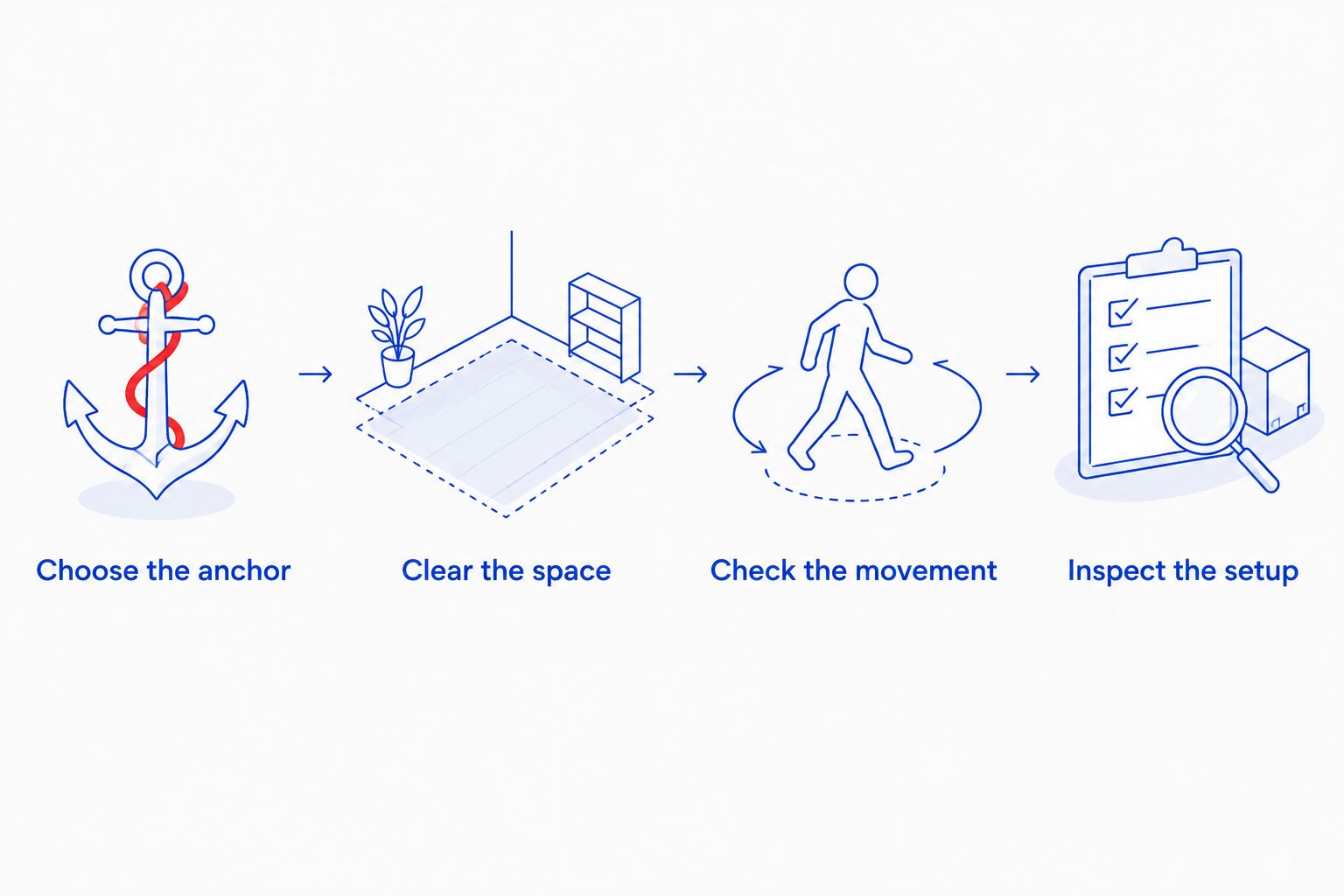
Use this sequence before committing:
- Choose the anchor: Identify the exact mounting method allowed by the equipment’s instructions.
- Clear the space: Check your intended standing and floor positions without attaching yourself to an improvised anchor.
- Check the movement: Consider where your body, hands, and feet will travel during each exercise.
- Inspect the setup: Check the straps, hardware, attachment, and adjustments before every session.
For door-mounted equipment, follow the manufacturer’s directions for door condition, orientation, and attachment. Prevent anyone from opening the door during use. Never assume a pull-up bar, railing, hook, or furniture leg is an approved suspension anchor.
A mat does not correct a sliding floor, and a heavier attachment does not prove structural suitability. If you cannot verify the mounting arrangement, stop at the planning stage.
Start with a simple standing routine
Once installation is confirmed, begin with exercises permitted by your trainer’s instructions. Keep the first session focused on setup familiarity rather than fatigue. You should be able to stop each movement under control.
As a conservative practice session—not a product specification—try these starting doses:
- Supported squat: Try 1 set of 6 repetitions, using the handles for balance rather than pulling yourself upright.
- Standing row: Try 1 set of 6 repetitions at a body position you can control without jerking.
- Standing press: Try 1 set of 6 repetitions, stopping before your trunk position breaks down.
- Between exercises: Take at least 30 seconds to reset, check strap length, and prepare your position.
These are practice recommendations, not performance targets. Reduce the repetitions or stop if control deteriorates. Sharp pain, dizziness, slipping hardware, or movement at the anchor ends the session.
For your next workout, repeat the same setup before changing the difficulty. Consistent strap length and foot placement make it easier to understand what changed. Avoid changing your body angle, repetition count, and exercise choice all at once.
How the ranking works
This 2026 ranking prioritizes exercise fit, mounting requirements, working footprint, and setup complexity. Single-anchor trainers lead for general standing workouts; separate straps serve independent positioning; rings serve ring-specific practice.
The named store product is included because its stated purpose is suspension and resistance training. Its position is not a durability verdict or a comparison of verified load capacities. Those decisions require the exact product instructions and specifications.
Which suspension trainer should you choose?
Choose a single-anchor suspension trainer as the default for general home bodyweight workouts. Choose separate straps when you need independent positioning, and choose gymnastics rings when ring training is the goal.
If you are considering Beferra’s suspension trainer, resolve the installation questions first. The next move is checking compatibility—not adding more accessories. A trainer that fits your routine but lacks a suitable mounting location is the wrong purchase.
FAQ
What’s the best suspension trainer for home workouts?
A single-anchor suspension trainer is the default choice for general standing bodyweight workouts. Choose a specific product only after confirming that its mounting instructions and permitted exercises match your home.
Is the Suspension Trainer Belt suitable for home workouts?
The Suspension Trainer Belt is described for suspension and resistance training. Confirm its mounting method, required accessories, and permitted exercises before deciding whether it suits your home.
Are gymnastics rings better than suspension straps?
Gymnastics rings are better suited to ring-specific training, while general-purpose suspension straps suit a different exercise brief. Choose by the movements you intend to practice rather than treating either option as universally better.
Can I attach a suspension trainer to any door?
No, a door must meet the equipment manufacturer’s installation requirements. Follow the directions for door condition, orientation, and attachment, and prevent the door from being opened during use.
Do suspension trainers replace dumbbells?
Suspension trainers do not duplicate dumbbell training. They use suspended bodyweight movements, while dumbbells provide an external load; choose equipment according to the exercises and progression you want.
How much space do I need for a suspension trainer?
You need enough unobstructed space to complete your intended exercises without contacting furniture or blocking a walking route. The required area depends on the mounting position, exercise, and your body position, so check both standing and floor movements.
What should a beginner do first with suspension straps?
A beginner should first confirm installation and learn a controlled standing movement permitted by the equipment’s instructions. Keep the initial session focused on setup and control rather than increasing difficulty.
One last thing
Mark your starting foot position with a removable floor marker that does not create a slipping hazard. Pair it with a note of your strap adjustment. Repeating the same position makes your next session easier to compare without adding another piece of equipment.