

Best Weight Bench for Small Home Gym (2026 Ranked)
The best weight bench for a small home gym in 2026 is a foldable flat-to-incline model that folds flat enough to lean against a wall in under a minute — the deciding factor isn't how many angles it offers, it's whether you'll actually put it away after leg day.
- A foldable flat-to-incline bench is the best weight bench for a small home gym in 2026 when floor space is tight.
- Adjustable FID benches replace three fixed-angle benches with one frame, covering the most exercises per square foot.
- Wall-mounted folding benches free up the most floor space but cap out at lighter total loads.
- Pair any bench with an adjustable dumbbell and barbell set to cover presses, rows, and curls from one corner.
Why this matters
A weight bench earns its floor space or it doesn't — there's no in-between in a spare bedroom or a studio apartment. Beferra's guide to 7 best weight benches for strength training, compared ranks specific models on capacity and adjustability; this guide narrows the decision down to which bench type actually fits a small footprint before you shop by brand.
Most buying guides rank benches by features alone — decline angle, pad thickness, max load. None of that matters if the bench can't fold flat and disappear into a closet between sets. In 2026, a full-size flat bench that never gets stored ends up as a laundry rack instead of a bench, and that's the mistake this guide is built to avoid.
What makes the best weight bench for a small home gym
- Folded footprint — how much wall or closet space it needs when stored, not in use
- Weight capacity — enough for your body weight plus the bar and plates loaded on it
- Adjustability range — flat, incline, and decline positions on one frame
- Pad length and density — enough to support your shoulders on presses without sliding
- Frame stability — no wobble under uneven dumbbell loads
- One-person fold — you can collapse and stand it up alone in seconds
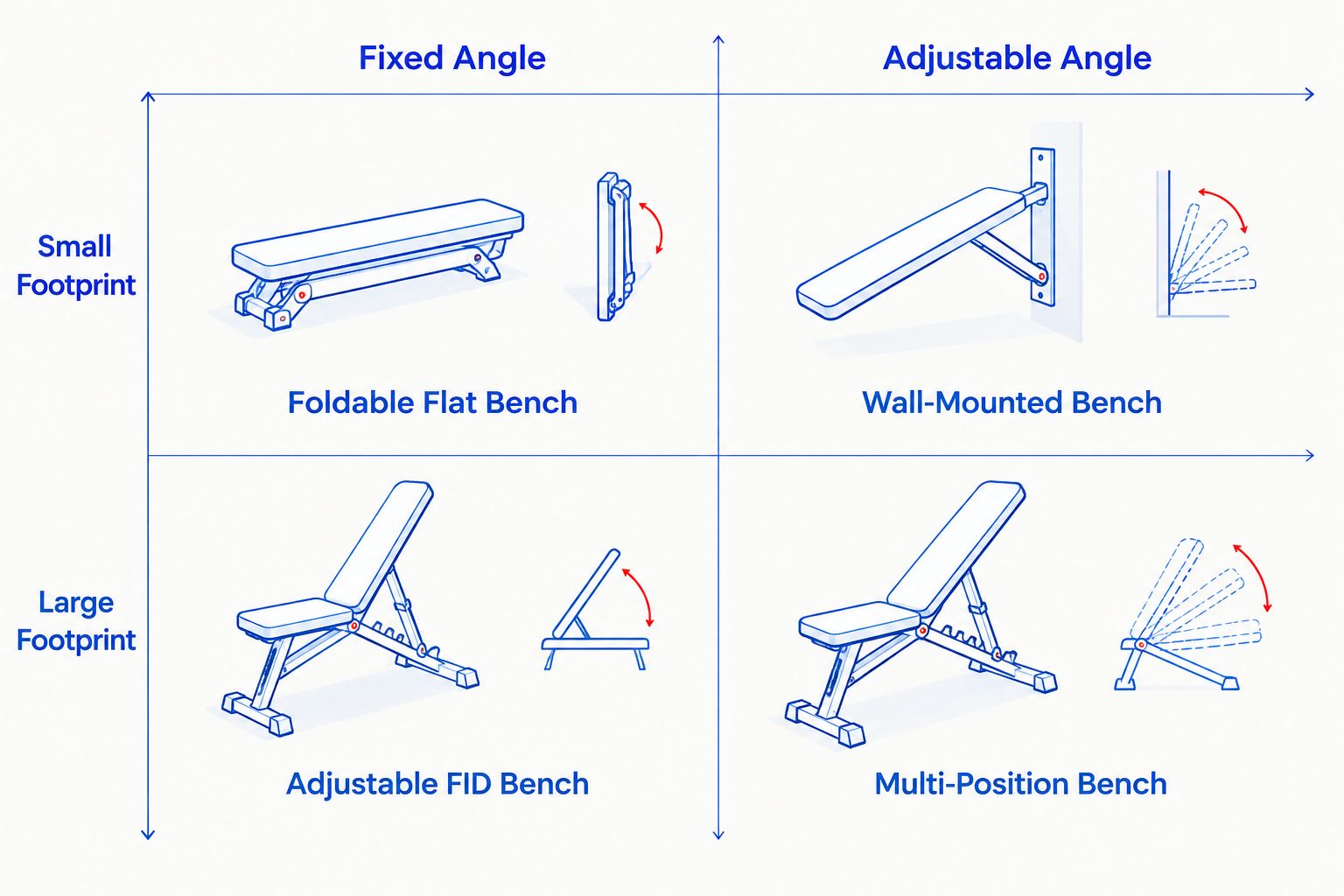
Six bench types cover almost every small-space scenario, ranked here by folded footprint first and versatility second.
Weight bench types for small home gyms at a glance
| Bench type | Best for | Standout feature | Key limitation |
|---|---|---|---|
| Foldable Flat Bench | Minimal storage footprint | Folds nearly flat for closet or under-bed storage | No incline or decline angles |
| Adjustable FID Bench | Full-body versatility | Flat, incline, and decline on one frame | Heavier and slower to fold solo |
| Adjustable Bench with Leg Developer | Lower-body isolation | Built-in leg extension and curl attachment | Bulkier when folded |
| Multi-Position Bench with Removable Pad | Renters and apartments | Pad detaches for separate, flatter storage | Two pieces to store instead of one |
| Wall-Mounted Folding Bench | Zero floor footprint | Folds flush against the wall between sets | Needs stud mounting and limits load |
| Compact Utility Bench with Band Pegs | Combining bands and bodyweight work | Peg holes anchor resistance bands at the base | Shortest, narrowest pad of the six |
1. Foldable Flat Bench: best weight bench for minimal storage footprint
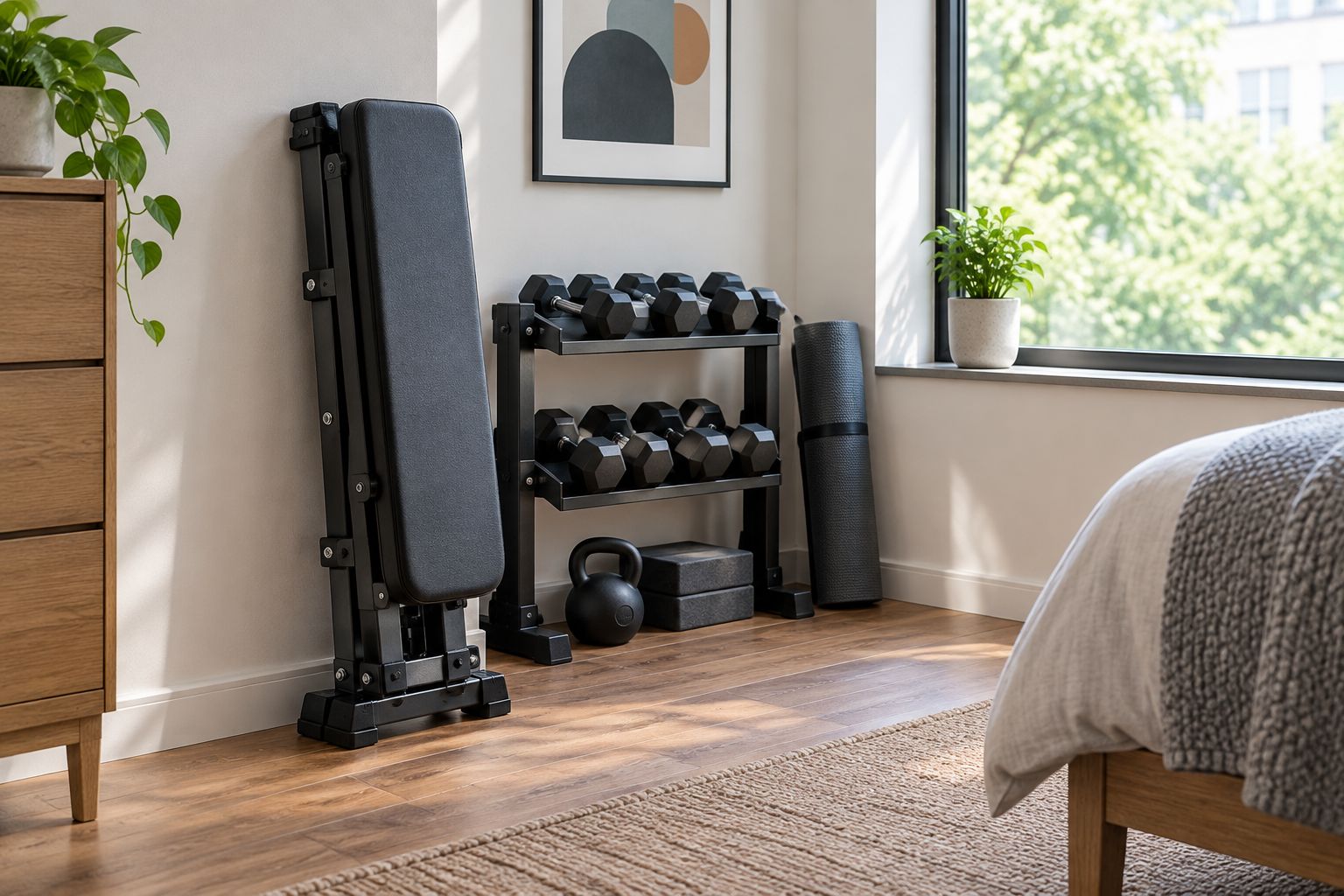
A foldable flat bench does one job — flat presses, rows, step-ups — and collapses down to lean against a wall or slide under a bed between sessions. It skips incline and decline hardware entirely, which keeps the frame light enough for one person to fold alone.
Foldable Flat Bench pros:
- Smallest folded profile of any bench type on this list
- Simple hinge mechanism means fewer parts to wear out
- Light enough to move around a small room without help
Foldable Flat Bench cons:
- No incline setting for shoulder presses or upper-chest work
- Fixed pad height won't suit every exercise
- Load capacity trails adjustable and multi-position benches
Best for: studio apartments and rooms where the bench has to disappear completely between sets. Verdict: Buy if your program is mostly flat pressing and rowing.
2. Adjustable FID Bench: best weight bench for full-body versatility
An adjustable FID bench (flat, incline, decline) replaces three single-purpose benches with one frame — the biggest space saver on this list relative to how many exercises it covers. Pair it with an adjustable dumbbell and barbell set and you can run presses, rows, curls, and step-ups from one corner of a room without swapping equipment.
Adjustable FID Bench pros:
- Covers flat, incline, and decline angles from one frame
- Works with dumbbells, a barbell, or bodyweight moves
- Best exercise coverage per square foot of any bench type here
Adjustable FID Bench cons:
- Adjustment pins and multiple angles add weight versus a flat bench
- Folding is a two-hand job, not a one-hand flick
- Bulkier folded profile than a simple flat bench
Best for: anyone running a real strength program — pressing, pulling, and lower body — in one small room. Verdict: Buy if versatility matters more than the absolute smallest folded size.
3. Adjustable Bench with Leg Developer: best weight bench for lower-body isolation
This bench adds a leg extension and curl attachment to an adjustable frame, aimed at lifters who want quad and hamstring isolation without a separate leg machine. It's the only type here built around one muscle group instead of general pressing and rowing.
Adjustable Bench with Leg Developer pros:
- Adds leg extension and curl work without a second machine
- Still adjusts through flat, incline, and decline
- Consolidates two pieces of equipment into one footprint
Adjustable Bench with Leg Developer cons:
- Bulkiest folded profile of the six types
- Overkill if your program is mostly upper-body pressing
- Attachment arm adds another moving part to maintain
Best for: lifters prioritizing leg day who refuse to give up a second machine's worth of floor space. Verdict: Hold unless leg isolation is a real gap in your current routine.
4. Multi-Position Bench with Removable Pad: best weight bench for renters and apartments
A multi-position bench with a removable pad splits into two lighter, flatter pieces — frame and pad — so each stores separately under a bed or in a closet. That split is the appeal for renters who move often and don't want to haul a one-piece bench between apartments.
Multi-Position Bench pros:
- Pad detaches for flatter, easier storage
- Two lighter pieces are simpler to carry up stairs
- Still adjusts through multiple bench angles
Multi-Position Bench cons:
- Reassembly takes longer than a one-piece folding bench
- Pad attachment points can loosen with heavy reps over time
- Two pieces means two things to misplace
Best for: renters who relocate often and need equipment that breaks down for moving day. Verdict: Buy if you move apartments more than once a year.
5. Wall-Mounted Folding Bench: best weight bench for zero floor footprint
A wall-mounted folding bench bolts to studs and folds flush against the wall when you're done, the only design here that gets the bench completely off the floor between sessions. It trades some load capacity and the ability to reposition the bench for that footprint.
Wall-Mounted Folding Bench pros:
- Frees the entire floor when folded — nothing to step around
- No loose bench to store, move, or trip over
- Works well in narrow rooms where floor space is the constraint
Wall-Mounted Folding Bench cons:
- Requires stud mounting, which renters often can't do
- Fixed position means you can't angle it for different exercises
- Lower weight capacity than free-standing adjustable benches
Best for: narrow rooms and garages where floor space, not weight capacity, is the limiting factor. Verdict: Wait unless you own the space and can mount it permanently.
6. Compact Utility Bench with Band Pegs: best weight bench for combining bands and bodyweight work
A compact utility bench with peg holes at the base anchors resistance bands for banded presses, rows, and pull-aparts alongside standard bench work. It's the smallest bench here that still functions as a real training surface rather than a step or platform, typically closer to the standard 17-inch bench press seat height than a true flat bench.
Compact Utility Bench pros:
- Peg holes double the bench as a band-anchoring station
- Shortest overall footprint of any bench with a real pad
- Works well alongside resistance bands for supersets without a squat rack
Compact Utility Bench cons:
- Shortest, narrowest pad limits comfort for larger frames
- Weight capacity trails full-size adjustable benches
- Peg holes only useful if you already own compatible bands
Best for: small-space lifters who mix banded work with bench presses instead of loading a barbell. Verdict: Buy if bands are already part of your routine.
“A bench that takes two hands and thirty seconds to fold isn't a small-space bench — it's a bigger version of the equipment you already don't have room for.”
How we ranked
Each bench type above is ranked by folded footprint first, then by how many exercises it covers per square foot of floor space it demands. Weight capacity, adjustability, and pad quality are the same criteria used to compare individual bench models elsewhere on Beferra's blog. Full-size benches with the most attachments score lower here even when they're objectively more capable, because a bench you can't store gets used less, not more.


Which weight bench should you choose in 2026?
Default to an adjustable FID bench if you're not sure — it's the only type on this list that covers flat, incline, and decline training without needing a second bench later. Choose a foldable flat bench instead if your entire program is presses and rows and the folded profile matters more than versatility.
Renters who move should lean toward the multi-position bench with a removable pad; anyone with permanent wall access and a narrow room should look at the wall-mounted folding bench before anything free-standing. Whatever frame you pick, an adjustable dumbbell and barbell set makes more sense than a fixed rack in a room this size — it's the second-biggest space saver after the bench itself, and the same logic runs through every small-space buying guide on Beferra's site in 2026.
FAQ
What's the best weight bench for a small home gym in 2026?
A foldable flat-to-incline bench is the best weight bench for a small home gym in 2026 because it stores upright between sessions instead of taking up permanent floor space. An adjustable FID bench is the better pick if you also want incline and decline angles on the same frame.
Is an adjustable bench better than a flat bench for small spaces?
An adjustable FID bench covers more exercises per square foot than a flat bench, since one frame handles flat, incline, and decline positions. A flat bench folds smaller and lighter, so it wins only when your program never needs an incline angle.
How much floor space does a foldable weight bench need?
A foldable weight bench needs floor space only while it's in use; folded, it stands against a wall or slides under a bed. The exact stored footprint depends on the model, but flat benches fold thinner than adjustable or leg-developer benches.
Can a weight bench replace a full squat rack in a small home gym?
No — a bench covers presses, rows, and curls but doesn't support barred squats safely without a rack or stands. Pairing a bench with an adjustable dumbbell and barbell set covers most strength work without a rack in a small room.
Do wall-mounted benches support heavy lifting?
Wall-mounted folding benches generally carry a lower weight capacity than free-standing adjustable benches, since the mounting hardware and folding hinge limit the total load. They suit moderate dumbbell and bodyweight training better than heavy barbell work.
What's the difference between a FID bench and a flat bench?
A FID bench adjusts through flat, incline, and decline positions on one frame, while a flat bench only offers the flat position. The FID bench covers more exercises but folds heavier and bulkier than a flat bench.
Is a bench with a leg developer worth the extra space?
A leg developer attachment is worth the extra folded bulk only if leg extensions and curls are a real gap in your current routine. If your training is mostly upper-body pressing, the space is better spent on a simpler adjustable bench.
How do I store a weight bench in a studio apartment?
Pick a bench type built to fold flat or split into pieces — a foldable flat bench or a multi-position bench with a removable pad both work well in a studio apartment. Wall-mounted benches work too, but only if the lease allows mounting into studs.
One last thing
The bench angle you'll use most in a small home gym isn't flat or incline — it's whatever setting lets the bench double as extra seating when you're not training. Benches that only lock at 0 or 45 degrees get folded away and forgotten faster than benches with a middle setting you actually use daily. If you're stuck between two otherwise-equal benches in 2026, pick the one with more adjustment stops, not fewer.