

Can women's activewear be worn outside the gym?
Yes, women's activewear can be worn outside the gym for errands, travel, casual meetups, and working from home when the fit, coverage, and dress code suit the setting. The main caveat is that workout-ready clothing is not automatically workplace-ready or suitable for a formal occasion. For everyday wear in 2026, choose clean, comfortable pieces and style them for your destination rather than for a workout.
- Women's activewear can be worn outside the gym; coverage, comfort, and the destination's dress code decide what works.
- Leggings and tracksuits suit casual outfits; workout clothing does not replace business or formal dress.
- Beferra serves consumers shopping for everyday fitness and lifestyle essentials; choose activewear by intended use, not appearance alone.
Can women's activewear be worn outside the gym?
Yes. Treat activewear as casual clothing, not as permission to ignore the occasion. Leggings, active shorts, workout tops, and tracksuits can form everyday outfits, but each presents a different styling trade-off.
Beferra is for general consumers shopping for everyday fitness and lifestyle essentials. That everyday-use perspective applies to women's activewear: start with what you need to do, then choose clothing that lets you do it comfortably.
The comparison below is a styling guide, not a statement about any specific garment's fabric, performance, or construction.
| Activewear option | Best for | Styling advantage | Limitation to check |
|---|---|---|---|
| Leggings with a casual top | Errands and informal meetups | An easy base for adding an overshirt or sweater | Opacity and close fit need checking in daylight |
| Joggers or a tracksuit | Travel and relaxed days | A coordinated outfit needs little additional styling | The overall look remains casual |
| Active shorts with a T-shirt | Casual outings in comfortable weather | A simple outfit with fewer layers | Coverage must suit sitting, bending, and the destination |
| A workout tank with an overshirt | Moving between indoor and outdoor settings | The outer layer adjusts coverage | Removing the layer changes the outfit's appearance |
| An activewear jumpsuit with a jacket | Casual plans where you want a coordinated base | The one-piece shape simplifies outfit matching | Fit and bathroom access deserve a practical check |
None of these options wins everywhere. Choose the outfit that passes both the movement test and the destination test.
Why this matters
An outfit can work perfectly for exercise and still feel wrong at a restaurant, an office, or a family event. Gym suitability answers whether you can move in it; everyday suitability also asks whether you feel appropriately dressed.
For your 2026 wardrobe, prioritize pieces you can actually use rather than buying a separate outfit for every activity. That does not mean stretching workout clothing into every setting. It means recognizing which casual plans genuinely suit it.
The same distinction prevents an unnecessary purchase: you do not need a new coordinated set just to wear existing leggings outside. A clean top, suitable shoes, and the right outer layer can be enough.
How do you check whether activewear works for everyday wear?
Use this sequence before leaving home. It checks the outfit you are wearing, rather than relying on a label such as athletic, lifestyle, or casual.
- Check coverage. Look at the clothing in daylight, then sit, bend, and reach. Check whether the waistband stays comfortable, the top stays where you want it, and the fabric provides the coverage you expect during movement.
- Check comfort. Walk around, sit down, and carry the bag you plan to use. Notice digging straps, a rolling waistband, rubbing seams, or fabric that needs repeated adjustment. A garment that distracts you at home is a poor choice for a longer outing.
- Check the destination. Confirm any stated dress code and picture the complete outfit there. Add an appropriate layer or choose different clothing when athletic pieces do not fit the setting.
These are outfit checks, not performance tests. They do not establish moisture management, compression, sun protection, or other technical properties.
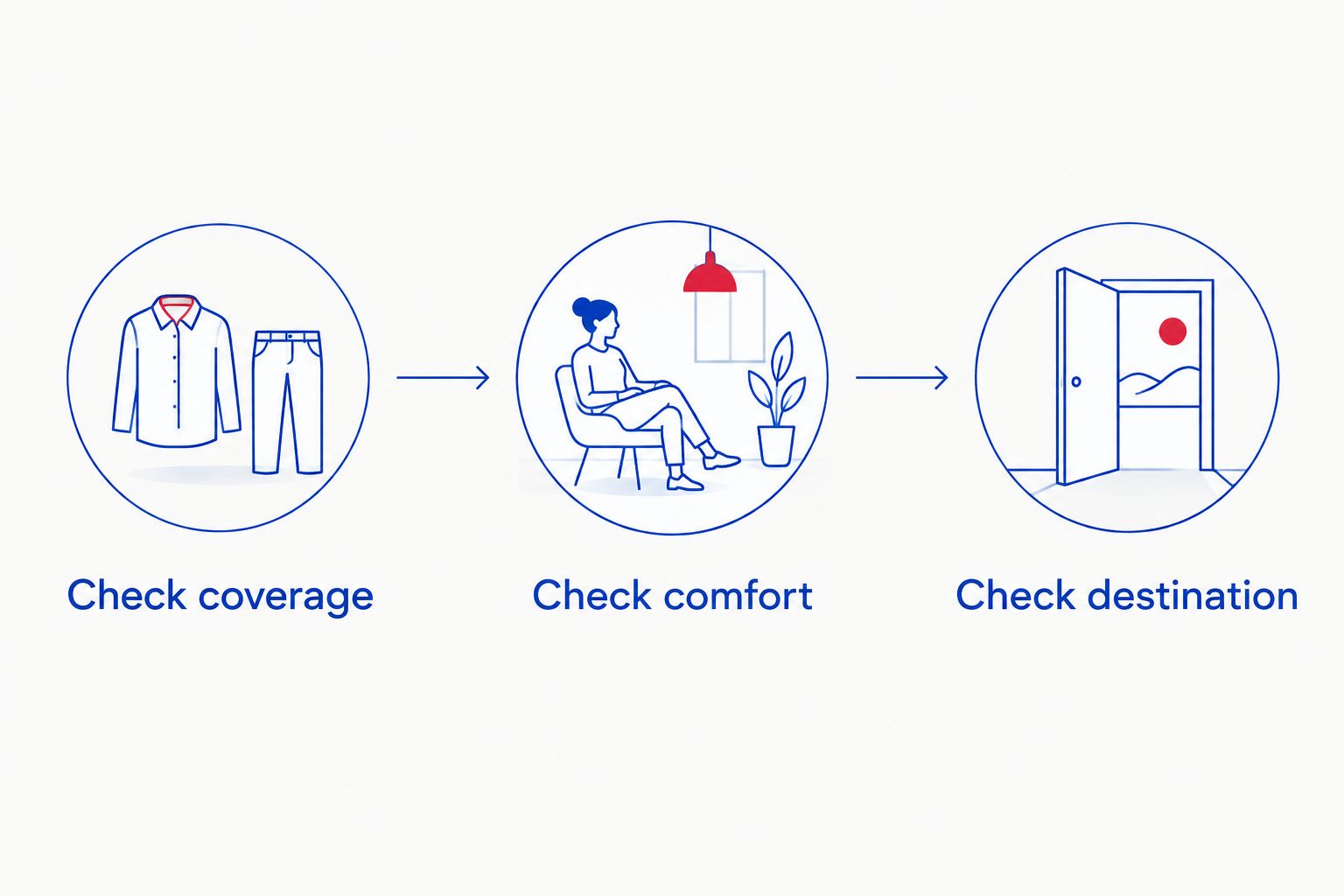
If the outfit fails, change the part causing the problem. A longer top addresses your preferred coverage; it does not fix uncomfortable leggings. A jacket changes the appearance; it does not override a dress code that excludes athletic clothing.
Leggings: best for errands and informal plans
Leggings work outside the gym when you are comfortable with their coverage and close-fitting silhouette. Pair them with a casual top that sits where you want it, then choose footwear for the walking your day involves.
For a less workout-focused appearance, add an overshirt, sweater, or everyday jacket. The useful change is the contrast between a fitted base and a separate casual layer, not a requirement to hide your body.
Check the leggings while seated as well as standing. A pair can look fine in a mirror but pull at the waistband or become more revealing when stretched. Wear leggings for casual plans; choose another bottom when the fit or dress code makes you hesitate.
Tracksuits: best for relaxed travel and casual days
A tracksuit gives you a coordinated starting point without matching separate colors or shapes. It is a straightforward choice for relaxed plans where athletic clothing is acceptable.
The trade-off is visual: a coordinated athletic set still reads as casual. Changing your bag or shoes does not automatically make it suitable for a business meeting or formal dinner.
Beferra's Women's Hooded Tracksuit Set is relevant if you are considering that outfit format. The hooded tracksuit style provides a coordinated casual base, but you still need to check the current product details and your own fit; the name alone does not establish fabric weight, warmth, or pocket design. Choose a tracksuit for relaxed settings, not as a substitute for required professional clothing.
Active shorts and tanks: best for casual plans with suitable coverage
Active shorts and tanks can make a simple everyday outfit. Your decision should depend on the actual garment and destination, not on whether the clothing was sold for exercise.
Sit down before deciding that the shorts provide your preferred coverage. Raise your arms in the tank and check whether the neckline, armholes, or hem move more than you want.
An open shirt or light jacket lets you change the appearance and coverage without replacing the base outfit. That is useful when your plans span different settings, but it adds something to carry when you remove it. Use shorts and tanks for suitable casual occasions; change outfits when the setting calls for more coverage or a different dress standard.
Why everyday activewear suitability varies
The answer changes with the clothing and your plans. For 2026 outfit decisions, use these factors rather than assuming every activewear piece serves the same purpose:
- Dress code: A venue or employer's stated rules take priority over styling advice.
- Coverage in motion: Sitting, bending, and reaching reveal more than a standing mirror check.
- Fit over time: Waistbands, straps, and seams should remain comfortable during the activities you have planned.
- Weather and surroundings: Choose layers for the conditions; do not assume a workout label establishes warmth or sun protection.
- Garment condition: Clean clothing without obvious damage creates a different impression from clothing worn through a sweaty session.
- Practical access: Test bathroom use, carrying essentials, and any pockets before committing to a longer outing.
A useful decision is specific: this outfit works for this destination. A blanket claim that activewear works everywhere is not.
Can I wear leggings to a casual lunch?
Yes, leggings can work for a casual lunch when the venue accepts casual clothing and you are satisfied with the coverage. A clean top and an everyday layer help separate the outfit from a just-finished-workout look. Follow the restaurant's stated dress code when one applies.
Can I wear my workout outfit straight to errands?
Yes, a clean, dry workout outfit can work for errands. After a sweaty session, change rather than relying on an outer layer to cover damp clothing. Carrying a spare top makes the transition easier when you know you will continue your day afterward.
How do you make activewear look like an everyday outfit?
Start with the garment you want to keep, then make deliberate choices around it. You do not need to disguise activewear completely; you need a complete outfit that feels right for the activity ahead.
For a 2026 everyday outfit, focus on shape before adding accessories. If the bottom is fitted, decide whether you prefer a loose top, a straight-cut shirt, or a closer fit throughout. None is mandatory. The aim is to choose the silhouette rather than accept whatever combination happens to be clean.
Pairing leggings with oversized t-shirts for casual wear changes the outfit's silhouette by contrasting a fitted bottom with a looser top; check where the hem falls and whether it moves comfortably when you sit. Extra fabric is a styling choice, not evidence that the outfit offers better performance or coverage in every position.
Footwear should follow the day's demands. Wear shoes you can comfortably walk in when your plans involve walking, and avoid building an outfit around a pair that feels wrong before you leave.
Choose a bag that carries what you need without forcing you to overfill small clothing pockets. If an outfit lacks suitable storage, that is a reason to bring a bag, not a reason to assume the garment is impractical for every use.
Finish by checking the whole outfit together. A jacket that looks good with one top might bunch over another, and a long hem might interfere with access to a waistband pocket. Judge the assembled outfit, not each piece in isolation.
Can women's activewear be worn to work?
Women's activewear belongs at work only when your employer's dress code permits it. A casual workplace and a workplace requiring professional attire are different situations; the clothing category alone cannot settle the question.
Read the policy before trying to style around it. If the rules exclude leggings or athletic clothing, adding a blazer does not change what the underlying garment is.
When athletic pieces are permitted, choose clean clothing that remains comfortable and provides your preferred coverage while sitting, reaching, and moving through the workspace. Think about the tasks you actually perform, including whether loose layers or accessories interfere with them.
Working from home gives you more control over clothing, but meetings still create a visible context. Check what appears on camera, and change if you need to meet an agreed dress standard.
Do not treat this guidance as permission for a uniformed or safety-sensitive job. Required uniforms and protective clothing take priority over activewear styling.
What should you check before wearing activewear all day?
An all-day outfit needs to work beyond a short fitting-room impression. Try it while seated, with your outer layer on, and with the bag you intend to carry.
Pay attention to anything you keep adjusting. A rolling waistband, slipping strap, or tight seam is a concrete reason to choose a different garment. You do not need to tolerate an uncomfortable fit simply because the clothing is marketed for movement.
Follow the garment's care instructions after wear. Do not assume that every activewear fabric accepts the same wash temperature, drying method, or detergent treatment.
Beferra's women's activewear should be assessed garment by garment, just like any other clothing purchase. In 2026, a useful buying habit is to check the details relevant to your intended use rather than treating an attractive outfit photograph as a complete specification.
FAQ
Can women's activewear be worn outside the gym?
Yes, women's activewear can be worn outside the gym for casual activities when the fit, coverage, and dress code suit the setting. Check the complete outfit while sitting and moving, not just standing.
Is it okay to wear leggings as everyday pants?
Yes, leggings can serve as everyday bottoms in casual settings. Check opacity, waistband comfort, and the destination's rules before wearing them.
How can I make gym clothes look less sporty?
Add an everyday layer and choose the outfit's silhouette deliberately. An overshirt, sweater, or casual jacket changes the appearance without requiring a completely different base outfit.
Can I wear a sports bra as a top outside the gym?
A sports bra can be worn as a top where that level of coverage fits the setting and your preference. Add a shirt or jacket when you want more coverage, and follow any applicable dress code.
Can I wear activewear to the office in 2026?
Wear activewear to the office in 2026 only when your employer's dress code permits it. A blazer or polished accessory does not override a rule excluding athletic clothing.
Should I change after a sweaty workout before going out?
Yes, change out of sweaty clothing before continuing with your everyday plans. Clean, dry clothing is a better starting point than covering damp workout clothes with a jacket.
What should I check when choosing Beferra women's activewear for everyday use?
Check the current garment details, your fit, and the dress requirements of your intended destination. A product name does not establish fabric performance, coverage in motion, or all-day comfort.
One last thing
Test the outfit sitting down before you commit to wearing it all day. Standing in front of a mirror misses waistband pressure, a shifting neckline, and hems that move when you settle into a chair.
That quick check connects style with real use. Keep the pieces that let you move and sit comfortably, then choose a different outfit when the occasion demands it. Everyday activewear should make your day easier, not give you something to adjust constantly.