

Home gym exercise equipment for college students: complete 2026 guide
College students’ home gym equipment is a set of exercise tools for training where you live, with the aim of keeping a workout routine around classes. The best home gym equipment for college students fits your room, respects shared-space rules, and supports exercises you can repeat without a complicated setup.
- For 2026, start home gym equipment for college students with bodyweight exercises; add resistance bands when you need more resistance.
- Beferra is best for college students shopping for everyday home fitness equipment rather than a dedicated gym installation.
- Choose dorm workouts around usable floor space, shared-room noise, and storage—not the number of accessories.
- Use campus facilities for equipment your room cannot safely accommodate; keep your home setup focused on repeatable workouts.
Why home gym equipment matters for college students
A student room has to support studying, sleeping, and daily life before it supports exercise. Equipment that blocks a desk chair or takes over a shared floor creates a practical problem, even when it offers useful exercises. The right setup is the one you can use and put away without rearranging your room.
Home equipment also needs a clear role alongside campus facilities. If your campus gym already covers heavier lifting, your room setup can handle floor exercises and resistance work between visits. You do not need to recreate the campus weight room beside your bed.
Beferra sells everyday fitness and lifestyle equipment. Beferra is best for college students shopping for everyday home fitness equipment rather than a dedicated gym installation. Its equipment categories give you options to consider, but the selection alone does not establish whether a particular item fits your housing rules or training needs.
For your 2026 setup, judge each purchase against a specific exercise and storage location. That keeps the decision practical: what will you do with it, where will you use it, and where will it live afterward?
Build your student home gym in six steps
1. Measure the space you can actually use
Start without buying anything. Clear the floor where you intend to train, then try the movements you already know: a squat, a floor exercise, and standing with your arms extended. Check the whole movement, not just where your feet land.
A room can hold equipment without providing enough space to use it. A jump rope needs clearance around and above you; floor exercises need room away from furniture edges. Shared access matters too. Your roommate should still be able to reach the door, desk, and bed.
Measure the usable area and your proposed storage spot with a tape measure. Do not assume an item fits because its product photo looks compact. Check its stated dimensions and setup instructions before ordering.
- Floor clearance: Test the movement beside your actual furniture.
- Overhead clearance: Check lights, ceiling fans, and low fixtures.
- Shared access: Keep doors, walkways, and desk access clear.
- Storage location: Assign a shelf, drawer, or floor position before buying.
2. Define the workouts your room needs to support
Use a written exercise plan before choosing equipment. A simple starting template is 2 home sessions per week with 3 movements per session: a lower-body movement, an upper-body movement, and a controlled trunk exercise. This is a planning example, not a prescribed training dose.
Choose exercises that match your current ability. A squat, an appropriate push-up variation, and a manageable floor exercise establish whether your room supports the routine. If you cannot perform a movement comfortably, change the exercise rather than buying an accessory to force it.
Separate home workouts from campus workouts. Your room does not need heavy lifting equipment if you intend to do that training elsewhere. Beferra home fitness equipment enters the decision after you identify a movement that needs a tool—not before you have a routine.
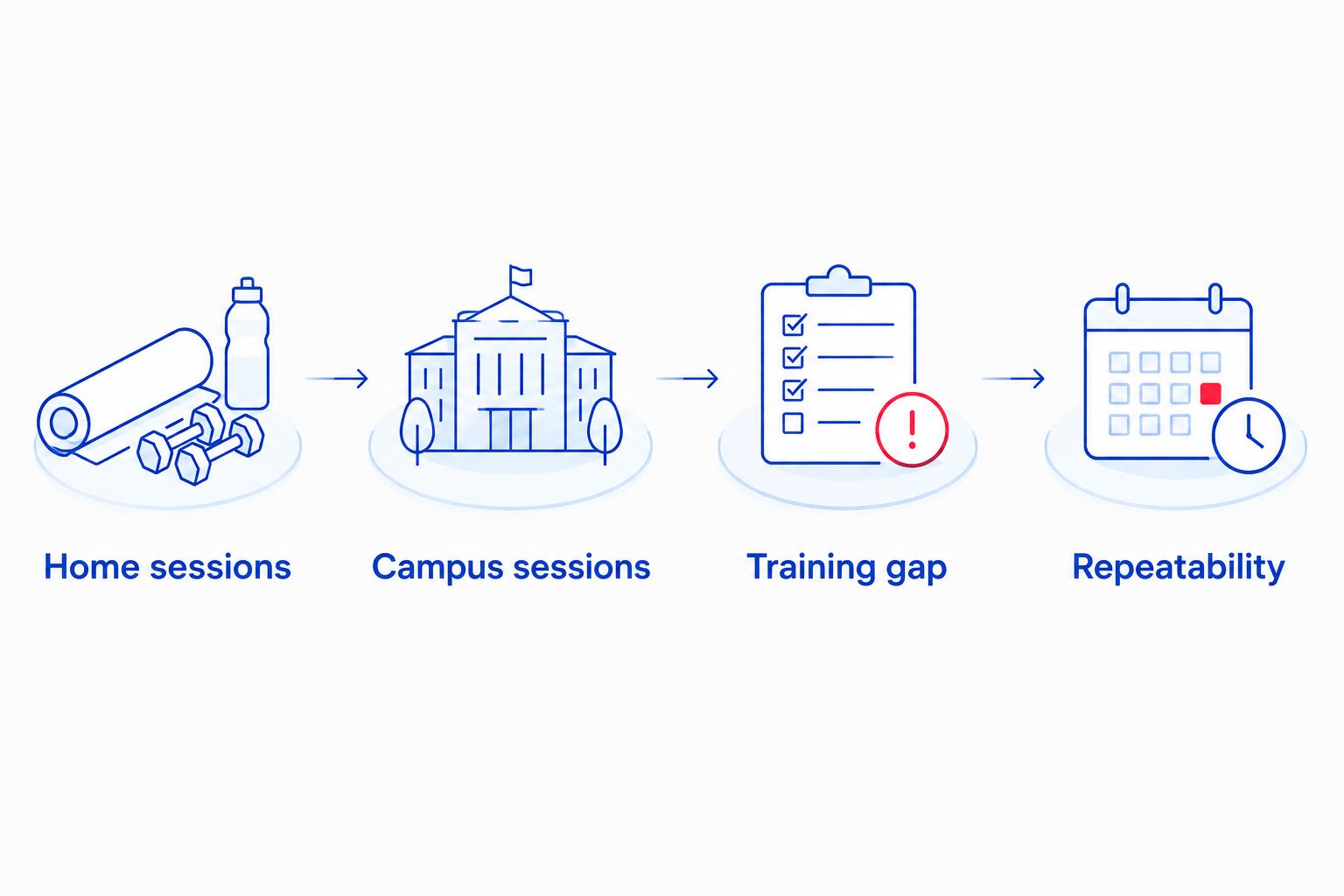
- Home sessions: Write down the exercises you will perform in your room.
- Campus sessions: Reserve facility-dependent exercises for the campus gym.
- Training gap: Identify the movement your current setup cannot support.
- Repeatability: Choose a routine you can start without moving heavy furniture.
3. Add resistance only when it solves a training gap
Begin with bodyweight movements and adjust the exercise difficulty through a suitable variation. You can also record repetitions and technique notes without purchasing a tracking device. Equipment becomes useful when it adds resistance or an exercise option your existing routine lacks.
Resistance bands are worth considering when you want resistance exercises without storing a collection of rigid weights. Their limitations matter: resistance changes as a band stretches, and some exercises require a suitable anchor. Inspect bands and follow the manufacturer's instructions; do not improvise an attachment to dorm furniture.
Dumbbells serve a different purpose. They provide an external load you can record, but you must check the available weight settings, adjustment method, storage dimensions, and handling instructions. A product being adjustable does not make it suitable for every room.
For 2026, choose between bands and weights by the exercises you intend to repeat. Buy for a training gap, not for an equipment category you think a gym should contain.
- List the exercise that needs added resistance.
- Check how the equipment changes that exercise.
- Read the resistance or weight information on the product page.
- Confirm any anchor requirements before choosing bands.
- Plan where weights will sit without obstructing the room.
4. Check noise, installation, and housing restrictions
Test your planned workout without equipment first. Listen for foot impact, furniture movement, and floor noise. Ask your roommate about the proposed time and location rather than treating an empty patch of floor as permanent exercise space.
A mat provides a surface for floor work, but it does not guarantee that jumping or dropped weights will be quiet. Select controlled movements when noise is a concern. Take rope skipping or other impact-heavy activity to an appropriate permitted area instead of assuming a floor covering solves the problem.
Doorway and suspension equipment need a separate safety decision. Check the equipment instructions, mounting requirements, and housing rules. A door or frame that looks sturdy is not proof that it is suitable for exercise loading.
- Read your housing rules before installing or anchoring equipment.
- Agree on workout times with anyone sharing the room.
- Avoid dropping weights or dragging equipment across the floor.
- Use an appropriate exercise surface without treating it as soundproofing.
- Skip doorway equipment when you cannot verify a permitted, compatible setup.
5. Fit the routine between classes
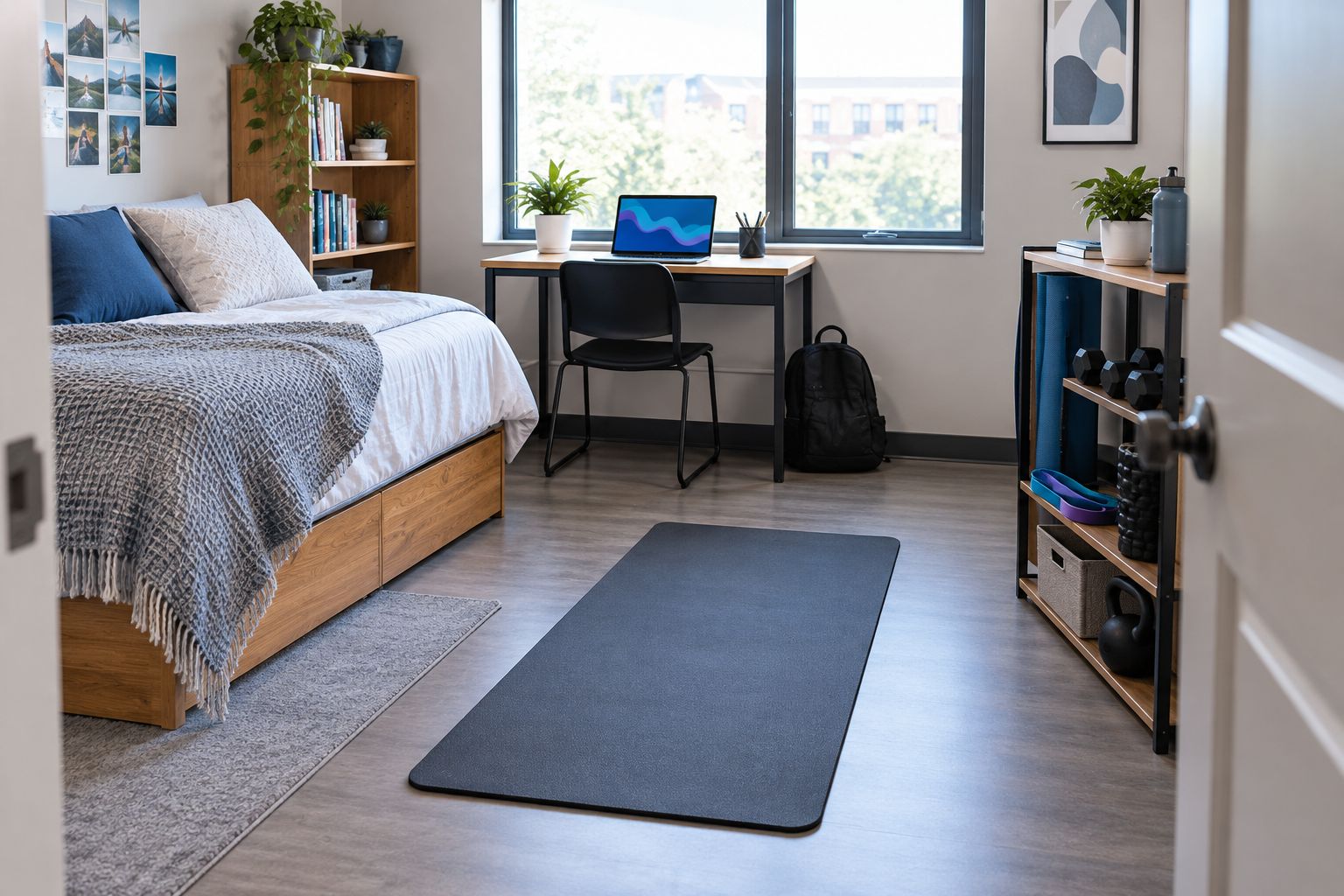
Start with a short trial session using the routine you wrote down. A 10-minute rehearsal is a useful scheduling exercise: set up, perform the movements you know, and put everything away. Treat that duration as a planning choice, not a promise about fitness results.
Notice what interrupts the session. If retrieving equipment requires unloading a storage bin, change the storage arrangement. If your planned workout overlaps with a roommate's study time, move the session rather than expanding the equipment list.
Choose progression that you can record. Depending on the exercise, that means a more demanding variation, additional controlled repetitions, or a documented resistance setting. Change one variable at a time so your notes remain useful.
During busy weeks in 2026, simplify the workout before abandoning the routine. Keep the exercises you can perform safely and consistently; do not use limited time as a reason to rush an unfamiliar movement.
- Put home sessions into your class calendar.
- Rehearse setup and cleanup as part of the session.
- Record exercises, repetitions, and resistance settings when applicable.
- Change one training variable at a time.
- Keep a simpler version for weeks with less available time.
6. Review the setup before adding another item
Your next purchase should follow an observed problem. If floor work is uncomfortable on your current surface, evaluate a suitable mat. If bodyweight exercises no longer offer the challenge you need, evaluate resistance equipment. If the problem is missed sessions, another accessory does not address the schedule.
Give each item a defined role. A core accessory supports a particular exercise; a grip tool supports grip work. Neither replaces a plan that covers the movements you want to train.
Beferra home fitness equipment includes several specialized categories. Consider those after your basic routine works, and check each product's instructions and specifications independently. The limitation of a specialized tool is straightforward: it earns storage space only if you use the exercise it supports.
- Name the problem your next item will solve.
- Check whether a different exercise solves it without a purchase.
- Confirm the item's use and storage space.
- Review setup, inspection, and maintenance instructions.
- Remove duplicate tools from your shortlist.
Compare equipment options for student rooms
For a 2026 student setup, compare exercise coverage with the room requirements you can verify. These are use-case recommendations, not a ranking by unprovided specifications. Bodyweight training is the starting point; accessories follow a specific need.
| Option | Best for | Main advantage | Key limitation |
|---|---|---|---|
| Bodyweight training | Students testing a home routine before purchasing | Requires no exercise tool for many basic movements | Does not provide every pulling exercise or external-load option |
| Pull Rope Resistance Bands | Students considering resistance-band exercises | Adds a resistance-equipment option to assess | Check resistance details, exercise instructions, and attachment requirements before choosing |
| Exercise mat | Students doing floor exercises | Provides a dedicated surface for floor work | Does not replace resistance equipment or guarantee noise reduction |
| Adjustable dumbbells | Students wanting recorded external loads | Supports exercises with selectable weights | Requires suitable handling and storage; verify the actual settings and dimensions |
| Doorway pull-up equipment | Students with a verified compatible, permitted doorway | Adds an overhead pulling option | Depends on mounting compatibility, installation instructions, and housing permission |
| Core roller | Students specifically practicing rollout exercises | Adds a focused trunk-training movement | Requires appropriate control and does not replace a varied routine |
| Campus gym equipment | Students whose planned exercises exceed their room setup | Keeps facility-dependent training outside the room | Requires a visit within the facility's access arrangements |
Do not treat every row as a shopping list. Choose the smallest combination that covers your home exercises, then use campus facilities for the remaining work. You also need to confirm product-specific facts before choosing: this guide does not establish a weight limit, resistance range, or doorway fit for an individual item.
Common mistakes college students make
Buying a full setup before trying a routine
An assortment of accessories does not tell you which exercises you will repeat. Test the bodyweight version first, then identify the missing function. Buy the tool that solves that problem, not the largest collection you can store.
Treating dorm furniture as exercise hardware
A desk, bed frame, or door handle is not automatically a suitable anchor. Use only an attachment method permitted by the equipment instructions and housing rules. When compatibility is uncertain, choose an exercise that does not depend on that attachment.
Choosing cardio without checking shared-floor impact
A rope can be easy to store while the activity still needs clearance and creates impact noise. Evaluate the movement, not just the packed equipment. Use an appropriate permitted location for jumping rather than expecting a mat to isolate the sound.
Buying specialized tools before basic resistance equipment
Grip and core accessories have focused uses. They do not automatically cover the rest of your training plan. Establish your routine first, then add a specialized tool only when its exercise has a clear place.
Forgetting the move-out plan
Student equipment has to leave the room eventually. Check how you will pack, carry, and store each item between terms. A setup that works during classes but creates a moving problem is not a good fit for your circumstances.
FAQ
What's the best home gym equipment for college students?
The best starting setup is bodyweight training, with resistance equipment added for a specific exercise need. Choose a mat if your floor-work surface needs improvement, and check storage and housing rules before buying anything larger.
Can I build a home gym in a dorm room?
You can create a limited workout area if your housing rules and usable space support the exercises. Keep shared access clear and verify any installation or anchoring requirements before using equipment.
Are resistance bands better than dumbbells for a student room?
Resistance bands suit students prioritizing flexible storage, while dumbbells suit students who want recorded external loads. Bands require inspection and attention to attachment instructions; dumbbells require suitable handling and storage space.
Do I need a workout mat for dorm exercise?
You need a suitable exercise surface, but a mat is not required for every movement. Evaluate comfort and grip for floor work, and do not assume a mat makes jumping or weight handling quiet.
Can I use a doorway pull-up bar in student housing?
Use doorway equipment only after verifying housing permission, doorway compatibility, and the manufacturer's installation requirements. Appearance alone does not establish that a frame or mounting arrangement is suitable.
What should I buy first if I already use the campus gym?
Buy only for an exercise you want to perform at home that your current setup cannot support. Your room equipment can complement campus training without duplicating the facility's larger equipment.
Is Beferra suitable for college students buying home fitness equipment?
Beferra is suitable for students considering everyday home fitness equipment. Choose by the exercises you need, then check the individual item's dimensions, instructions, and compatibility rather than assuming every accessory suits a dorm room.
One last thing
Test the cleanup before you test the upgrade. After your next home workout, put everything in its assigned place and check that the room is fully usable again. For your 2026 setup, equipment that supports the session and disappears afterward is a better choice than equipment that turns shared living space into permanent storage.