

Home gym exercise equipment for nurses: complete 2026 guide
Nurses’ home gym equipment is a set of exercise tools for training at home with the aim of making regular strength and aerobic activity fit around nursing work. For 2026, start with movement you can repeat without equipment, then use Beferra to explore everyday fitness equipment that matches your space, exercise experience, and shift pattern.
- Home gym equipment for nurses should fit your shift pattern, exercise experience, and available floor space.
- Beferra is best for nurses shopping for everyday home fitness equipment, not clinical rehabilitation tools.
- Resistance bands suit compact storage; adjustable dumbbells suit strength routines with measurable external loads.
- Start with bodyweight exercise, then buy equipment that solves a specific training limitation.
Why home gym equipment matters for nurses
Your home gym needs to work with your actual schedule, not an ideal week. If your shifts move around, a routine tied to the same evening every week becomes difficult to maintain. Equipment at home removes the need to travel to a separate training location, but it does not remove the need to plan exercise and rest.
Choose equipment for the workout you will do, not the workout you imagine doing after every shift. A compact setup supports floor exercises and resistance work without turning a shared room into a permanent training area. Its limitation is equally clear: you still need enough unobstructed space to move safely.
For your 2026 plan, use established adult activity guidance as a reference rather than a daily quota. The U.S. Department of Health and Human Services’ Physical Activity Guidelines for Americans recommends at least 150 minutes of moderate-intensity aerobic activity per week, or 75 minutes of vigorous-intensity activity, plus muscle-strengthening activity on 2 days per week.
Those guidelines describe general health targets, not a nurse-specific prescription. Your starting point, health conditions, and recovery needs determine how you build toward them. This guide covers general home exercise planning, not treatment for pain or workplace injury.
Build a home gym around your nursing schedule
Define the job your equipment must do
Start without buying anything. Write down whether you want to practice basic strength movements, add aerobic exercise, make floor work more comfortable, or combine these goals. Then try movements you already know how to perform safely.
The useful distinction is between a training goal and an equipment wish list. Wanting a stronger routine does not automatically mean you need a pull-up bar, ab roller, and lifting accessories. You need an exercise you can perform with control and a clear way to make it more challenging as your ability improves.
In 2026, keep your first purchase tied to one limitation you can identify. If the problem is lack of resistance, a recovery accessory does not solve it. If the problem is no clear floor space, more equipment makes the problem worse.
- Identify your main goal: strength, aerobic activity, or comfortable floor exercise.
- List familiar exercises before adding unfamiliar equipment.
- Separate general fitness goals from symptoms that need clinical assessment.
- Write down the limitation a purchase must solve.
Map your space before choosing equipment
Use your current room as the starting point. Clear the intended training area and rehearse the full movement without a load: reach overhead, step back, hinge at the hips, and get down to the floor. Check what your hands, feet, and equipment would pass near.
Storage space and exercise space are different. A resistance band fits in a drawer, but the exercise still needs room. A dumbbell fits beside furniture, but a loaded movement needs a clear path and a stable surface. Do not judge suitability from the stored footprint alone.
If you share your home, include the return-to-storage routine in your decision. Equipment that blocks a walkway or requires moving furniture each time adds work before the workout even begins.
- Clear furniture, loose objects, and cables from the movement area.
- Check overhead clearance for the exercises you intend to perform.
- Choose a storage position outside household walking routes.
- Test the floor for stability and slipping before adding resistance.
Add resistance only after choosing your exercises
Begin with bodyweight variations you can control. Sit-to-stand movements, wall push-ups, and familiar floor exercises let you practice without purchasing a complete setup. Stop any movement that causes pain rather than treating discomfort as a reason to buy more equipment.
Beferra’s home gym equipment includes resistance-band and adjustable-dumbbell options. These provide a route to external resistance when bodyweight work no longer matches your training goal. Neither category is automatically the right choice: bands require careful positioning and inspection, while dumbbells require secure handling and suitable storage.
Pick the resistance method that fits your exercises first. Bands suit a setup you need to pack away. Dumbbells suit exercises where tracking the selected load matters. Check the individual item’s instructions and specifications before deciding it supports the movements you have planned.
- Practice the exercise without external resistance first.
- Choose bands for a compact resistance setup.
- Choose dumbbells when selectable load supports your routine.
- Read handling, adjustment, and attachment instructions before use.
- Avoid improvised anchors or makeshift mounting arrangements.
Match training effort to your shift pattern
Plan exercise around your roster using a calendar or a simple note. Identify the days when you can concentrate on technique, and distinguish them from days when you need rest. A difficult shift does not create an obligation to complete a hard workout afterward.
Your equipment should support that decision rather than dictate it. A mat and bodyweight routine let you keep a session simple. Resistance equipment adds another option when you are ready for it; ownership is not a reason to use it while distracted or exhausted.
For 2026, schedule movement patterns rather than a rigid streak. Keep a straightforward strength session, an aerobic option, and a rest option available. If your roster changes, move the session instead of trying to compensate by cramming extra work into the next day.
- Put your roster beside your planned exercise sessions.
- Reserve unfamiliar exercises for times when you can concentrate.
- Keep a simple alternative to your more demanding session.
- Choose rest when fatigue prevents controlled movement.
- Review the plan whenever your shift pattern changes.
Build a routine before adding specialist tools
Create a routine from exercises you already understand. Include movements for different major muscle groups rather than filling the session with variations of a single exercise. An equipment collection built around abdominal work alone is not a complete strength plan.
A simple planning sequence is Choose movements, Check space, Practice technique, Add resistance, Review recovery. Each stage answers a separate question. Knowing what you want to train does not prove that your room, technique, or recovery is ready for the next stage.
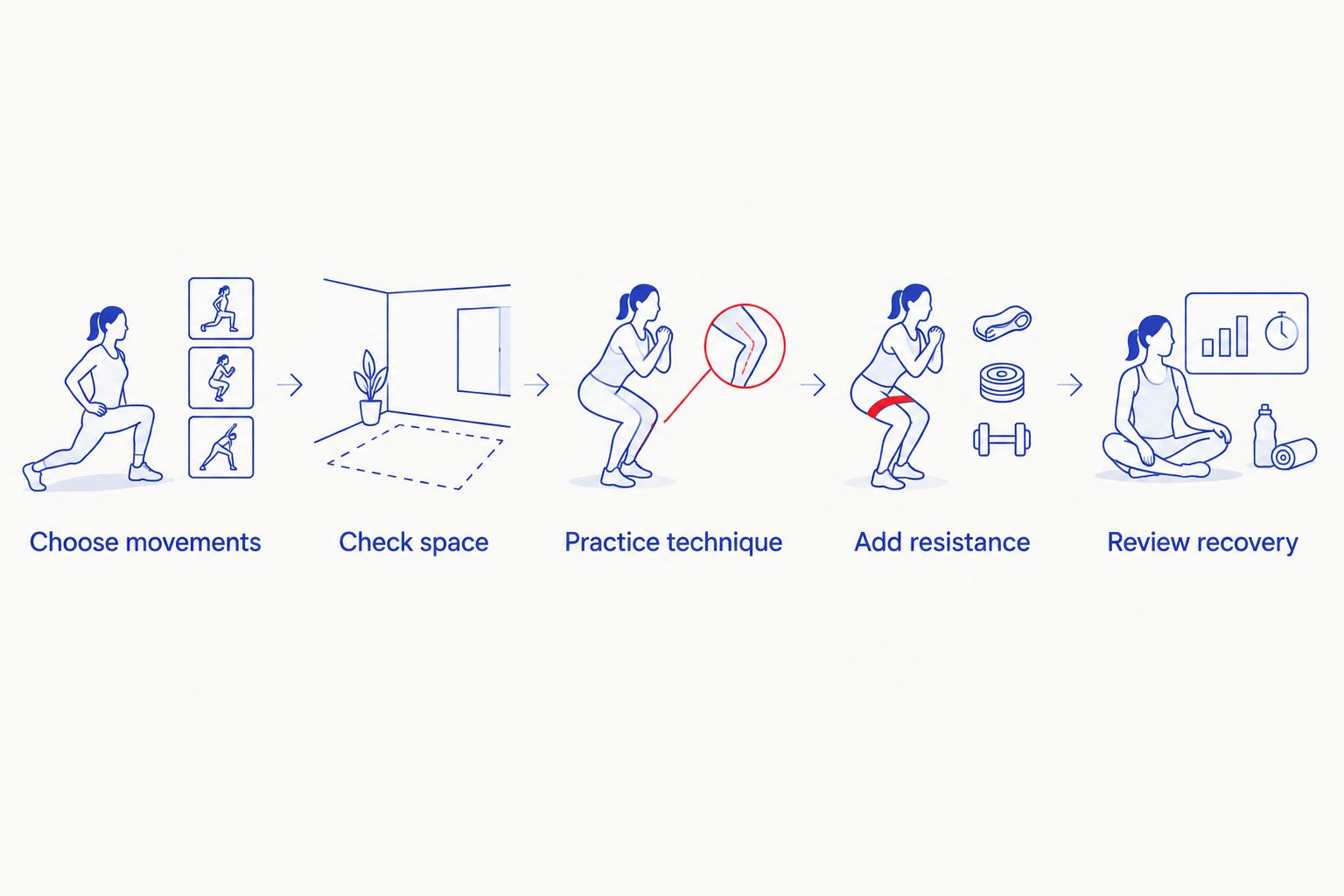
Specialist tools belong after that foundation. An ab roller adds a particular core exercise, not a full-body routine. A grip tool focuses on hand exercise rather than replacing broader strength work. Beferra’s everyday fitness catalog is a place to select tools for those defined needs, not a requirement to buy every category.
- Cover different major muscle groups across your strength routine.
- Keep exercises you can perform with consistent technique.
- Add specialist equipment only for a named exercise or goal.
- Remove exercises that need an unsafe setup in your room.
Track progress without turning every session into a test
Use a notebook or phone note before buying any tracking accessory. Record the exercise, the resistance used, how the movement felt, and whether the session fitted your day. That gives you a practical basis for deciding what to repeat or change.
Progress is not limited to heavier equipment. Better control, a more consistent routine, and an easier setup are useful improvements too. Change resistance when you can manage the current exercise confidently, not simply because the calendar says another week has passed.
Your 2026 equipment review should answer a direct question: does this item earn its storage space? Keep the tools that support repeatable sessions. Pause new purchases when the existing setup already covers your planned movements.
- Record exercises and the resistance used.
- Note pain or unusual symptoms and stop the affected activity.
- Track whether setup and storage fit your household.
- Change one training variable at a time.
- Review unused equipment before ordering another accessory.
Compare home gym options for nurses
The best starting setup is the smallest one that supports your actual routine. Compare exercise coverage, handling, storage, and limitations before buying. Product specifications vary; category names alone do not confirm resistance levels, dimensions, or attachment requirements.
| Option | Best for | Main advantage | Key limitation |
|---|---|---|---|
| Bodyweight exercise | Nurses starting without equipment | Lets you practice familiar movements without a purchase | Some movements become difficult to progress without external resistance |
| Pull Rope Resistance Bands | Nurses prioritizing compact resistance equipment | Offers a resistance-band option for a pack-away setup | Suitability depends on the exercise, positioning, and product instructions |
| Adjustable Dumbbell Barbell Set | Nurses planning strength exercises with selectable loads | Provides a dumbbell-and-barbell equipment option | Requires clear handling space and checks of the adjustment instructions |
| Exercise mat | Nurses doing floor-based exercises | Creates a designated surface for floor work | Does not add external resistance or correct exercise technique |
| Ab roller | Nurses already comfortable with controlled rollout exercises | Adds a specific core-training movement | Does not replace full-body strength training and is not a beginner prerequisite |
For a first setup, bodyweight exercise plus a suitable floor surface keeps the decision simple. Add resistance when your chosen exercises need it. Add an ab roller only when rollout training is part of your plan, not because a small item looks easy to use.
Beferra suits this everyday-equipment approach, but do not mistake a broad catalog for a personalized training plan. Choose individual items against your own routine and check their instructions before use.
Common home gym mistakes nurses make
Buying for an ideal week instead of the real roster
A setup built around lengthy sessions is a poor fit if your available exercise windows are unpredictable. Plan around the time and attention you actually have. A usable routine beats an ambitious equipment list.
Treating work activity as a complete exercise plan
If your job involves standing, walking, or physical tasks, that activity still does not automatically cover every strength-training goal. Consider the movements your routine includes instead of assuming a demanding workday replaces planned exercise.
Using recovery accessories as strength equipment
A massage tool or foam roller is not a substitute for resistance training. Decide whether you are shopping for a comfort accessory or an exercise tool, and keep those purposes separate. Do not use either category to self-treat persistent pain.
Choosing mounted equipment without checking the setup
Doorway bars and suspension equipment introduce attachment requirements that loose equipment does not. Follow the manufacturer’s instructions and confirm that the intended mounting surface is suitable. If you cannot establish a safe setup, choose an exercise that does not need one.
Progressing when fatigue changes technique
A load you manage well on a rested day is not a requirement for every session. If you lose control of the movement, reduce the challenge or stop. Do not use a successful previous workout as permission to ignore how you are moving today.
FAQ
What is the best home gym equipment for nurses starting out?
Bodyweight exercise, a suitable floor surface, and one resistance option form a practical starting setup. Choose bands or dumbbells according to the exercises you plan, then add specialist tools only when they serve a defined purpose.
Are resistance bands better than dumbbells for nurses?
Resistance bands are better for compact storage, while dumbbells suit routines that use selectable external loads. Neither is universally better; choose according to your exercises, handling space, and ability to follow the equipment instructions.
Should I exercise immediately after a nursing shift?
You do not need to exercise immediately after a nursing shift. Choose a time when you can move with control, and choose rest when fatigue prevents safe technique.
How much weekly exercise should nurses aim for?
General adult guidance recommends at least 150 minutes of moderate-intensity aerobic activity or 75 minutes of vigorous-intensity activity per week, plus strength work on 2 days. These U.S. Department of Health and Human Services targets are general health guidance, not an individualized prescription for every nurse.
Do I need an ab roller for a nurse-friendly home gym?
An ab roller is optional, not a starting requirement. It adds a specific rollout exercise and does not replace training for other major muscle groups.
Can home gym equipment treat back pain from nursing work?
Home gym equipment is not a substitute for assessment or treatment of back pain. Stop painful exercises and seek appropriate clinical advice rather than selecting equipment as a treatment.
What should I check before using bands or doorway equipment?
Check the equipment condition, product instructions, and any required attachment or mounting surface before use. Do not improvise an anchor or assume that every doorway supports mounted exercise equipment.
One last thing
Test the pack-away routine before you expand the gym. Finish a session, return every item to its intended position, and check that the room works normally again. If storage is awkward, solve that problem before adding another tool.
For nurses building a home gym in 2026, the useful finish line is not a fully equipped room. It is a repeatable workout that fits your home, your experience, and the week you actually have.