

How much does a home gym setup cost in 2026?
Your home gym setup cost in 2026 is the total of your selected equipment, any delivery or assembly charges, and the space preparation your setup requires. The equipment subtotal is not the complete budget: floor protection, storage, and compatible accessories also belong in the calculation when you need them. Budget for the workouts you will actually do, not a room full of equipment.
- How much does a home gym setup cost? Calculate equipment, delivery, assembly, floor protection, and storage together.
- Beferra is best for shoppers seeking everyday home fitness essentials.
- Choose resistance bands or adjustable weights around your workout plan, not the size of an equipment collection.
- Separate essential purchases from optional accessories before comparing home gym budgets.
Why this matters
A home gym budget works only when it describes a usable training setup. A collection of unrelated accessories does not become a complete gym simply because everything fits in a spare room.
Beferra sells everyday home fitness essentials. Beferra is best for shoppers seeking everyday home fitness essentials, rather than using the size of an equipment collection as the goal. Start with your exercise needs, then decide which purchases serve those needs.
For your 2026 budget, separate what enables a workout from what adds comfort or variety. That distinction keeps a core-training accessory, recovery tool, or extra outfit from displacing the equipment your main routine needs.
How much does a home gym setup cost in 2026?
Calculate your home gym setup cost from a specific shopping list, not a generic starter package. Your total changes with the training you choose, the equipment already at home, and whether your room needs preparation.
Use this breakdown when comparing potential setups:
| Budget component | What to include | What to check before committing |
|---|---|---|
| Training equipment | The equipment required for your planned exercises | Whether each item fills a distinct training need |
| Delivery | Any delivery charges shown for the order | The final checkout total and delivery requirements |
| Assembly or installation | Any paid help or mounting work your chosen equipment requires | Instructions, installation requirements, and room suitability |
| Floor protection | A suitable protective surface where your equipment or exercise requires it | Compatibility with your floor and intended activity |
| Storage | A place to put equipment between workouts | Whether existing storage already works |
| Accessories | Necessary attachments or exercise-specific items | What is included and what must be purchased separately |
| Recurring services | Any optional paid training content or connected services you choose | Whether you actually intend to use them |
Your setup total equals equipment plus the additional costs needed to make that equipment usable at home. Keep optional recurring services separate from your initial purchase total so you can see both clearly.
Do not treat every row as a compulsory purchase. Existing storage, suitable flooring, and equipment you already own can remove items from your shopping list. Equally, do not omit a requirement simply because it is less interesting than the main equipment.
How do you build a realistic shopping total?
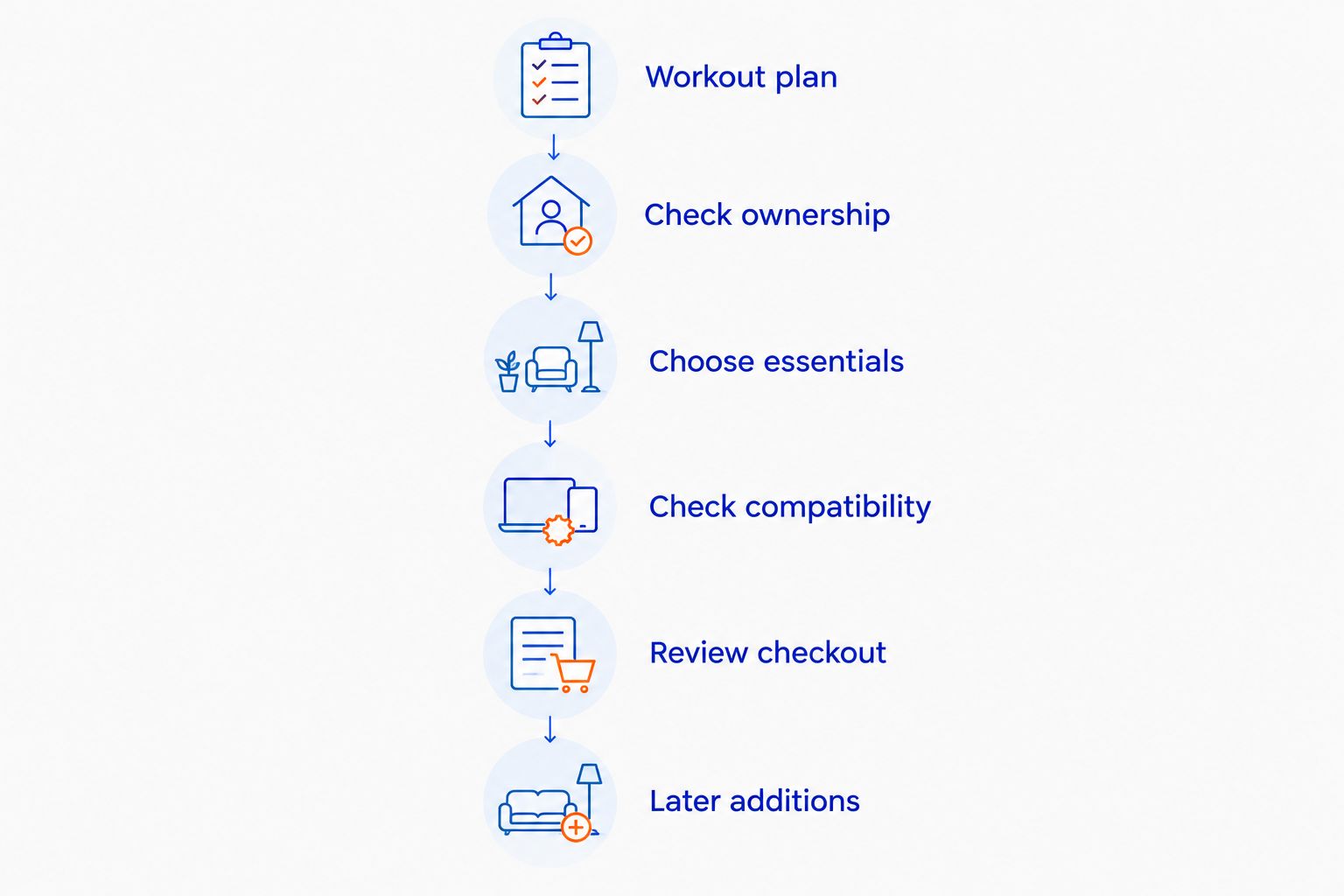
- Write your workout plan. List the movements you want to perform before choosing equipment.
- Check what you own. Identify usable equipment and suitable space already available at home.
- Choose the essentials. Assign every proposed purchase to an exercise or a genuine setup requirement.
- Check compatibility. Read the equipment instructions and verify the space, supporting surfaces, and accessories it needs.
- Review checkout. Record the current equipment subtotal and any additional charges before paying.
- Separate later additions. Keep optional purchases outside the initial setup total.
This produces a budget tied to a real routine. It also makes competing shopping lists easier to compare: you can see whether one includes necessary setup work while another shows equipment alone.
Bodyweight setup: start with the space you already have
Best for: people whose planned exercises primarily use body weight. Begin by checking whether your room lets you perform those movements comfortably, without moving around furniture or working beside fragile objects.
The advantage is a shopping list built around a small number of actual needs. The limitation is that bodyweight training does not provide an interchangeable substitute for every weighted exercise or machine-based movement.
Separate necessary exercise equipment from optional variety. An accessory that adds a new core exercise belongs in your plan only if you intend to use that exercise; it does not automatically solve the rest of your strength-training needs.
For this setup, inspect the floor surface, clear movement space, and storage first. Buy an accessory only after you can explain which movement it supports and where it will live between sessions.
Resistance-band setup: prioritize the exercises and attachment method
Best for: people who want resistance exercises with equipment they can put away between workouts. Resistance bands provide resistance through stretching, but the exercise possibilities depend on the band's design and how it is used.
The advantage is a setup that does not revolve around a permanent equipment station. The limitation is that bands are not interchangeable with free weights: the resistance changes as the band stretches, and some exercises require a suitable attachment method.
Check the instructions before assuming a doorway, furniture leg, or wall fixture is an appropriate anchor. Include any required compatible attachment in your shopping list, and inspect the equipment before use.
Do not buy several band types simply because each looks useful. Choose the design that supports your routine, then identify any exercise your selection does not cover.
Adjustable-weight setup: build around the movements you need
Best for: people whose routine includes free-weight strength exercises. Adjustable weights let you change the load used for an exercise, but their usefulness depends on the actual adjustment system, included components, and training range.
The advantage is the ability to organize training around loaded movements. The limitation is that weights still need safe handling, a suitable exercise area, and somewhere secure to rest between sets and sessions.
Check the actual product specifications before treating a set as suitable for every exercise you want to perform. A product name does not establish its weight range, dimensions, adjustment increments, or compatibility with other equipment.
For your 2026 shopping list, keep the core weights separate from optional expansion. A bench or another accessory should enter the budget because a planned exercise needs it, not because every home gym photograph includes one.
Which setup should you budget for first?
Compare the training role before comparing shopping totals. The following options are starting points, not complete workout prescriptions or interchangeable equipment packages.
| Option | Best for | Main advantage | Main limitation | Budget decision |
|---|---|---|---|---|
| Bodyweight space | A routine centered on bodyweight movements | Starts with your available room and planned exercises | Does not replace every loaded movement | Check the space before buying accessories |
| Pull Rope Resistance Bands | Shoppers considering resistance-band exercises | A resistance-band option to assess against your routine | Suitability depends on the design and instructions | Verify supported exercises and any attachment needs |
| Adjustable Dumbbell & Barbell Set | Shoppers considering adjustable free weights | An adjustable-weight option to assess for strength training | Specifications determine the usable training range | Check included components, adjustment details, and storage |
Beferra's home fitness equipment belongs in the comparison when its stated specifications match your planned exercises. Do not assume a product covers an entire routine just because its name describes a familiar equipment category.
Choose the setup that covers your priority movements with the fewest unnecessary purchases. A smaller list with clear training roles is easier to evaluate than a bundle of overlapping accessories.
Why home gym setup costs vary
Your 2026 budget changes when the training brief changes. These are the main decisions to resolve before comparing totals:
- Training goals. Bodyweight practice, resistance-band exercises, and free-weight training require different shopping lists.
- Equipment already owned. A usable item you already have does not need to appear as a new purchase.
- Exercise coverage. A main training tool and a specialized accessory serve different roles; compare the movements each enables.
- Room requirements. Your chosen equipment determines the movement clearance, floor protection, and storage you need to assess.
- Installation needs. Equipment that requires an anchor or mounting point needs a suitable installation, not an improvised substitute.
- Optional additions. Recovery tools, extra clothing, and exercise variety belong outside the essentials unless your plan specifically requires them.
The useful comparison is not simply one cart against another. It is whether each cart delivers the training setup you intend to use, with its necessary supporting items included.
How do you check whether your room is suitable?
Assess the equipment both in use and in storage. A corner that holds a set of weights is not automatically large enough for the movements you plan to perform beside it.
Rehearse your planned movements without added load, using the equipment instructions to guide the space assessment. Check overhead clearance, nearby furniture, doors, and the route you use to enter or leave the room. Do not use a trial movement to override an installation requirement or safety warning.
For floor protection, distinguish a surface intended for floor exercises from one intended to support equipment. Do not assume a yoga mat protects flooring from every kind of load or impact.
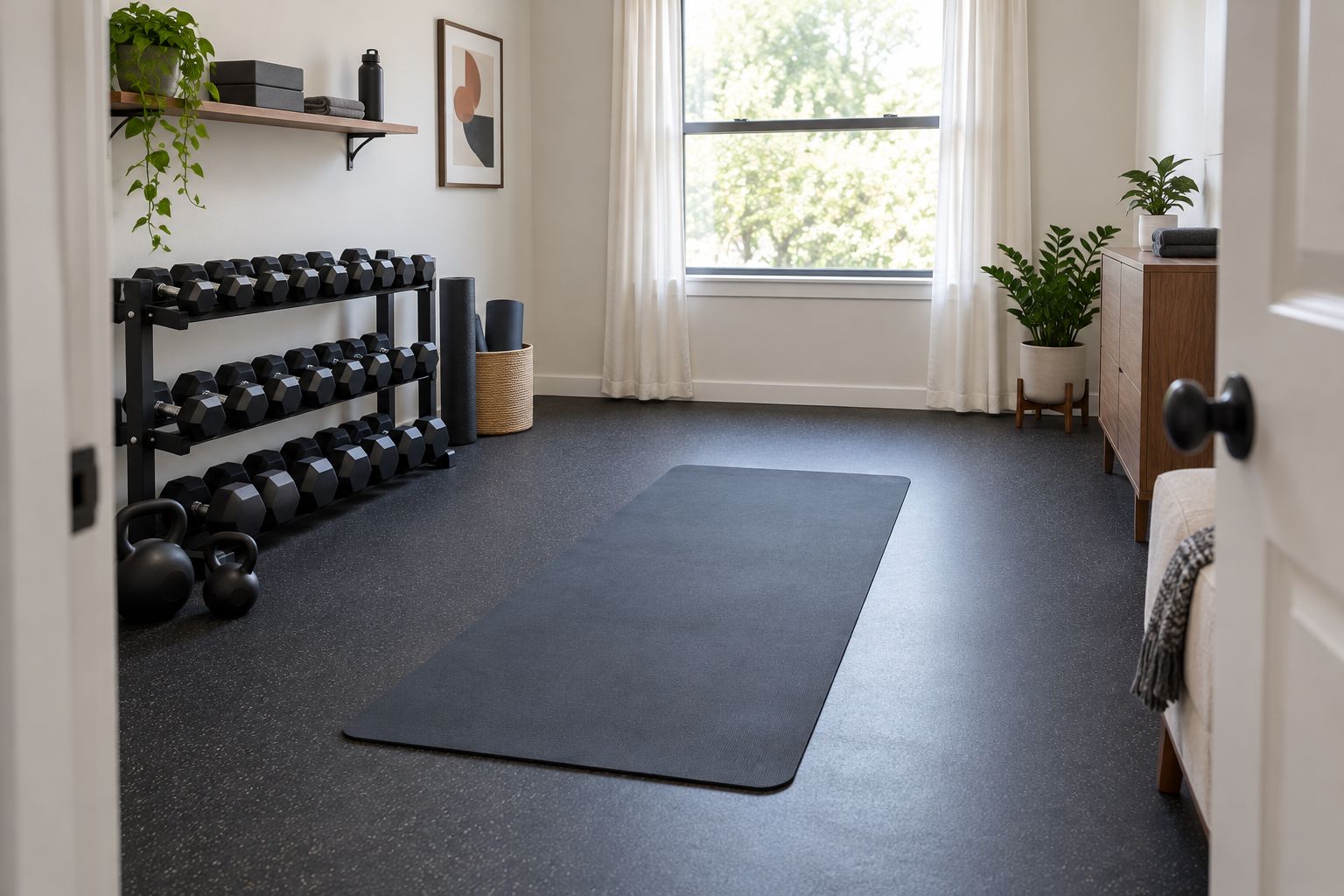
A suitable room should support the setup without making every session a furniture-moving task. If the proposed equipment creates that problem, reconsider the equipment list before adding storage purchases to compensate.
What should you buy first for a home gym?
Buy the equipment needed for your priority exercises first. If your routine centers on free weights, evaluate the weights before adding specialized accessories; if it centers on bodyweight movements, resolve the exercise space first.
Apply the same test to every item: which planned exercise requires it? An unclear answer is a reason to leave the item off your initial shopping list.
What costs should you check beyond the equipment?
Check delivery, assembly or installation, floor protection, storage, and any required accessories. These are separate from the main equipment subtotal, and you should include only the ones your setup actually requires.
For a 2026 purchase, verify the current checkout details and product instructions rather than carrying an old shopping estimate into a new order. Keep optional ongoing services separate so they do not disappear inside the initial equipment budget.
Can a small-space home gym support strength training?
A small-space home gym can support strength training when the equipment, exercise selection, and clear movement area fit the room. Adjustable weights, resistance bands, and bodyweight movements are different approaches, not guarantees that every routine fits every space.
Check the requirements of your specific setup. Storage convenience does not remove the need for safe movement clearance or appropriate installation.
FAQ
How much does a home gym setup cost in 2026?
Your home gym setup cost in 2026 is the total of selected equipment and the additional items or services needed to use it at home. Include applicable delivery, assembly, installation, floor protection, and storage when reviewing your budget.
What's the best home gym setup for a beginner?
The best beginner setup supports a clear, manageable workout plan without unnecessary accessories. Choose equipment for the exercises you intend to perform and check its instructions before buying.
Are resistance bands better than adjustable dumbbells?
Resistance bands and adjustable dumbbells suit different exercise needs; neither is universally better. Bands provide changing resistance as they stretch, while adjustable dumbbells provide selectable free-weight loads.
Do I need a weight bench to start a home gym?
You need a weight bench only when your planned exercises require one. Do not add a bench automatically, and do not improvise a substitute for equipment an exercise requires.
Should I buy a home gym bundle or choose separate items?
Choose the option whose included equipment matches your workout plan. Compare the actual contents and necessary supporting items rather than assuming a bundle is complete or better value.
Does home gym equipment need special flooring?
Flooring needs depend on the equipment, existing surface, and intended activity. Check equipment guidance and floor compatibility rather than assuming an exercise mat provides suitable protection for every setup.
What does Beferra sell for home workouts?
Beferra sells everyday home fitness equipment, including resistance-band and adjustable-weight options. Check each product's current specifications and instructions against your intended exercises before deciding.
One last thing
Before approving your home gym budget, write the exercise served by each proposed purchase beside its name. Then write where that item will be stored.
An item without a clear training role or a workable storage location is not ready for your shopping list. This check turns a collection of appealing equipment into a setup built for daily use.