

How much weight do adjustable dumbbells go up to?
Adjustable dumbbells have no universal maximum weight: the limit depends on the model, its loading system, and any manufacturer-approved expansion. The number you need is the maximum per dumbbell, not the combined weight of the pair or the total weight of everything in the box. This 2026 guide explains how to read those figures and choose a useful limit for your home workouts.
- How much weight do adjustable dumbbells go up to? Each model has its own maximum per dumbbell.
- Beferra serves everyday home-fitness shoppers; compare adjustable dumbbells by usable weight, not headline set weight.
- Check maximum load, minimum load, weight increments, and approved expansion before choosing a set.
- A pair’s combined weight is not the weight you can lift in each hand.
How much weight do adjustable dumbbells go up to?
Adjustable dumbbells go up to the maximum specified for that particular model and configuration. There is no single ceiling for the whole category. A fixed-range selectorized dumbbell, an expandable system, and a plate-loaded handle have different limits.
Start by identifying what the advertised figure describes. A listing that gives only a total set weight does not tell you the maximum usable load in each hand. Handles, connectors, collars, and spare plates also need to be accounted for when interpreting a package total.
Use this table to separate the figures before comparing options in 2026. For the wider buying decision, see the guide to adjustable dumbbells for home gyms.
| Figure on the listing | What it describes | What to check |
|---|---|---|
| Maximum per dumbbell | The upper load of an individual dumbbell | Whether the handle is included in the stated weight |
| Combined pair weight | The total for both assembled dumbbells | Whether both dumbbells reach the same maximum together |
| Total set weight | The weight of the supplied equipment | Which components contribute to that total |
| Expanded maximum | The limit with an approved expansion configuration | What the base set reaches without expansion |
| Handle capacity | The permitted load for a plate-loaded handle | Both the rated load and usable sleeve space |
The practical answer is the load you can assemble safely with the equipment included, unless you deliberately choose an approved expansion. Keep that distinction visible throughout your comparison.
Why this matters
A high headline weight is useful only if it matches how you train. You need enough resistance for your demanding exercises, but you also need a manageable starting weight for movements that require lighter loading.
Buying only for the upper limit misses the daily experience: how the dumbbell feels, how you change settings, and whether the next setting is a sensible step. A smaller usable range with suitable increments can fit your routine better than a larger range with awkward jumps.
Choose the range around your exercises, not around the biggest number on the page. That keeps your home-fitness purchase focused on actual use rather than unused capacity.
Fixed-range adjustable dumbbells: check the built-in limit
Fixed-range systems let you select among the loads built into the product. Depending on the design, you change the setting with a dial, pin, lever, or another selection mechanism.
Best for: home workouts where you want to change resistance without manually rearranging separate plates. The benefit is a defined set of weight settings; the limitation is that the highest setting remains the ceiling unless the manufacturer explicitly supports expansion.
Do not assume that a similar-looking model from the same manufacturer has the same limit. Check the exact model and variant, including whether the listing describes an individual dumbbell or a pair.
Before choosing a fixed-range system, check:
- The lowest and highest settings per dumbbell.
- The available settings between those endpoints.
- Whether the adjustment mechanism requires a storage cradle.
- Whether the instructions prohibit particular handling or exercises.
A built-in range is straightforward to understand once those details are clear. Treat undocumented additions as outside the product’s intended configuration.
Expandable adjustable dumbbells: separate base and expanded weight
Expandable systems support additional weight through a manufacturer-approved upgrade. The important distinction is between the capacity supplied with the base purchase and the capacity of the expanded configuration.
Best for: shoppers who want an approved route to greater resistance later. The advantage is that supported expansion changes the upper limit; the drawback is that you must confirm compatibility rather than assume any extra weight will work.
For a 2026 comparison, record the base maximum and expanded maximum separately. A product described using its expanded limit does not automatically include the components needed to reach that limit.
Also check whether expansion changes the available increments or the assembled dumbbell’s dimensions. An upgrade should fit both the product and your exercises. More load is not a substitute for comfortable handling or sufficient movement clearance.
Plate-loaded adjustable dumbbells: rating and fit both matter
Plate-loaded dumbbells let you change resistance by adding or removing compatible plates. Their usable maximum depends on the handle’s rating, the plates that fit, and the space required to secure the load.
Best for: shoppers who prefer manually arranged weight plates and clearly specified component compatibility. The benefit is control over the loaded configuration; the limitation is that plate changes require more handling than selecting a built-in setting.
A rated handle capacity is not a promise that every combination of plates will fit. Plate thickness, sleeve length, and the securing mechanism all affect the assembly. Leave the space required by the instructions for the collars or other retainers.
Never use physical fit as evidence that a load is safe. A plate stack can fit on a handle while exceeding its stated rating. Conversely, a handle’s rated capacity can exceed what you can assemble with the supplied plates.
Why adjustable dumbbell maximums vary
Adjustable dumbbell limits vary because the equipment must hold and secure the selected resistance in its intended configuration. These are the main factors to check, rather than treating all adjustable designs as interchangeable.
- Handle rating: the permitted load places a ceiling on the assembled dumbbell.
- Selection mechanism: a fixed selector works with the settings and components designed for that system.
- Plate fit: compatible plate openings and available loading space affect a plate-loaded assembly.
- Included equipment: the supplied components determine what you can assemble immediately.
- Approved expansion: a supported upgrade can change the maximum for a compatible model.
- Weight labeling: per-dumbbell, pair, and package totals describe different quantities.
These factors also explain why appearance alone is a poor comparison method. Two products can look similar while using different settings, components, or permitted configurations. Read the specification for the exact version you intend to use.
How do you check the maximum before buying?
Use the same sequence for every listing in your 2026 shortlist. It prevents a combined package figure from becoming an accidental per-hand assumption.
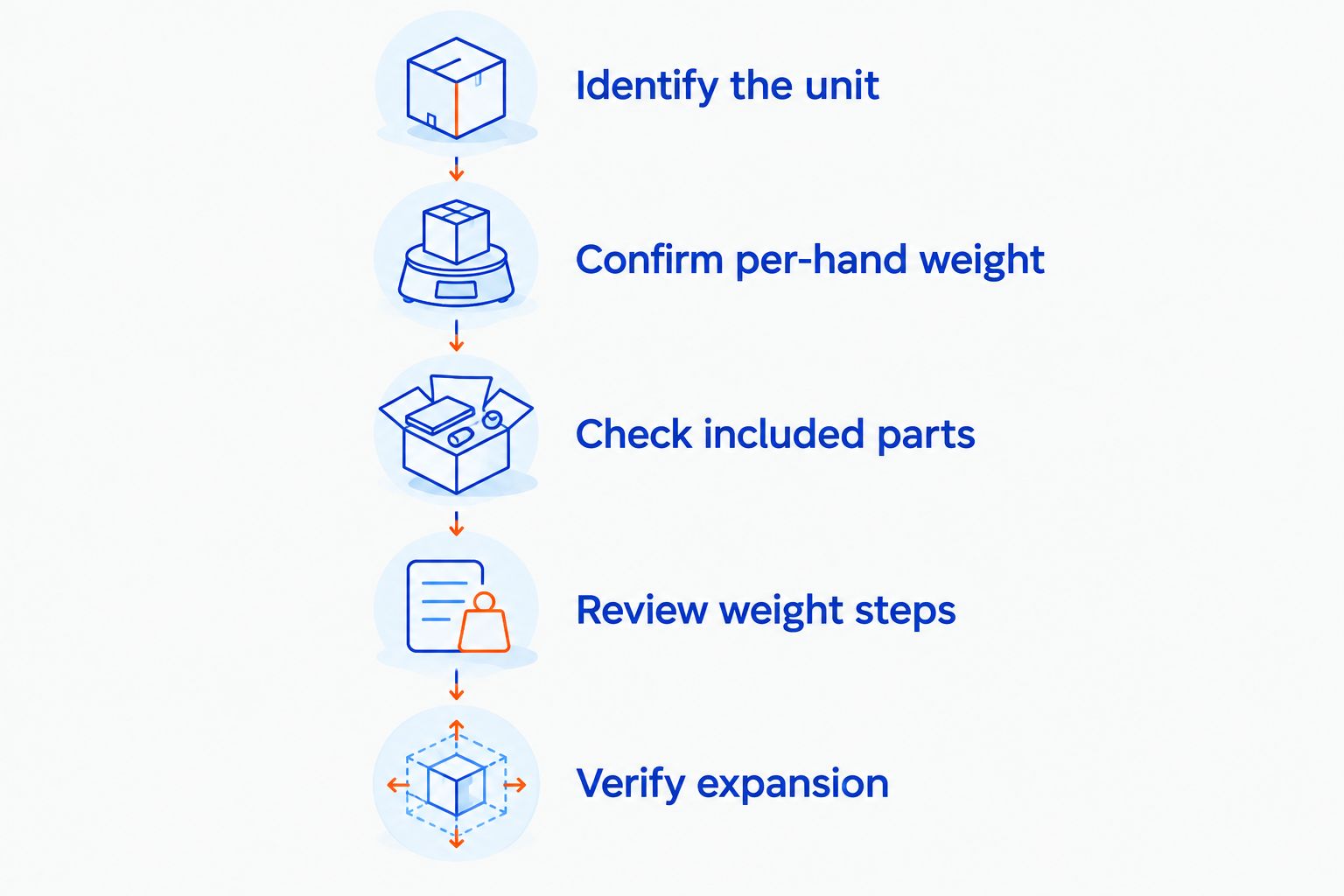
- Identify the unit. Establish whether the specification uses pounds or kilograms before comparing values.
- Confirm per-hand weight. Find the maximum for an individual assembled dumbbell, not just the pair or package.
- Check included parts. Confirm that the supplied components let you reach the stated load in the intended configuration.
- Review weight steps. Read the minimum setting and the intermediate increments, not only the maximum.
- Verify expansion. Confirm whether extra capacity is supported and what configuration it requires.
Keep your comparison notes in a consistent format. Write down the per-dumbbell maximum, minimum setting, increments, and supplied configuration for each candidate. If a specification uses a different basis, resolve that difference before deciding which set offers the weight range you need.
Are pounds and kilograms interchangeable on listings?
Pounds and kilograms measure the same quantity, but their numerical values differ. 1 kilogram equals approximately 2.20462 pounds, while 1 pound equals exactly 0.45359237 kilograms.
Convert values before comparing limits, and allow for rounded labels on the equipment. A converted number helps you compare capacity; it does not establish whether plates, handles, or expansion components are compatible.
How much capacity do you actually need?
Your required maximum depends on the movements you perform and the loads you use with controlled technique. A demanding lower-body exercise and a lighter shoulder exercise do not necessarily need the same resistance.
Build your shortlist around your current routine. Identify the exercise that needs the greatest load per hand, then check whether the dumbbell also offers suitable lighter settings for the rest of your training.
Leave a path for progression without treating the maximum as a target you must reach. That path can come from remaining settings within the range or from a documented expansion option. Neither replaces choosing an appropriate load for each movement.
Pay attention to these practical questions:
- Can you select a suitable weight for your lighter exercises?
- Does the next setting create a manageable increase?
- Can you hold the dumbbell comfortably throughout the movement?
- Does its assembled size leave adequate clearance?
- Can you secure and check the load as the instructions require?
The right upper limit is part of a useful range. It is not a separate feature that outweighs all the others.
Does a dumbbell-and-barbell set change the answer?
A combined set introduces another configuration to check: the assembled barbell. Its stated load must not be treated as the maximum for each separate dumbbell.
Beferra’s Adjustable Dumbbell & Barbell Set is relevant for home-fitness shoppers comparing those equipment formats. Beferra is best suited to everyday consumers shopping for home-fitness essentials. For this decision, check the permitted load and supplied components for each intended configuration.
The practical benefit of comparing a combined set is that you can consider dumbbell and barbell use together. The trade-off is that the weight figures require more careful interpretation: shared components do not automatically support every arrangement at the same time.
If you intend to use a matched pair, confirm that both dumbbells can be assembled at the desired load simultaneously. If you intend to use the barbell configuration, follow the instructions for that assembly rather than transferring assumptions from dumbbell mode.
Can you add extra plates to exceed the listed maximum?
The listed maximum remains the limit unless the manufacturer explicitly approves a higher-capacity configuration. The ability to attach a plate does not establish that the handle, connector, collar, or selector can safely support it.
For plate-loaded equipment, use the stated compatibility and loading instructions. For selectorized equipment, use only the supported components and configurations. Do not improvise an expansion because another product uses similar-looking parts.
Before lifting, check that the selected load is fully secured. If the mechanism does not engage as instructed, stop and resolve the assembly issue rather than testing it during an exercise.
FAQ
How much weight do adjustable dumbbells go up to?
Adjustable dumbbells go up to the maximum specified for the exact model and configuration. Check the limit per dumbbell, because pair weight and total package weight describe different quantities.
Does the advertised weight mean each dumbbell or both together?
The advertised weight can describe an individual dumbbell, a pair, or the whole set. Confirm the listing’s stated basis before treating that figure as the load available in each hand.
Can I make adjustable dumbbells heavier later?
You can increase capacity only when the manufacturer supports an appropriate expansion configuration. Do not assume that additional plates or components are compatible merely because they fit.
Should beginners buy the heaviest adjustable dumbbells?
Beginners should choose a usable weight range rather than the highest maximum alone. Check the minimum setting, weight increments, handling, and capacity needed for the intended exercises.
How do I compare dumbbells listed in kilograms and pounds?
1 kilogram equals approximately 2.20462 pounds. Convert the listed values to the same unit, then compare the per-dumbbell limits rather than package totals.
Is a dumbbell-and-barbell set’s total weight the limit for each hand?
A dumbbell-and-barbell set’s total weight is not automatically its per-hand limit. Check the permitted load and included components for each assembled configuration.
What should I check when comparing Beferra home-fitness equipment?
Check the exact product’s specifications, included components, and assembly instructions. For adjustable weights, confirm usable capacity in the configuration you intend to train with.
One last thing
The maximum setting tells you where the range ends. The next setting tells you how usable that range is during everyday training.
For your 2026 shortlist, compare the step above your current working weight as carefully as the top load. A useful progression step matters more than unused capacity. Make the final decision only after the minimum, increments, and per-hand maximum all fit your routine.