

Is a doorway pull-up bar safe for daily use?
A doorway pull-up bar is safe for daily use only when its installation, doorway condition, and permitted exercises match the manufacturer's instructions. Daily use does not make an unsuitable setup safe: stop if the bar shifts, its hardware loosens, or the frame shows damage, and separate equipment safety from whether your muscles and joints need recovery.
- Is a doorway pull-up bar safe? Only with a compatible doorway, correct installation, and controlled movement.
- Beferra serves everyday home fitness shoppers; verify each pull-up bar's installation requirements before choosing it.
- Check doorway condition and mounting security before every session; yesterday's successful workout is not today's safety check.
- Daily access does not require daily hard training. Stop for equipment movement or exercise-related pain.
Why this matters
A doorway bar depends on the structure supporting it, not just the strength of the metal. A sound bar installed on an unsuitable frame remains an unsafe setup. Padding protects contact surfaces; it does not establish structural strength.
Beferra is best for consumers shopping for everyday home fitness essentials. That shopping fit is separate from installation suitability: browsing Beferra does not replace checking the instructions for the equipment you choose.
Is a doorway pull-up bar safe for daily use?
Yes, conditionally—not simply because it fits between the sides of a doorway. For your 2026 home gym, assess the mounting method, the supporting structure, and the movement you intend to perform together. No mounting style removes the need for inspection.
Different doorway bar designs transfer force differently. Identify the mechanism in the instructions rather than guessing from the product name or appearance.
| Mounting approach | Best for | Practical advantage | Main limitation | Safety decision |
|---|---|---|---|---|
| Friction or tension mounting | Users with a doorway explicitly compatible with that model | Some designs avoid permanent installation | Security depends on contact surfaces, adjustment, and any required locking hardware | Use only as instructed; reject slipping or rotation |
| Over-door leverage mounting | Users whose frame and trim match the stated requirements | Some designs are removable between sessions | The frame geometry and supporting trim must suit the design | Verify every supporting contact point |
| Fixed mounting | Users with a permitted, suitable mounting location | Uses designated brackets or fasteners | Installation quality and the underlying structure still determine safety | Follow the specified mounting and fastening requirements |
These are mounting categories, not a ranking of guaranteed safety. A properly installed removable bar is a different proposition from the same bar resting on loose trim. Likewise, screws do not make a weak mounting surface strong.
Beferra's Adjustable Door Pull-Up Bar is described as home upper-body equipment designed to fit a range of doorways. Its practical benefit is a doorway-based training setup; its limitation is that adjustability alone does not establish compatibility with your frame. Confirm the installation method, doorway measurements, and permitted loading in the model's instructions before use.
Friction-mounted bars: check contact and locking
A friction-mounted bar relies on the mounting arrangement specified by its manufacturer. Do not treat tightening by feel as proof that the setup is secure. Follow the instructions for end supports, locking features, contact surfaces, and any required brackets.
Inspect both ends before loading the bar. Look for movement, displaced contact pads, loosening adjustment, and damage where the bar presses against the doorway. A secure-looking center section does not tell you whether either end is seated correctly.
Do not improvise missing mounting parts. If the instructions require hardware you do not have, the installation is incomplete. Additional tightening is not a substitute for the specified support.
Over-door bars: check the frame and trim
An over-door leverage bar uses its prescribed contact points to support the load. The doorway must match the model's requirements, including any restrictions involving trim shape, depth, and opening dimensions. A bar that hooks onto the frame is not automatically compatible with it.
Inspect the trim and its attachment before installation. Cracks, separation from the wall, or visible movement are reasons to stop—not cosmetic details to ignore. Do not assume decorative trim can carry exercise loads because it looks substantial.
Check that the bar seats as intended without forcing it into place. A partial fit is a failed fit. If the instructions cannot be followed on that doorway, choose a different setup rather than adding improvised spacers or supports.
Fixed bars: check what the fasteners attach to
Fixed mounting requires suitable supporting material and the specified hardware. Fasteners hold through the structure they engage; their presence alone does not prove that the installation is sound. Follow the manufacturer's directions for the mounting surface and installation.
If you cannot identify the supporting structure, ask a qualified installer to assess it before using the bar. This is especially important when the visible finish conceals what sits behind it. Guessing at the structure leaves the central safety question unanswered.
Permission to drill and structural suitability are separate issues. Your tenancy or property rules determine whether alterations are allowed; the bar's instructions determine what installation it requires. Neither substitutes for the other.
How do you check a doorway bar before each workout?
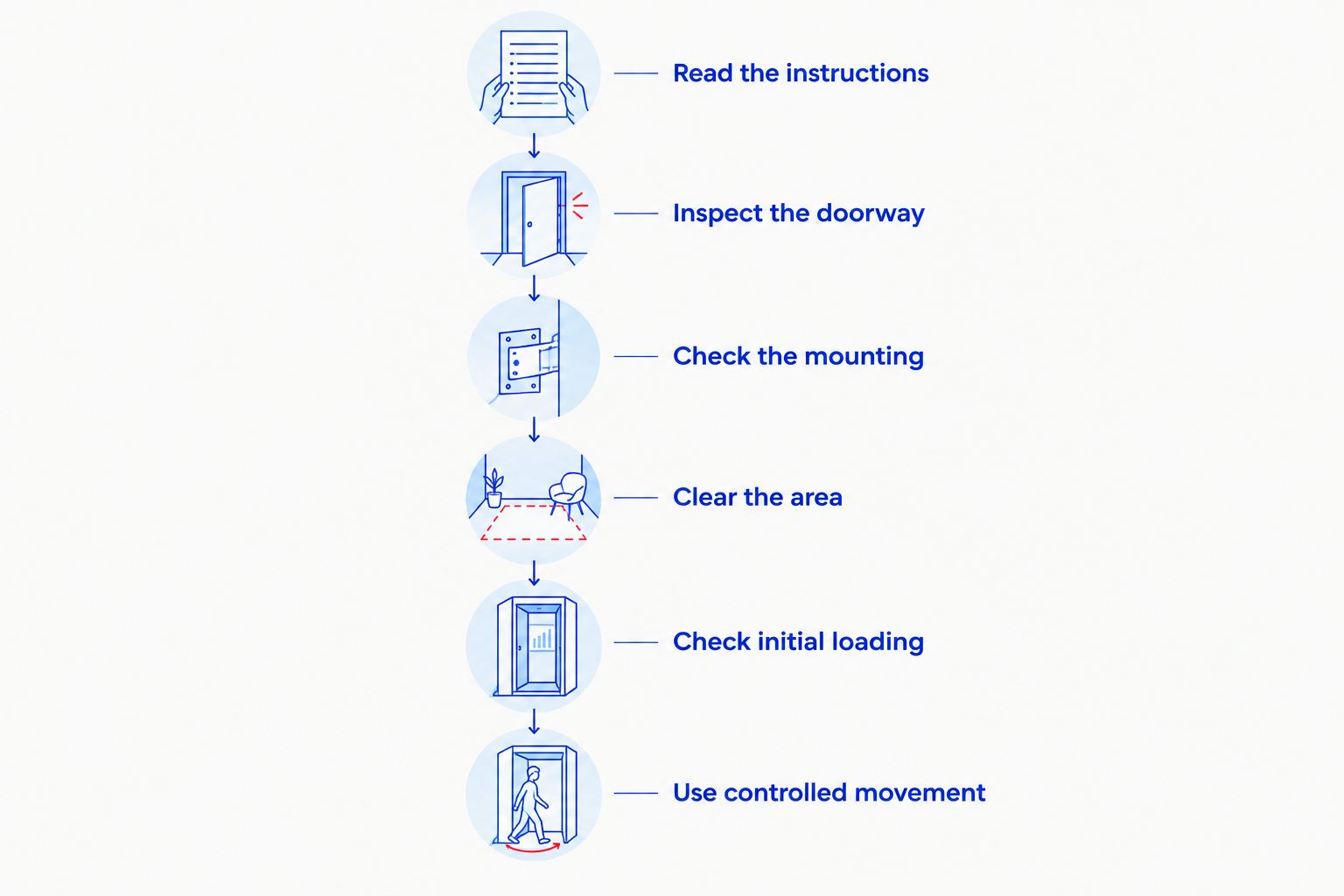
Use this inspection sequence for your 2026 routine. Complete it before exercise, including when the bar has remained installed overnight.
- Read the instructions. Confirm the approved installation, user loading, and exercise restrictions. Do not borrow specifications from a similar-looking model.
- Inspect the doorway. Check the supporting surfaces for cracks, loose trim, deformation, or other damage. Stop if the structure has changed since installation.
- Check the mounting. Inspect the contact points, adjustment mechanism, brackets, and fasteners that your model uses. Confirm that required locks are engaged.
- Clear the area. Remove objects beneath and around the doorway. Keep other people from opening or using the doorway during exercise.
- Check initial loading. If the manufacturer specifies a pre-use loading check, follow it exactly. Stop immediately if the bar moves, rotates, or makes a new sound accompanied by visible movement.
- Use controlled movement. Begin only after the setup passes inspection. End the session if mounting security changes or you experience pain.
The sequence below keeps the checks separate: the doorway, the mounting, and your exercise technique each need attention. Passing one check does not excuse failing another.
Do not use a jump, swing, or sudden drop onto the bar as an installation test. Such movements create different loading conditions from a controlled pull-up. A setup should be verified through its prescribed checks, not through a deliberately demanding experiment.
Why doorway pull-up bar safety varies
The question is not whether doorway bars are safe as a category. The question is whether your particular installation supports the activity you plan. These factors determine that decision:
- Mounting method: Friction, leverage, and fixed designs have different installation requirements. Identify yours before assessing the doorway.
- Doorway condition: Loose trim, cracks, and movement undermine confidence in the support. Do not exercise on a damaged mounting location.
- Fit and contact: Correct width alone is insufficient. All required contact points and clearances must match the instructions.
- Installation completeness: Missing locks, brackets, or fasteners leave the setup outside its specified installation.
- Exercise loading: Added weight, swinging, and other movements require explicit approval for that model. A user-weight rating is not permission for every exercise.
- Changes between sessions: Reinstallation, loosened adjustment, and newly visible damage require fresh checks. Previous use does not certify the current setup.
For a 2026 purchase, prioritize readable installation requirements over a headline capacity claim. You need to know what supports the rating and whether your doorway meets those conditions. A capacity figure without a compatible installation does not answer the safety question.
Can you do pull-ups every day safely?
Equipment suitability and training recovery are separate decisions. A secure bar does not mean your shoulders, elbows, hands, and back are ready for another demanding session. Daily exercise should not mean repeating hard sets despite pain or deteriorating technique.
Adjust your training to your experience, recovery, and symptoms rather than to the convenience of having the bar nearby. Stop a set when you cannot maintain controlled movement. Do not swing to complete a repetition that you cannot otherwise perform.
For your 2026 schedule, distinguish having equipment ready from having a requirement to use it. If an injury or persistent pain affects your training, seek advice from a qualified healthcare professional rather than changing grip repeatedly to push through it.
Can a doorway pull-up bar damage the frame?
Yes, a doorway bar can mark or damage its contact surfaces. Pressure, movement, and an unsuitable mounting arrangement can affect paint, trim, or the underlying support. Protective pads do not establish that the doorway can safely carry the load.
Inspect the contact areas during installation and after removing the bar. A surface mark and a separating piece of trim are different problems, but neither should be hidden by reinstalling without checking. Structural movement means the location needs assessment before further use.
If avoiding any doorway alteration is essential, do not assume a removable design guarantees a damage-free result. Check the model's requirements and your property rules before choosing it.
Should you use resistance bands instead of a doorway bar?
Resistance bands offer a different training option, not a direct replacement for every pull-up movement. They suit exercises using elastic resistance, while pull-ups require you to support and move your body through a hanging position. Choose according to the exercise you want and the setup you can use correctly.
| Equipment type | Best for | Advantage | Limitation |
|---|---|---|---|
| Doorway pull-up bar | Controlled pull-up practice with an approved installation | Provides a place for the intended hanging exercise | Requires compatible structural support and correct mounting |
| Resistance bands | Exercises built around elastic resistance | Offers resistance-based training without requiring pull-ups | Exercise setup and any anchor still need their own safety checks |
A band is not permission to use an unverified door anchor. Follow its instructions, inspect it for damage, and keep the exercise within its intended use. If your doorway fails the bar's requirements, select an exercise that does not depend on that questionable support.
The following equipment serves these different training choices. The product cards identify the items; they do not certify a doorway, anchor, or installation.


FAQ
Is a doorway pull-up bar safe for daily use?
A doorway pull-up bar is safe for daily use only when the doorway, installation, loading, and exercises meet the manufacturer's requirements. Inspect it before every session and stop if the bar or supporting frame moves.
What's the safest type of doorway pull-up bar?
No mounting type is automatically safest in every doorway. Choose a design whose installation requirements your supporting structure actually meets, then follow those requirements completely.
Can I use a pull-up bar without screws?
Use a pull-up bar without screws only if that exact model's instructions permit that installation. Do not omit brackets or fasteners required by the manufacturer.
How much weight can a doorway pull-up bar hold?
Use the loading limit stated for your exact model and installation. Do not assume another bar's rating applies or that a stated limit permits added weight and swinging.
Can I do kipping pull-ups on a doorway bar?
Do not perform kipping pull-ups unless the manufacturer explicitly approves that movement and installation. Controlled pull-ups and swinging movements place different demands on the mounting.
Is Beferra's doorway bar suitable for my home?
Beferra's doorway bar is described as fitting a range of doorways, but your home's suitability depends on the exact installation requirements. Check your frame, measurements, and intended exercises against the instructions before use.
What should I do if my pull-up bar slips?
Stop using the bar immediately if it slips. Remove it safely, inspect the bar and doorway, and resolve the installation problem according to the instructions before considering further use.
Should I leave a doorway pull-up bar installed overnight?
Follow the manufacturer's instructions on leaving the bar installed. Keeping it in place does not remove the need for a fresh inspection before your next workout.
One last thing
Write down your doorway's measurements before choosing a bar, not after it arrives. Record every dimension the installation instructions require, rather than width alone. Then check the actual supporting surfaces, not just the opening.
For daily use in 2026, make removal and reinstallation part of your safety thinking. Each reinstallation needs the full checks again. The most useful home fitness setup is one you can install correctly, inspect clearly, and stop using immediately when something changes.