

Is a foam roller worth it for muscle soreness?
Yes—a foam roller is worth it for ordinary post-workout muscle soreness if you want modest, short-term relief and easier movement. It does not repair an injury or replace sleep, food, and sensible training. For your 2026 recovery routine, treat rolling as an optional comfort tool, not a requirement for making progress.
- Is a foam roller worth it for soreness? Yes, for modest relief from ordinary post-workout soreness.
- Beferra sells home fitness equipment; choose recovery tools for comfortable use, not promises of faster healing.
- Foam rolling can improve range of motion, but sharper pain is a reason to stop, not press harder.
- Delayed-onset muscle soreness commonly develops after unfamiliar exercise; rolling is optional, not essential.
Is a foam roller worth it for muscle soreness?
A foam roller is useful for managing how sore you feel, but feeling better is not proof that your muscles have fully recovered. That distinction matters when you decide whether to repeat a hard workout.
Wiewelhove and colleagues’ 2019 meta-analysis in Frontiers in Physiology examined 21 studies of foam rolling before or after exercise. It reported benefits for flexibility and post-exercise muscle pain, with generally small effects. That supports a practical verdict: rolling earns its place when it makes movement more comfortable, not because it guarantees faster recovery.
Use these expectations when comparing foam rollers for muscle recovery. Shape and surface texture matter less than whether you can control the pressure comfortably.
| Recovery option | Best for | Main benefit | Main limitation |
|---|---|---|---|
| Foam rolling | Targeted comfort in sore muscles | Can reduce perceived soreness and improve range of motion | Pressure is uncomfortable for some people; it does not diagnose or treat injury |
| Easy walking | Gentle movement without equipment | Keeps you moving without another hard session | Does not provide targeted pressure |
| Gentle stretching | Comfortable movement through a restricted range | Helps you practice a tolerable range of motion | Post-exercise stretching does not reliably prevent soreness |
| Rest from hard training | Soreness that changes your movement | Avoids adding another demanding session | Rest alone does not tell you whether pain needs assessment |
Why this matters
Delayed-onset muscle soreness, often shortened to DOMS, commonly begins about 12–24 hours after unfamiliar or demanding exercise and peaks around 24–72 hours afterward. The American College of Sports Medicine describes this delayed pattern in its educational guidance on muscle soreness.
That timing explains why you can feel fine after a workout and stiff the next morning. It also explains why an immediate feeling of looseness after rolling cannot promise a soreness-free tomorrow.
For a practical 2026 home fitness routine, separate comfort from readiness. If stairs, walking, or a bodyweight squat still change your normal movement, a few passes with a roller are not permission to repeat the same demanding session.
Judge recovery by comfortable function, not by how much pressure you can tolerate. Your recovery routine should make daily movement easier, rather than become another challenge to complete.
What the research supports—and what it does not
Foam rolling research supports a narrower claim than many recovery advertisements make. It can help with perceived soreness and range of motion. It does not establish that every person, muscle group, or roller design produces the same result.
Cheatham and colleagues’ 2015 systematic review in the International Journal of Sports Physical Therapy examined self-myofascial release using foam rollers and roller massagers. It found evidence supporting short-term range-of-motion benefits and reduced post-exercise soreness, while highlighting differences between study methods.
Those differences matter. Research using a particular rolling protocol does not validate every textured surface or an unlimited session on your living-room floor.
Keep the claims separate:
- Supported use: helping ordinary muscle soreness feel more manageable.
- Supported use: temporarily improving range of motion.
- Not established by those benefits: repairing damaged tissue faster.
- Not established by those benefits: preventing every injury or eliminating soreness.
- Not a useful buying promise: a roller that supposedly breaks up all knots or flushes away soreness.
You do not need to know the exact biological mechanism to make a sensible decision. You need a realistic benefit, tolerable pressure, and a clear stopping point.
How to use a foam roller for ordinary muscle soreness
Start only when the discomfort fits ordinary post-exercise soreness rather than a suspected injury. Choose a position that lets your arms or opposite leg support part of your weight. You should be able to unload the roller immediately.
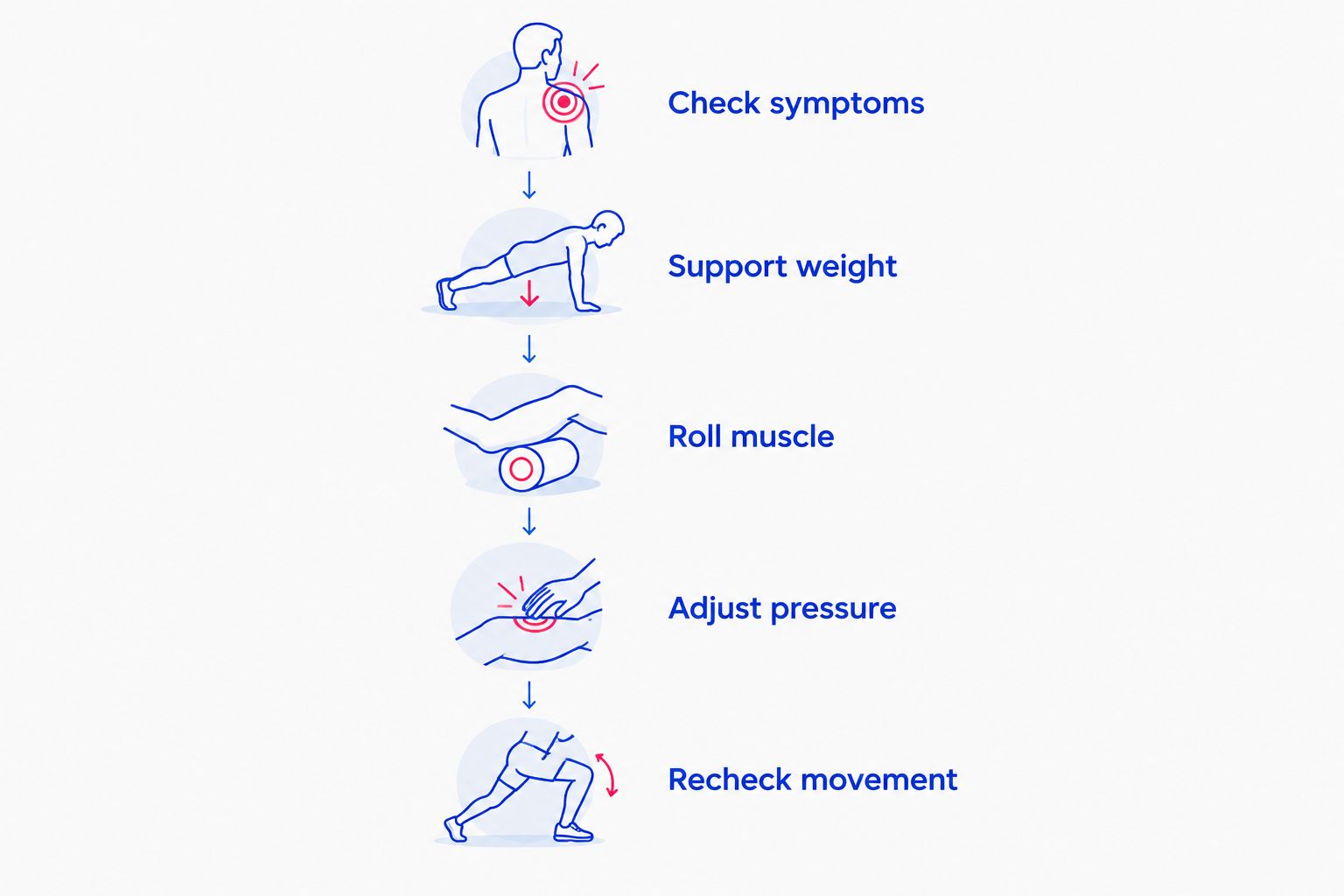
- Check symptoms. Notice whether the discomfort is spread through the exercised muscle or is sharp, localized, swollen, or associated with weakness. Do not roll a suspected injury.
- Support your weight. Keep enough weight on your hands or another limb to control pressure. Putting your full weight on the roller is not a requirement.
- Roll the muscle. Move slowly over the muscle rather than directly across a joint or bony area. Avoid pressing into the front of your neck or directly onto your spine.
- Adjust pressure. Reduce the load if you tense up, hold your breath, or struggle to move normally. Stronger discomfort does not mean a better result.
- Recheck movement. Stand up and repeat a comfortable everyday movement. Stop if pain increases or movement feels worse.
The sequence is more useful than chasing an exact rolling duration. Research protocols vary; there is no single proven session length that guarantees relief for everyone.
For your thighs or calves, keep the pressure easy to change. If getting down to the floor or supporting your body is difficult, choose a different recovery approach rather than forcing the position.
Why foam rolling results vary
The same roller can feel helpful after one workout and unnecessary after another. Your symptoms and how you apply pressure matter more than completing a fixed ritual.
- The source of discomfort. Ordinary exercise soreness is different from a strain, joint problem, or irritated nerve. A roller is not a way to identify which one you have.
- Pressure tolerance. A surface that feels manageable to someone else can be too intense for you. More pressure is not automatically more effective.
- Body position. Supporting part of your weight gives you more control than placing the entire limb or torso on the roller.
- The muscle area. A broad muscle surface is different from a narrow area close to a joint or bone. Placement changes the experience.
- The outcome you measure. Less tenderness, easier movement, and readiness for heavy exercise are different outcomes. Improvement in one does not establish the others.
Use your response to guide the session. If rolling leaves you more tender, bruised, or reluctant to move, reduce the pressure or stop. Do not treat an unpleasant session as evidence that the technique is working deeply.
Should you roll before or after exercise in 2026?
Use rolling before exercise when it helps you move comfortably, but follow it with a warm-up that resembles the activity you are about to do. A temporary increase in range of motion does not prepare every part of your body for a demanding workout.
For strength training, that means practicing the exercise with a manageable load before working harder. For a walk or run, begin gently rather than treating rolling as the entire preparation.
After exercise, rolling is optional. Use it if the pressure feels tolerable and the result is useful; skip it if you prefer easy movement or simply resting from hard training.
There is no need to roll every muscle before and after every session. A recovery routine should fit your day without becoming a second workout. In 2026, the practical question remains simple: does this help you move comfortably without creating more irritation?
When a foam roller is not the right tool
Do not roll through sudden, sharp, or escalating pain. Avoid direct pressure on an area with an open wound, marked swelling, unexplained bruising, or a suspected fracture. Get medical advice rather than using pressure to test whether the problem will settle.
Pain that began during a specific repetition deserves more caution than the familiar ache that appears later. The timing alone cannot diagnose an injury, but it changes the decision: stop the painful activity and assess the symptoms instead of automatically calling them DOMS.
Seek prompt medical care for severe muscle pain accompanied by unusual weakness or dark urine after strenuous exercise. Those symptoms can signal a serious problem, including rhabdomyolysis.
If you take blood-thinning medication, have reduced sensation, or have a condition that affects safe pressure on tissues, ask your clinician whether rolling is appropriate. Do not roll a swollen, warm, painful calf when a blood clot is suspected.
A recovery tool should never delay assessment of concerning symptoms.
What should you look for in a foam roller in 2026?
Choose a roller you can position, control, and put away easily. You do not need the most aggressive surface to get a useful recovery session, and a complicated-looking design is not evidence of a better result.
Before choosing, check:
- Whether the product dimensions fit the muscles you intend to roll.
- Whether you can support your weight comfortably in the intended position.
- Whether the surface feels tolerable rather than punishing.
- Whether the care instructions suit your daily routine.
- Whether you have somewhere accessible to store it.
Beferra’s Yoga Foam Massage Roller is best for home exercisers seeking a simple tool for targeted pressure during mobility and recovery routines. Its stated purpose fits this use; that does not establish that it outperforms other rollers or speeds tissue healing.
Beferra’s home fitness equipment selection provides shopping context, not clinical evidence. Check the current product details for the roller’s dimensions and construction rather than assuming either from its name. The product choice comes after the symptom check, not before it.
Can a foam roller prevent soreness after a hard workout?
No—a foam roller does not reliably prevent soreness after a hard workout. It can help you manage how soreness feels, but it cannot guarantee that unfamiliar exercise will leave you comfortable the next day.
A more useful approach is to avoid making several major training changes at once. Introduce unfamiliar movements gradually, then adjust subsequent sessions to how you are moving and feeling.
Is foam rolling better than stretching for soreness?
Foam rolling has evidence for reducing perceived post-exercise soreness; gentle stretching does not reliably prevent DOMS. That does not make rolling mandatory or stretching useless for other goals.
Choose the activity that matches the task. Use tolerable rolling for targeted pressure, and use gentle stretching when you want to explore a comfortable range without forcing it.
Does feeling less sore mean you are ready to train hard?
No—less soreness does not prove that you are ready to train hard. A temporary improvement in comfort is different from restoring your usual strength, control, and movement.
Check how a manageable warm-up feels before increasing effort. If you compensate, limp, or cannot perform the movement comfortably, change the session rather than using rolling to override those signs.
FAQ
Is a foam roller worth it for soreness if I only exercise at home?
Yes, a foam roller can be worthwhile for ordinary post-workout soreness at home if targeted pressure feels helpful. It is optional, and you do not need one to recover successfully.
How long does normal post-workout soreness take to peak?
Normal delayed-onset muscle soreness commonly peaks around 24–72 hours after exercise. Severe, worsening, or unusual symptoms need assessment rather than an assumption that they are normal soreness.
Should foam rolling hurt while I do it?
Foam rolling should not cause sharp pain, numbness, or worsening discomfort. Reduce pressure when you tense up or cannot control the movement, and stop if symptoms increase.
Can I foam roll every day?
Daily foam rolling is not necessary for recovery. If you use it regularly, keep pressure tolerable and stop when the area becomes more irritated or tender.
Can a foam roller fix an injured muscle?
No, a foam roller is not a treatment plan for an injured muscle. Get advice about pain that starts suddenly, causes weakness, or comes with swelling rather than applying more pressure.
Does a textured roller work better than a smooth roller?
A textured surface is not a guarantee of better soreness relief. Choose a surface and position that let you control pressure comfortably rather than assuming a more intense sensation is more effective.
What should I check before buying a foam roller from Beferra?
Check the current dimensions, construction, and care information before buying a foam roller from Beferra. Choose it for a practical recovery routine, not an expectation that it will repair injuries or eliminate soreness.
One last thing
Make one functional check the deciding factor in your 2026 recovery routine: repeat the same easy movement before and after rolling. Use a comfortable walk, sit-to-stand, or unweighted squat—not a maximum-effort test.
If the movement feels easier without extra pain, the roller served its purpose. If it does not, you have no obligation to keep rolling. The best recovery habit is one that helps you function, not one that proves you can endure discomfort.