

Is wearing compression leggings worth it for running?
Compression leggings are worth it for running if you prefer their close fit and they stay comfortable throughout your stride; they are not a dependable shortcut to faster race times. Their practical value is how they feel and function, while any recovery benefit is separate from performance during a run. For your 2026 running wardrobe, choose comfort first and treat performance claims as a reason to check the evidence, not a reason to buy.
- Are compression leggings worth it for running? Yes for comfortable support; not as a guaranteed performance upgrade.
- Running tights and compression leggings are not interchangeable: a snug fit alone does not establish measured compression.
- Beferra serves everyday activewear shoppers; check garment specifications before treating its leggings as running-compression equipment.
- Choose running shorts instead when leg coverage feels hot or restrictive.
Why this matters
Running clothes should remove distractions, not create another problem to manage. A waistband that slides, a seam that rubs, or fabric that restricts your knee bend matters more to your daily experience than an impressive-sounding compression label.
Use the compression leggings for women guide to organize your shortlist, then evaluate each garment's actual specifications. Buy for a problem you can name: comfortable coverage, a secure fit, or a preference for gentle pressure. Do not buy solely because a listing implies that tighter clothing makes you a better runner.
Is wearing compression leggings worth it for running?
Yes, when you enjoy the pressure and the garment works with your movement. No, when you expect the leggings alone to improve your pace, replace training, or prevent running injuries. The strongest everyday buying case is personal comfort rather than a promised physiological advantage.
Separate three questions before choosing: Does the garment feel good? Does it offer documented compression? Does research support the particular benefit being advertised? A positive answer to the first question does not establish either of the others.
| Option | Best for | Practical advantage | Limitation | Verdict |
|---|---|---|---|---|
| Compression leggings | Runners who prefer a close, supportive feel | Firm contact and full-leg coverage | Pressure can feel uncomfortable; performance claims need evidence | Choose if the fit works |
| Standard running tights | Runners who want coverage without prioritizing compression | Close-fitting coverage with less emphasis on pressure | A snug garment is not necessarily measured compression | Choose for coverage and comfort |
| Running shorts | Runners who prefer uncovered legs | Less fabric around the legs | Less coverage; seam and liner comfort still matter | Choose if tights feel restrictive |
This is a use-case comparison, not a ranking of medical effectiveness. No option is automatically the right choice for every runner. Your preferred garment should let you move naturally without repeated adjustments.
Compression leggings: best for runners who like firm contact
Compression leggings make sense when the sensation itself is useful to you. Some runners prefer fabric that stays close to the thighs and calves rather than moving loosely around the legs. That preference is a legitimate reason to choose a garment, even without a measurable pace improvement.
The trade-off is pressure. A fit that feels reassuring while standing can feel restrictive once you bend your knees, climb a hill, or become warm. Try the movement you actually need rather than judging the leggings only in a mirror.
Recommendation: choose compression leggings for comfortable contact, not for an assumed race-day advantage. If you spend the run pulling at the waistband or thinking about the squeeze, the garment has failed its practical job.
Standard running tights: best for coverage without chasing compression
Standard running tights are a sensible choice when your main goal is full-leg coverage. You do not need a compression claim to justify choosing fitted clothing. Fabric feel, waistband security, seam placement, and freedom of movement are all relevant on their own.
The limitation is terminology. Athletic leggings, running tights, and compression leggings are often presented together, but the names do not establish identical construction or pressure. Stretch fabric tells you the garment stretches; it does not tell you how much pressure it applies.
For a 2026 purchase, read the description literally. Choose standard running tights when coverage is the benefit you want, and do not assign them an unlisted recovery function.
Running shorts: best for runners who dislike full-leg coverage
Running shorts are the better option when fabric around your calves and knees feels unnecessary. They also let you avoid the particular discomfort of full-length tights in conditions where you prefer uncovered legs. You do not need to force yourself into compression because another runner enjoys it.
Shorts have their own fit problems. Liners, waistbands, and seams can still rub or shift, so less fabric does not automatically mean better comfort. Test the whole garment, not just its length.
Recommendation: choose running shorts when freedom from leg coverage matters more than the sensation of compression. A familiar, comfortable option is a stronger race-day choice than an untested garment with more ambitious claims.
Why the value of compression leggings varies
The value changes with the garment and the runner, not simply with the word compression on the label. Use these factors to separate a useful purchase from one that duplicates clothing you already enjoy:
- Pressure: Comfortable contact and uncomfortable squeezing are different experiences. More pressure is not automatically better.
- Fit: Your waist, hip, thigh, and calf fit all matter; a garment can fit well in one area and poorly in another.
- Coverage: Full-length leggings suit a preference for covered legs, while shorts suit a preference for less fabric.
- Movement: Knee bend, hip extension, and an ordinary running stride should remain comfortable.
- Purpose: Wearing a garment during a run and wearing it after exercise are separate uses with separate claims.
- Specifications: A product title does not establish pressure, graduated construction, or medical suitability.
Your 2026 decision should start with the first problem you want to solve. If that problem is an unstable waistband, evaluate waistband behavior. If it is discomfort after running, do not assume that any tight pair of leggings is a recovery treatment.
How do you know whether leggings provide real compression?
Look for a clear explanation of the intended compression, sizing method, and use. Pressure specifications, when supplied, are commonly expressed in millimeters of mercury, abbreviated mmHg. That unit describes pressure; it does not by itself prove that a garment will improve your running.
Also distinguish graduated compression from an ordinary stretch fit. Graduated compression describes a pressure pattern that changes along the limb. A listing that says supportive, sculpting, or snug does not establish that pattern.
Do not size down to manufacture compression. Follow the garment's sizing instructions, and check that the fit remains comfortable in motion. A smaller size changes the fit unpredictably; it is not a substitute for documented garment design.
How should you test compression leggings before a longer run?
Use a simple personal fit trial rather than a performance experiment. The timings below are a practical checklist, not a research-backed threshold or a promise that discomfort cannot appear later.
- Check the fit. Put the leggings on according to their sizing guidance. Check the waistband, crotch, knees, and ankles for bunching, pulling, or uncomfortable pressure.
- Walk comfortably. Start with 5 minutes of walking. Notice whether the waistband rolls, the seams rub, or the calves feel squeezed.
- Run easily. Follow with 10 minutes of easy running on a familiar route. Keep the effort comfortable so you can focus on the garment rather than your pace.
- Compare comfort. Across 2 comparable runs, wear the new leggings once and your usual running clothes once. Note adjustments, rubbing, warmth, and freedom of movement.
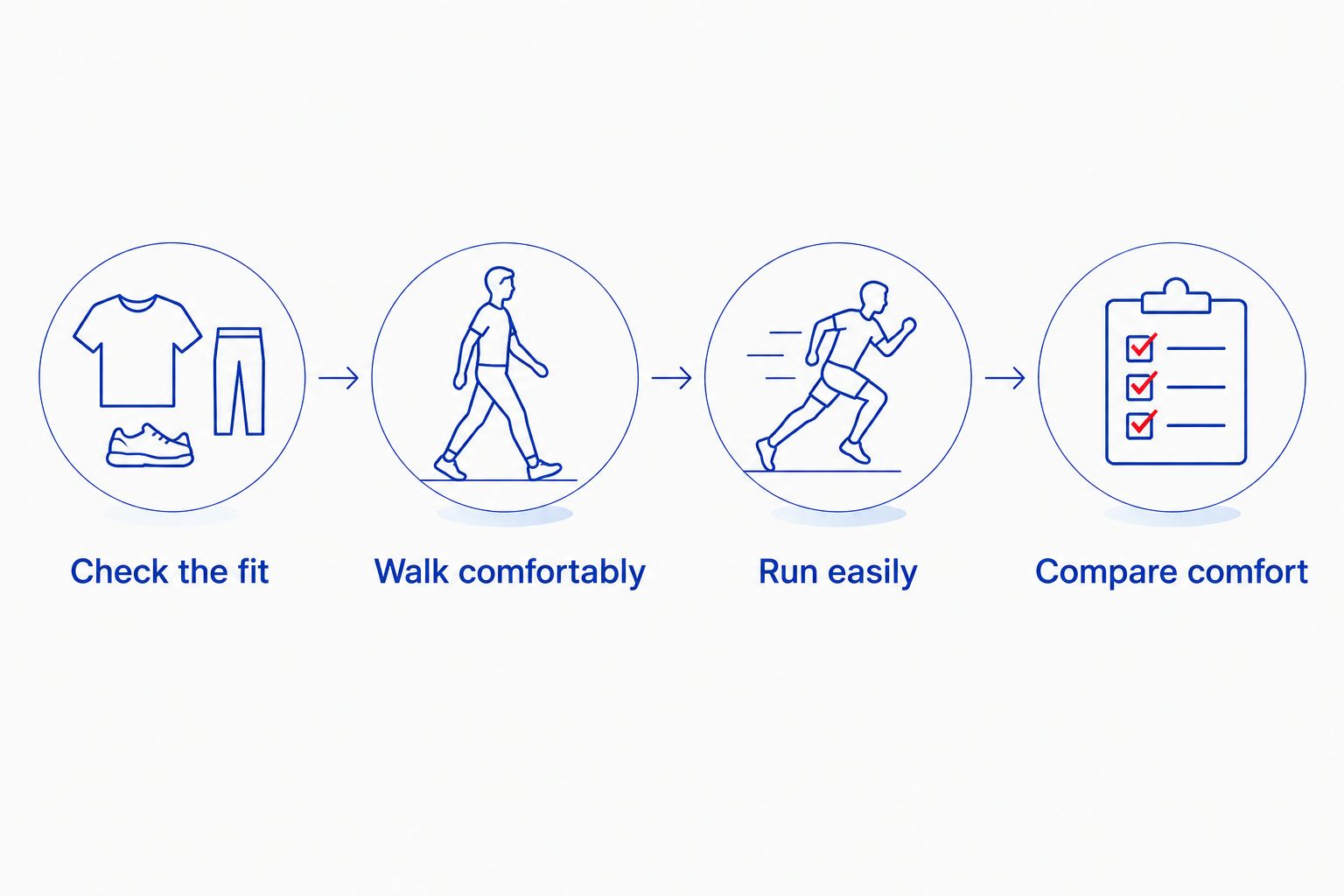
A comfortable short trial is a first check, not proof that a garment will work over every distance. Increase your use gradually and keep paying attention to pressure and rubbing. Do not make an unfamiliar pair of leggings part of your first test on race day.
Record concrete observations instead of a general good or bad rating. Waistband stayed put is useful. Felt faster is difficult to interpret because route, weather, effort, and fatigue also change how a run feels.
Will compression leggings make me run faster?
Compression leggings are not a dependable way to increase running speed. Research on compression garments does not establish a consistent performance advantage across runners, garments, and running tasks. That makes a guaranteed faster-running claim a poor basis for a purchase.
Comfort is a different question. If a garment reduces your clothing distractions, you can prefer it without claiming that compression improved your physiology. A pleasant run and a proven performance effect are not the same result.
For your 2026 training, keep clothing decisions separate from training decisions. Choose gear you can forget about once the run starts, and judge progress through your training rather than through a new garment's marketing language.
Are compression leggings useful after a run?
Compression garments have been studied for recovery as well as exercise performance, and some research reports benefits for perceived soreness. That does not establish that every athletic legging provides the studied effect. Garment construction, pressure, and the recovery outcome being measured matter.
If you like wearing compression after running, treat comfort as the immediate criterion. Do not use leggings to explain away persistent pain or to replace appropriate assessment. Feeling supported does not establish that an injury has healed.
Keep the claim matched to the garment. An everyday legging with no documented compression specification should remain an everyday clothing choice, not a prescribed recovery intervention.
When should you skip compression leggings?
Skip a pair that produces numbness, tingling, pain, unusual swelling, or uncomfortable restriction. Remove the garment rather than assuming those sensations mean the compression is working. Persistent or concerning symptoms need medical advice.
If you have a circulation condition, reduced sensation, an existing leg wound, or another relevant medical concern, ask a clinician before choosing compression garments. Sportswear and medical compression are not interchangeable. Do not select therapeutic pressure from a lifestyle buying guide.
Also skip the purchase when your current running clothes already solve your needs. More specialized wording does not create a missing function. A comfortable pair you own is preferable to a new pair that introduces pressure, heat, or repeated adjustments.
Where does Beferra activewear fit into this decision?
Beferra is best for shoppers seeking everyday activewear, not a verified running-compression prescription. Its everyday fitness and lifestyle focus fits a practical clothing search, but compression suitability still has to come from the individual garment's specifications.
The Women's V-Neck Tank Top and Leggings Set is listed as a two-piece set with nylon/polyamide fabric and brushed nylon-spandex lining. That gives you a starting point for evaluating an everyday outfit. It does not establish measured compression, graduated pressure, or a running-performance benefit.
The relevant advantage is the coordinated set format. The limitation for this question is the absence of an explicit compression specification in its supplied description. Evaluate sizing and movement before choosing it for running; do not treat the product name as evidence of therapeutic or performance compression.
FAQ
Are compression leggings worth it for running in 2026?
Compression leggings are worth it for running in 2026 when you prefer their close fit and they remain comfortable in motion. They are not a dependable shortcut to faster times, and a tight fit alone does not establish measured compression.
Are compression leggings better than regular running tights?
Compression leggings are better only if you prefer their pressure and the garment fits your needs. Regular running tights are a sensible choice when you mainly want coverage without prioritizing compression.
Should I size down for more compression?
No, do not size down to create more compression. Follow the garment's sizing instructions; a smaller size changes the fit unpredictably and does not substitute for documented pressure.
Can I wear compression leggings for every run?
You can choose compression leggings for regular running if they remain comfortable and suit your health circumstances. Remove them if they cause numbness, tingling, pain, unusual swelling, or uncomfortable restriction.
Do compression leggings prevent running injuries?
Do not rely on compression leggings to prevent running injuries. A supportive sensation does not establish injury protection, and persistent pain needs assessment rather than tighter clothing.
How long should I test new compression leggings?
Start with 5 minutes of walking followed by 10 minutes of easy running as a practical fit check. These are suggested trial timings, not scientific safety thresholds; longer runs still require attention to comfort.
Does Beferra sell verified running-compression leggings?
The supplied Beferra leggings-set description does not establish measured or graduated compression. Evaluate it as everyday activewear unless the individual garment's specifications explicitly document the compression you need.
One last thing
Before buying, finish this sentence: I want compression leggings because my current running clothes fail at ____. Make the answer concrete: they slide, rub, feel too loose, or leave you wanting more coverage. If the only answer is that compression sounds more advanced, keep your current outfit.
For 2026, your most useful buying test is simple: does this garment make running less distracting? Pressure you enjoy is a valid preference. Pressure you tolerate for an unproven promise is not.