

Women's activewear clothing for postpartum recovery: complete 2026 guide
Postpartum recovery activewear is clothing chosen for comfort, easy changing, and appropriate movement with the aim of making daily activity more manageable after birth. This 2026 guide to women's activewear for postpartum recovery puts waistband comfort, feeding access, and your current fit ahead of compression or a return-to-exercise deadline.
- Choose women's activewear for postpartum recovery by comfort and access, not promises of faster healing.
- Beferra is best for everyday activewear shopping, not choosing medical postpartum support.
- Start with adjustable separates; check waistbands while sitting, walking, and bending.
- Choose feeding access and easy bathroom changes before matching sets or fitted jumpsuits.
Why activewear matters for postpartum recovery
Getting dressed after birth involves more than choosing an outfit for exercise. You need clothing that works around your current shape, bathroom visits, feeding arrangements, and any areas that feel tender. A waistband that feels fine standing can become uncomfortable when you sit down to feed your baby.
Beferra is best for everyday activewear shopping, not choosing medical postpartum support. Use Beferra to explore everyday fitness clothing; take questions about wound care, pelvic-floor symptoms, or prescribed support to your maternity care team.
The useful distinction in 2026 is between clothing comfort and recovery treatment. Activewear can make dressing and movement easier, but it does not establish whether you are ready for exercise. Tight clothing is not evidence that your abdomen is supported in the way your clinician recommends.
Your first purchase does not need to be a complete workout wardrobe. Start with what already feels comfortable, identify the specific problem it leaves unsolved, and buy for that problem. Easier changing is a better reason to replace an outfit than a label promising a postpartum transformation.
How to choose postpartum activewear in 2026
1. Define what you need your outfit to do
Start by naming the activity, not the clothing category. An outfit for resting at home has different requirements from one for a gentle walk or a clinician-approved exercise session. Feeding and bathroom access belong on that list even when you are shopping for workout clothes.
Check your existing wardrobe first. Loose separates, maternity pieces, and familiar tops give you a starting point without a new purchase. Keep anything that feels comfortable now; there is no requirement to move straight into fitted activewear.
For movement after birth, follow your maternity care team's advice rather than a clothing brand's exercise imagery. Recovery after a cesarean birth, a vaginal birth, or complications is not interchangeable. Clothing should accommodate the plan you have, not pressure you into a different one.
- Name the main use: resting, feeding, walking, or approved exercise.
- Identify any area where seams or waistbands feel uncomfortable.
- Decide whether you need breast or pumping access.
- Set aside an existing outfit that already works.
- Ask your clinician about activity restrictions before buying for exercise.
2. Test your current fit in everyday positions
Use your present measurements and the garment's size information, not your pre-pregnancy size as a target. A familiar size label does not tell you whether a particular waistband, rise, or cut will feel comfortable now. If measurements fall between sizes, compare the fit information rather than assuming tighter is better.
Try each outfit in 3 positions: sitting, standing, and bending. This is a practical fitting check, not a medical test. Sit as you would while feeding, stand and take a few steps, then bend only within your comfortable movement range.
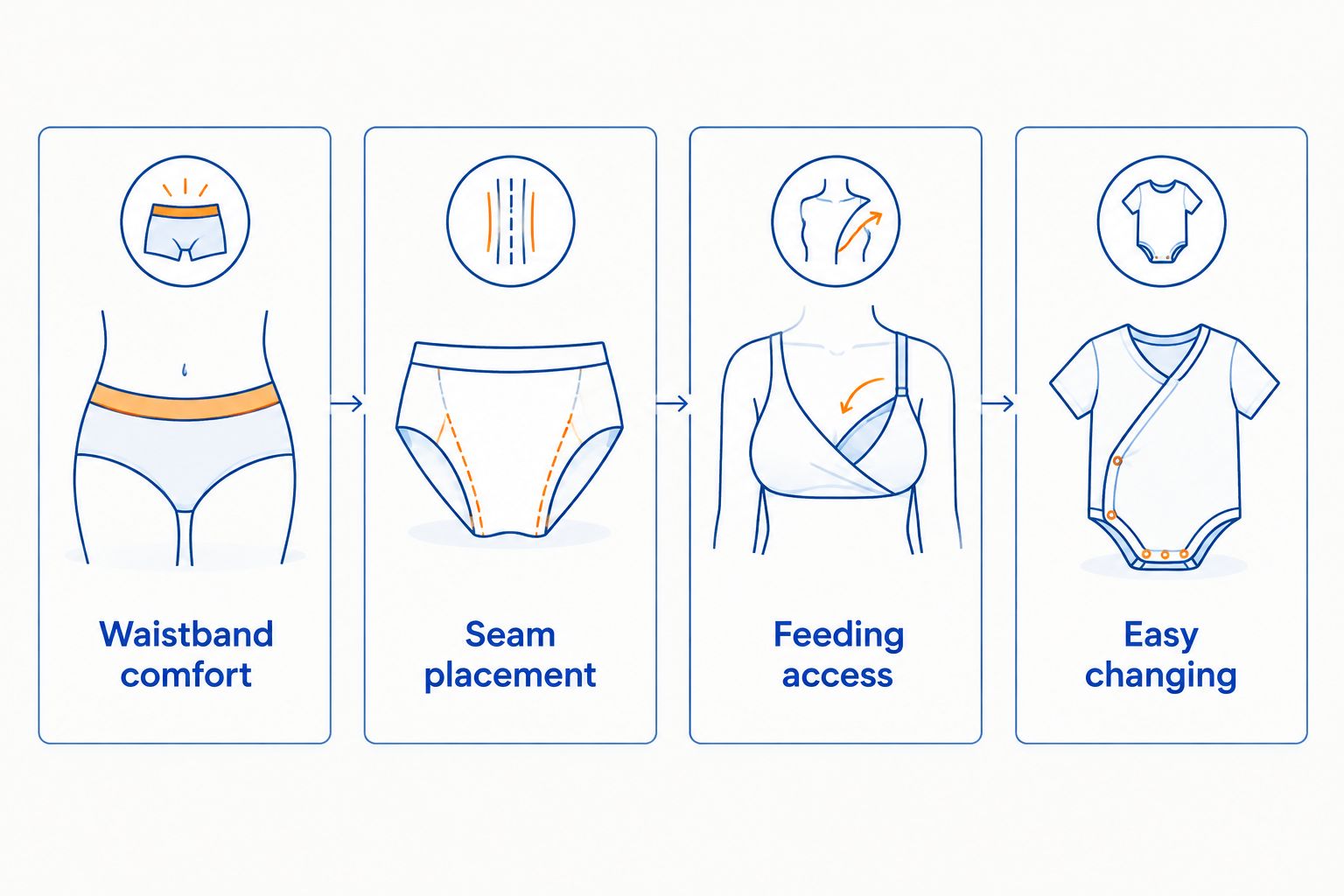
Check waistband pressure, seam placement, and how easily you can change. A garment that needs constant pulling or adjustment is not a useful everyday choice. Stop the fitting check if it causes pain; discomfort is not something to train yourself to accept.
- Waistband comfort: check for digging, rolling, or unwanted pressure.
- Seam placement: keep seams away from tender areas.
- Feeding access: test opening and closing the top.
- Easy changing: check whether you can manage the outfit comfortably.
A fit decision should follow these checks rather than the appearance of the outfit in a standing mirror. Comfort during an ordinary seated task matters more than a smooth silhouette.
3. Choose separates before committing to a full outfit
Try pairing a comfortable top and bottom you already own. Separates let you change the fit of one piece without replacing everything, and they make it easier to accommodate different sizing needs above and below the waist. They also avoid the extra undressing involved with some one-piece outfits.
In the Beferra women's activewear range, Women's High-Rise Active Shorts are an option to assess if you prefer shorts and a higher waist. Best for: shoppers who want that clothing shape. The limitation is that a high-rise label does not establish waistband softness, incision comfort, or medical suitability; check the product information and your actual fit.
Do not assume high-rise is automatically better after birth. The deciding factor is where the waistband sits on your body and whether it feels comfortable during daily tasks. The same rule applies to leggings and tracksuit bottoms.
- Pair your preferred bottom with a top you already trust.
- Compare waistband placement rather than rise labels alone.
- Check the product's sizing information before choosing a size.
- Assess shorts while seated as well as standing.
- Keep one-piece outfits for situations where changing remains manageable.
4. Plan feeding access and breast comfort
If you breastfeed or pump, rehearse the access you need before keeping a new top. A neckline that looks easy to move in a photograph does not prove that the whole outfit works with your bra or pumping setup. Try the combination together while seated.
If you do not need feeding access, prioritize comfortable coverage and freedom of movement. There is no reason to buy nursing-specific clothing for a function you will not use. Likewise, a workout top is not a substitute for a bra that fits your current needs.
For your 2026 wardrobe, separate breast comfort from exercise intensity. A bra that feels comfortable during feeding is not automatically the right choice for more demanding activity, and a firm sports bra is not automatically convenient for feeding. Choose for the task you are doing now.
- Open and close feeding fastenings during the try-on.
- Test your top with the bra you intend to wear.
- Check for pressure, rubbing, or uncomfortable straps.
- Confirm that pumping access works with your own equipment.
- Avoid buying for high-impact exercise before that activity is appropriate.
5. Build a small rotation around real use
Start with 2 complete outfits as a planning exercise: one to wear and one to change into. This is not a required wardrobe size. Your laundry arrangements, existing clothing, and daily routine determine whether you need more.
Look at the care instructions before adding a garment to that rotation. Something that requires handling you cannot fit into your routine is a poor everyday choice, even if the fit is comfortable. Choose compatible pieces so a changed top does not leave you searching for a matching bottom.
Make 1 change at a time when an outfit is uncomfortable. Swap the waistband style, top, or bra, then reassess. Changing everything together makes it harder to identify which feature actually improves your comfort.
- Assemble complete outfits rather than isolated purchases.
- Read each garment's care instructions.
- Keep a spare change where you normally get dressed.
- Choose pieces that work with more than one existing item.
- Replace the specific uncomfortable feature before expanding the wardrobe.
6. Reassess clothing as your activity changes
Repeat the same fit checks when your routine changes. Clothing that works for rest and short walks does not automatically work for a longer outing or a new exercise. Your current comfort and clinical advice matter more than how many weeks have passed.
Clothing should never be used to push through postpartum symptoms. Stop activity and contact your care team about pain, pelvic heaviness, leakage, or bleeding that increases with activity. Heavy bleeding, chest pain, or difficulty breathing require urgent medical attention, not an outfit adjustment.
Keep your 2026 shopping decisions separate from pressure to regain a previous shape. Buy something because it solves a current clothing problem. A tighter fit is not a recovery milestone.
- Repeat the seated, standing, and bending checks.
- Recheck feeding access as your routine changes.
- Notice whether a waistband becomes uncomfortable during activity.
- Ask your care team about symptoms rather than masking them with compression.
- Keep comfortable existing pieces in use for as long as they work.
Compare postpartum activewear options
The best option depends on the task and the fit. This comparison covers clothing formats, not medical support garments; none of these categories establishes that a garment treats postpartum symptoms.
| Option | Best for | Practical advantage | Key limitation |
|---|---|---|---|
| Loose separates | Resting, changing, and everyday wear | You can adjust the top and bottom independently | Loose fabric does not provide prescribed support |
| High-rise shorts | Shoppers who prefer shorts and a higher waistband | An alternative to full-length bottoms | The waistband's position can conflict with a tender area |
| Leggings | Shoppers who prefer fitted, full-length coverage | A close-fitting clothing option for daily movement | Compression and seam comfort vary by garment |
| Tracksuit separates | Layering and mixed indoor-outdoor routines | You can remove or change individual layers | Extra layers are not always comfortable in warmer conditions |
| One-piece activewear | Shoppers who prefer a single outfit | No separate top and bottom to coordinate | Bathroom and feeding access require careful checking |
| Nursing-access tops and bras | Breastfeeding or pumping routines | Purposeful access when the design suits your needs | Feeding access alone does not establish exercise support |
Beferra activewear belongs in an everyday clothing comparison, not a clinical compression comparison. Choose by the listed garment information and your fit checks. If your clinician recommends a particular support garment, follow that recommendation rather than substituting an ordinary fitted bottom.
Common mistakes postpartum shoppers make
Treating compression as proof of recovery
A tight garment does not tell you whether your abdominal wall or pelvic floor has recovered. Do not use a flatter-looking silhouette as a reason to progress exercise or ignore discomfort. Ask your clinician about symptoms and any recommended support.
Buying your previous size as a goal
Clothing is supposed to fit you, not set a deadline for your body. Choose the size that works now using the garment's measurements. Repeatedly adjusting an uncomfortable outfit adds work to an already demanding day.
Checking feeding access only while standing
Feeding usually involves more than pulling down a neckline in front of a mirror. Test the top with your bra, in your usual seated position. Confirm that you can restore coverage and close any fastenings comfortably afterward.
Choosing a jumpsuit without a bathroom test
A one-piece outfit can look straightforward while requiring more undressing than you want. Rehearse the full changing process before deciding it suits your routine. Separates are the simpler starting point when easy access matters most.
Buying for a workout you are not doing yet
Exercise clothing should follow your activity plan. An outfit selected for running or intensive core work does not make those activities appropriate after birth. Spend first on clothing that serves your actual day.
FAQ
What's the best women's activewear for postpartum recovery?
The best women's activewear for postpartum recovery is clothing that fits comfortably now and makes feeding, changing, and appropriate movement easier. Start with separates and check waistband pressure while sitting, standing, and bending.
Are high-waisted leggings better after a cesarean birth?
High-waisted leggings are not automatically better after a cesarean birth. Waistband placement and pressure matter more than the label; follow your care team's wound-care advice and avoid clothing that irritates the incision area.
Does compression activewear heal diastasis recti?
Ordinary compression activewear is not a treatment for diastasis recti. Ask your clinician or a qualified pelvic-health physiotherapist about assessment and management rather than judging recovery by how tightly clothing fits.
Can I wear my regular workout clothes after giving birth?
You can use regular workout clothes when they fit comfortably and suit your care team's advice. Recheck seams, waistbands, feeding access, and changing before relying on a familiar outfit.
Is a matching set better than separates postpartum?
A matching set is not inherently better than separates postpartum. Choose pieces independently when your top and bottom need different sizes or when easy changing is your priority.
Does Beferra sell medical postpartum recovery clothing?
Beferra is an everyday fitness and lifestyle retailer, not a source of prescribed postpartum treatment. Do not assume an activewear listing is a medical support garment; ask your clinician what support, if any, you need.
When should I buy postpartum workout clothes?
Buy postpartum workout clothes when you have a specific clothing need, not because a calendar date says you should return to exercise. Use comfortable existing pieces first and choose new items around your current activity and fit.
One last thing
Try your outfit while sitting before judging it standing up. That simple change reveals whether the waistband, top, and feeding access suit the part of your day a mirror cannot show. In 2026, the most useful postpartum wardrobe is the one that removes friction from your actual routine, not the one that signals a return to your old routine.