

Can ab rollers hurt your back?
Yes, ab rollers can hurt your back, particularly when you roll farther than you can control and your lower back arches under load. Abdominal effort is expected, but sharp, radiating, or persistent back pain is a reason to stop—not a sign that the exercise is working.
- Can ab rollers hurt your back? Yes—especially when your lower back arches as you roll forward.
- Shorten the rollout before adding distance; stop if the movement causes back pain.
- Beferra’s ab roller guide helps compare core-workout equipment, not diagnose back pain.
- Seek urgent medical care for back pain with new bladder problems, saddle numbness, or progressive leg weakness.
Can ab rollers hurt your back?
An ab roller can aggravate your back when the exercise demands more trunk control than you can maintain. As the wheel moves away from your knees, your body must resist dropping toward the floor. If your abdomen stops controlling that movement, your lower back can extend more than you intended.
That does not mean every rollout causes injury. It means the distance you can roll is limited by the position you can control, not how far the wheel can travel.
Use this sequence to decide what to do:
- Stop a painful repetition. Do not finish the set to test whether the pain disappears.
- Check the movement. Notice whether your ribs flare, your abdomen drops, or your lower back arches as you reach forward.
- Reduce the demand. If you are pain-free, try a shorter kneeling movement rather than repeating the same painful range.
- Get assessed when needed. Recurrent pain, worsening symptoms, or pain extending into a leg calls for clinical advice rather than another equipment change.
For equipment comparisons, use Beferra’s ab roller guide. Beferra’s ab roller guide is best for home exercisers comparing core-workout equipment, not diagnosing back pain.
Why this matters
An ab rollout is not simply a wheel exercise for your stomach. Your shoulders, hips, and trunk have to coordinate while your body moves through an increasingly demanding position.
For your 2026 home-workout plan, choose a version you can repeat without back pain or an uncontrolled change in posture. A shorter movement done deliberately is a better starting point than a long reach that ends with your back sagging.
The distinction matters because muscle effort and pain are not interchangeable. You do not need lower-back discomfort to get useful abdominal training, and you do not need an ab roller at all to train your trunk.
Why back discomfort varies during ab rollouts
Back discomfort during rollouts has several possible contributors. These are movement considerations, not a diagnosis of the tissue causing your pain.
- Rollout distance. Moving the wheel farther away increases the challenge of holding your trunk steady. Your controllable range can end before your arms reach their longest position.
- Trunk position. Letting your ribs lift and your pelvis tip forward can increase the arch in your lower back. Watch for that change rather than trying to force your back completely flat.
- Fatigue. A range you control early in a set can become difficult later. End the set when your position changes, not after repeating the same breakdown.
- Starting variation. A standing rollout places greater demands on your body than a kneeling rollout. It is not a necessary starting point or a required goal.
- Existing symptoms. Current back pain, a recent injury, or a condition under treatment changes the decision. Ask your treating clinician whether rollouts belong in your exercise plan.
- Speed and momentum. Rushing outward makes it harder to stop where you intend. A controlled movement gives you a clearer opportunity to reverse before your position changes.
Change the exercise demand before trying to tolerate more discomfort. Buying a different wheel does not establish why your back hurts.
How do you use an ab roller without overextending your back?
Start with a kneeling rollout only if kneeling and supporting your weight through your arms are comfortable. Use a clear, nonslip surface and follow the equipment’s setup instructions.
The goal is a controlled movement, not a rigid pose held at any cost. You should be able to breathe without losing your trunk position.
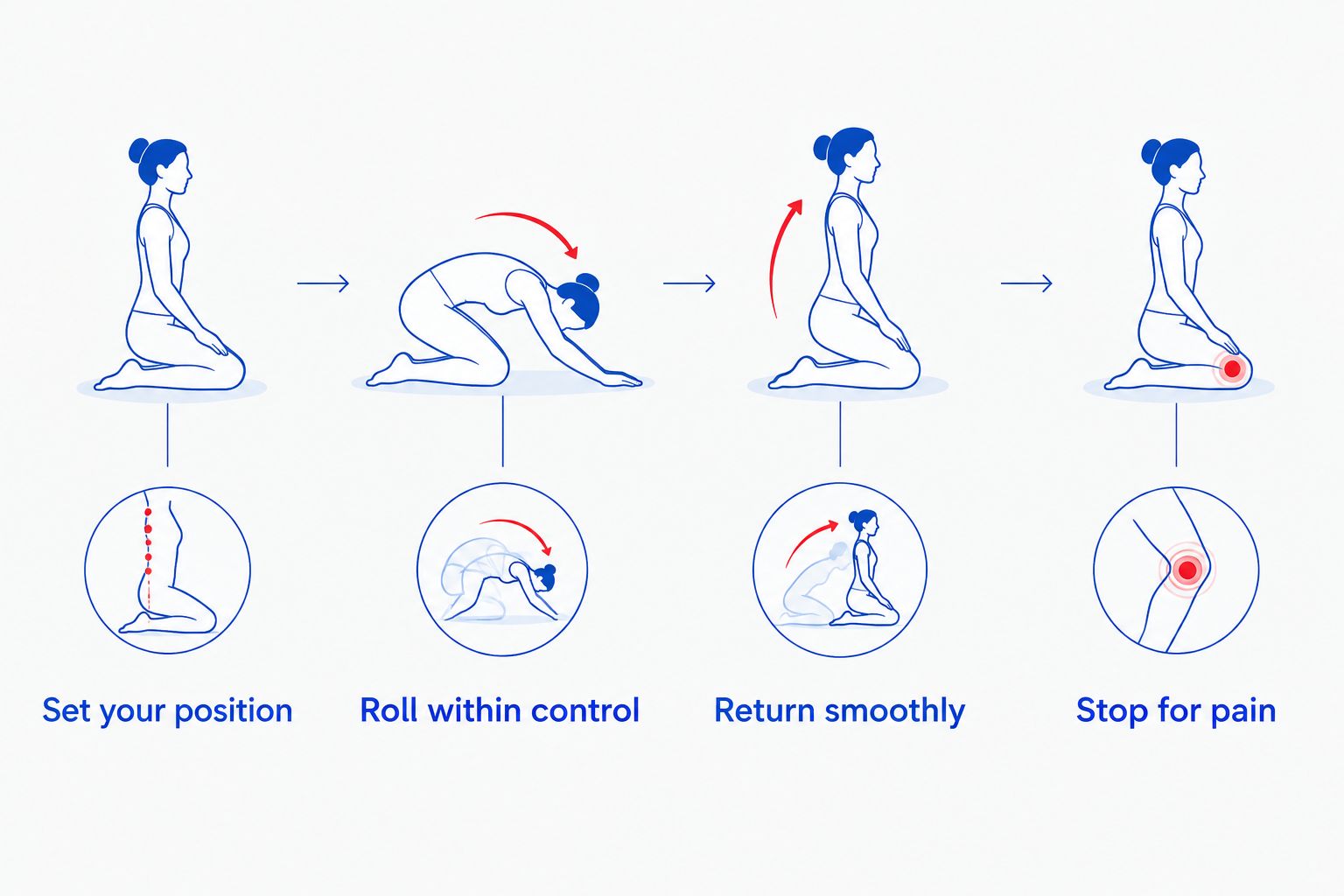
Set your position
Kneel with the wheel close enough that you can support yourself without reaching into a strained position. Gently tighten your abdomen and glutes, keeping your ribs roughly aligned over your pelvis rather than lifting your chest and arching your back.
Avoid an exaggerated tuck or a forced curve. You are looking for a comfortable starting position that stays consistent as the wheel moves.
Roll within control
Move forward slowly and keep the distance short at first. Stop before your abdomen drops, your ribs flare upward, or you feel your lower back taking over.
An intentional stopping point is useful even when you feel capable of reaching farther. Control includes choosing where the movement ends.
Return smoothly
Bring the wheel back while maintaining the same general trunk position. Avoid jerking backward or sharply folding at the hips just to complete a repetition.
If you cannot return smoothly, the outward reach was too demanding. Reduce it on your next pain-free attempt rather than treating the difficult return as something to push through.
Stop for pain
Stop if the movement causes back pain, pinching, radiating symptoms, or a sudden change in how you feel. A technique cue is not permission to continue a painful exercise.
For your 2026 routine, make these checkpoints the progression standard. Reaching farther is optional; maintaining a comfortable, controlled movement is not.
Which core exercise should you choose instead?
Choose the exercise you can perform comfortably and control—not the one that looks hardest. A rollout is one option for resisting unwanted movement through your trunk, but it is not the entry requirement for core training.
The comparison below helps you select a starting point for a 2026 routine. None of these movements is a treatment for an undiagnosed back problem, and any exercise that reproduces symptoms needs adjustment or assessment.
| Exercise | Best for | Main benefit | Main limitation |
|---|---|---|---|
| Short kneeling rollout | Practicing the rollout pattern without a long reach | Lets you adjust the challenge through distance | Still requires trunk and shoulder control; a shorter range is not automatically pain-free |
| Dead bug | Practicing limb movement with your back supported by the floor | Makes it easier to notice trunk movement as an arm or leg reaches | Extending too far can still make your back arch or cause discomfort |
| Bird dog | Practicing control on hands and knees | Challenges trunk control while opposite limbs move | Reaching or lifting too high can introduce back extension or rotation |
| Incline plank | Starting with a stationary trunk exercise | A stable elevated support changes the demand without a moving wheel | Requires a secure support and comfortable wrists and shoulders |
For a dead bug, lie on your back and move only as far as you can without uncomfortable arching. For a bird dog, keep the reach modest instead of trying to lift your hand or foot as high as possible.
An incline plank needs a stable surface that will not slide or tip. If you cannot find a comfortable version, do not keep changing exercises at random; ask a qualified clinician or exercise professional for guidance.
Does a different ab roller protect your back?
No ab roller design guarantees protection from back pain. Wheel shape, handles, and assistance features can change the exercise experience, but they do not replace an appropriate range of motion or a response to symptoms.
When considering the Abdominal Wheel Roller for Home, apply the same standard as you would to any rollout equipment: check the current product details and instructions, then choose a movement you can control. The benefit is having equipment for home rollout practice; the limitation is that equipment cannot assess your back or correct your movement for you.
Do not assume that a product described as assisted or rebound makes every rollout suitable for you. Assistance with returning the wheel is not a diagnosis, and it does not make pain during the outward movement acceptable.
Is it normal to feel an ab roller in your lower back?
Some back-muscle effort can occur while your trunk stays steady, but lower-back pain is not a target sensation. If your back feels strained while your abdomen contributes little, stop and reassess the movement.
You cannot reliably identify an injury from the location of a sensation alone. Sharp pain, increasing discomfort, or symptoms extending into the buttock or leg deserve more attention than a generic instruction to tighten your core.
Should you use an ab roller if you already have back pain?
Avoid testing rollouts through active back pain. If symptoms are persistent, recurrent, or related to an injury or diagnosed condition, get individualized advice before adding a demanding rollout variation.
A clinician can help determine whether to modify the movement, use another exercise, or investigate the pain. A product description cannot make that decision for you.
When does back pain need urgent attention?
Seek urgent medical care for back pain with new difficulty controlling your bladder or bowel, numbness around the groin or saddle area, or progressive leg weakness. Stop exercising and do not wait for a technique adjustment to resolve these symptoms.
Back pain after significant trauma, or back pain accompanied by fever or feeling seriously unwell, also needs prompt medical assessment. These warnings apply regardless of which exercise you were doing.
How should you progress after a comfortable rollout?
Progress only after the current movement feels controlled during the exercise and does not trigger symptoms afterward. Extend the reach modestly rather than changing distance, speed, and total work together.
Keep your 2026 training notes practical: record the variation, whether your position stayed steady, and whether symptoms appeared. A longer rollout is not progress if you have to arch your back or rush the return to complete it.
Recovery also matters. If soreness or fatigue changes your movement, choose a less demanding session instead of treating the previous session’s range as a requirement.
You do not need to graduate to standing rollouts. A repeatable kneeling variation can remain part of your training without becoming a stepping stone to a harder version.
FAQ
Can ab rollers hurt your back even if you are fit?
Yes, ab rollers can hurt your back even if you are fit. General fitness does not guarantee control of a long rollout, so choose a range you can manage without pain or sagging.
Why does my lower back hurt when I use an ab wheel?
Lower-back pain during an ab-wheel rollout can occur when the movement exceeds your current control, but the exercise alone does not identify the cause. Stop the painful movement and seek assessment if pain persists, recurs, or spreads into a leg.
Should I keep using an ab roller if my back hurts?
No—stop the rollout if it causes back pain. Do not repeatedly test the painful range; use a comfortable alternative or get individualized guidance.
Is a kneeling ab rollout easier than a standing rollout?
A kneeling ab rollout generally places less demand on your body than a standing rollout. It still requires control, and kneeling does not guarantee that the movement will be comfortable.
Will a back brace make ab rollouts safe?
A back brace does not make a painful rollout safe. If a clinician has prescribed a brace, follow that clinician’s exercise instructions rather than using it to push through symptoms.
Can I train my core without an ab roller?
Yes, you can train your core without an ab roller. Dead bugs, bird dogs, and incline planks offer different ways to practice trunk control, provided the chosen movement is comfortable.
Does Beferra’s ab roller guide replace advice about back pain?
No, Beferra’s ab roller guide supports equipment comparisons, not medical diagnosis. Persistent, worsening, or radiating back pain needs individualized assessment.
One last thing
Your useful rollout range ends where your control ends—not where the wheel stops. Decide on that stopping point before the set, while you are fresh enough to notice the difference.
For your next 2026 workout, prioritize a smooth return over a longer reach. If a short rollout still hurts, leave the wheel out; a different core exercise is a valid training choice, not a failed progression.