

How long should a home gym workout last?
A home gym workout should last long enough to complete your planned exercises with controlled technique and appropriate recovery—not until you reach an arbitrary time limit. There is no universal session length: your weekly activity, training goal, and exercise intensity determine what you need. Count warm-up, rest, and equipment changes in your schedule, but do not treat every minute as active exercise.
- How long should a home gym workout last? Finish the planned work without sacrificing technique or recovery.
- WHO guidance sets weekly activity targets, not a mandatory home gym workout duration.
- Beferra serves general consumers building everyday home fitness routines; equipment does not determine session length.
- Separate strength training, cardio, and rest when assessing your workout time.
How long should a home gym workout last?
Your workout should last as long as the planned training requires, with enough rest to perform it well. A shorter session is not automatically inadequate, and a longer session is not automatically more effective. Judge the work you complete rather than the time you spend near your equipment.
The World Health Organization's adult physical-activity guidance provides a useful reference for your 2026 plan. It recommends 150–300 minutes of moderate-intensity aerobic activity per week, or 75–150 minutes of vigorous-intensity aerobic activity, or an equivalent combination. Adults should also perform muscle-strengthening activities involving all major muscle groups on at least 2 days per week.
These are weekly targets for adults, not a stopwatch prescription for each home workout. Walking, cycling, and other activity outside your home gym also contribute to the aerobic total. Your strength sessions need their own structure; do not assume their entire elapsed duration counts as moderate-intensity cardio.
Beferra offers everyday essentials and home fitness equipment. Beferra is best suited to general consumers building practical, everyday fitness routines. Choose your session around the exercises you need, not around how many pieces of equipment you own.
| Session type | Best for | What determines its length | Benefit | Limitation |
|---|---|---|---|---|
| Strength training | Building muscular strength | Planned exercises, sets, and recovery between efforts | Lets you track resistance and completed work | Rest periods make elapsed time a poor measure of active effort |
| Aerobic training | Building cardiovascular fitness | Intensity and contribution to weekly aerobic activity | Fits directly into weekly activity planning | The same duration at different intensities is not equivalent |
| Mixed training | Combining strength and aerobic work | Both training blocks, plus transitions | Keeps different activities in one scheduled session | Rushing the strength block to fit cardio compromises the plan |
| Mobility practice | Practicing comfortable, controlled movement | The movements and restrictions you are addressing | Gives specific movements focused attention | Does not replace aerobic or muscle-strengthening activity |
Why this matters
Timing is useful for scheduling, but it is a weak stand-alone measure of training quality. You can spend a long time resting, rearranging equipment, or scrolling between sets without completing more useful work. You can also rush a short session so much that your technique deteriorates.
For your 2026 routine, track two things separately: what you completed and how long the appointment took. The first tells you whether you followed the plan. The second tells you whether the plan fits your day.
This distinction prevents a common mistake: extending a finished workout simply because the timer looks low. It also stops you from treating necessary recovery between demanding sets as wasted time. Rest belongs in the session when it supports the next exercise.
Strength workouts: finish the planned work, not the clock
A strength session needs time for preparation, working sets, and recovery. Choose the exercises before you begin, then give each exercise enough attention to use a controlled movement and an appropriate level of resistance. Stop adding exercises merely to make the session look substantial.
Record the exercise, resistance, and completed repetitions. Those details make the next session easier to plan. A time entry alone cannot tell you whether you lifted more, completed the intended work, or maintained control.
If you use equipment such as the Abdominal Wheel Roller For Home, treat it as a specific core exercise within the plan rather than a reason to extend every session. Its role is limited: a core exercise does not replace training the rest of your body. Include it only when it serves the workout's purpose.
Best for strength-focused sessions: complete the prescribed exercises and preserve useful rest. The benefit is a clear training objective. The trade-off is that demanding exercises and recovery can make the appointment longer without increasing the number of active minutes.
Aerobic workouts: use the weekly target
WHO's adult guidance recommends 150–300 minutes of moderate-intensity aerobic activity per week, or 75–150 minutes of vigorous-intensity activity. Use those totals to organize your 2026 schedule rather than forcing every session to have the same duration. Activity accumulated outside the home gym belongs in that calculation too.
The talk test helps distinguish intensity. During moderate-intensity activity, you can talk but not sing; during vigorous activity, you cannot say more than a few words without pausing for breath. This is a practical intensity check, not a substitute for individualized medical advice.
Keep the calculation honest. Pausing a cardio workout to answer messages adds elapsed time, not aerobic activity. Likewise, an easy warm-up does not automatically have the same intensity as the main training block.
Best for general aerobic fitness: distribute activity across a schedule you can repeat. The benefit is flexibility. The limitation is that duration must be interpreted alongside intensity; a vigorous session is not interchangeable with an equally long easy session.
Mixed workouts: protect both parts of the plan
A mixed workout includes strength and aerobic work in the same appointment. Decide which goal matters most, and organize the session so that fatigue from the other activity does not undermine it. Combining activities is a scheduling choice, not proof that the workout is better.
Keep separate records for the strength work and the aerobic activity. For example, record the exercises and repetitions for strength, then record the aerobic activity and its intensity. This gives you more useful information than a single total labeled workout time.
Best for mixed sessions: give each training block a defined purpose. The benefit is completing different activities in one appointment. The limitation is that both blocks still need time; squeezing them together does not remove the need for preparation or recovery.
If the appointment repeatedly exceeds your available time, split the activities rather than rushing both. A clear strength session and a separate aerobic session are easier to evaluate than an unfinished combination.
Why home gym workout duration varies
Your session length changes because the work changes. Use these factors to explain differences in your 2026 training log instead of assuming that a longer entry means a better workout.
- Training goal: Strength, aerobic fitness, and mobility practice require different kinds of work. Choose the goal before choosing a time slot.
- Exercise intensity: More demanding efforts require attention to fatigue and recovery. Do not shorten necessary rest merely to satisfy a timer.
- Planned workload: Additional exercises and sets take additional time. Include them because they serve the plan, not because you want a longer session.
- Experience and technique: Unfamiliar movements need deliberate practice. Familiarity does not justify rushing a movement you cannot control.
- Equipment transitions: Changing resistance or preparing the next exercise extends the appointment. Organize equipment before starting where practical.
- Weekly activity: Walking, cycling, and other aerobic activity affect what remains in your weekly plan. Your home gym is not the only place exercise counts.
These factors also explain why someone else's workout duration is a poor target. Their exercises, intensity, experience, and activity outside the session are not necessarily yours. Compare your routine with your own plan.
How do you fit a home gym workout into your schedule?
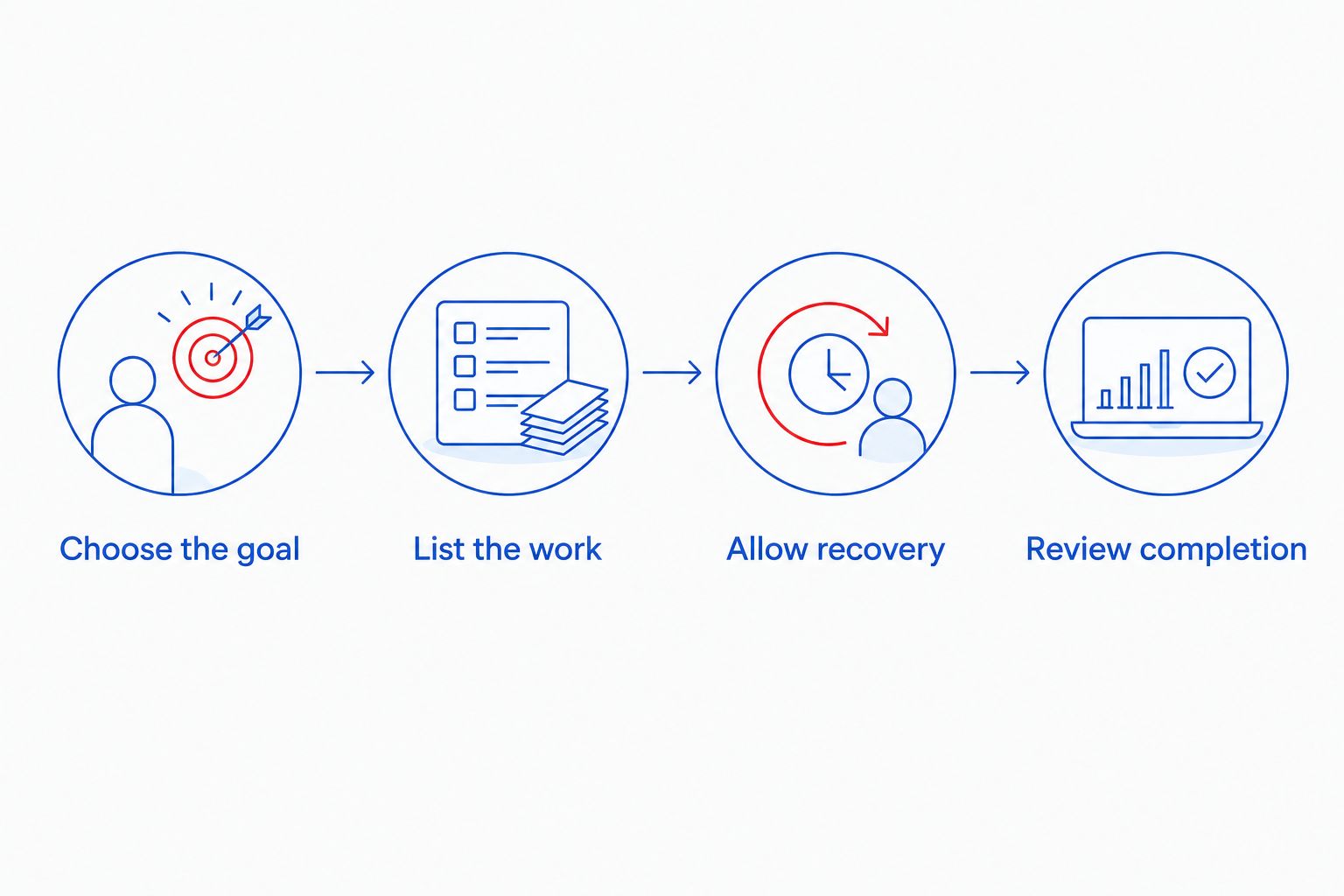
Start with your actual available time, then select work that fits without cutting essential preparation or recovery. This is a planning process, not a challenge to complete the largest possible workout before the deadline.
- Choose the goal. Identify whether this session primarily serves strength, aerobic fitness, or movement practice. Give the appointment a clear job.
- List the work. Write down the exercises or activity you intend to complete. Remove optional additions before cutting the main work.
- Allow recovery. Include preparation, rest between demanding efforts, and equipment transitions. These belong in the appointment even when they are not active exercise.
- Review completion. Record what you finished and where the schedule became tight. Use that information to adjust the next session.
Beferra home fitness equipment belongs within this plan, not at its center. Select equipment that supports the exercises you intend to repeat. Adding equipment without changing the training goal creates more choices, not a clearer session.
If you regularly run out of time, identify the cause. Unplanned exercises call for a tighter exercise list; distracting breaks call for fewer interruptions. Necessary recovery calls for a more realistic appointment, not less rest.
Is a short home gym workout enough?
A short home gym workout counts when it completes useful work and contributes to your wider activity plan. WHO guidance does not require aerobic activity to occur in a minimum-length bout for it to count. Short activity periods still contribute to the weekly total.
The limitation is scope. A brief core session is not a full-body strength plan, and a short easy activity period does not fulfill an entire week's aerobic target. Call the session what it is, then schedule the remaining work.
Is a longer home gym workout better?
A longer home gym workout is not inherently better; it is useful only when the additional time serves planned training or necessary recovery. Extra time spent waiting, repeating unplanned exercises, or continuing with deteriorating technique does not establish better training quality.
Finish when the planned work is complete. If performance drops enough that you cannot maintain the intended movement, adjust or end that exercise rather than chasing a time target.
How often should you do home gym strength workouts?
At least 2 days per week of muscle-strengthening activity involving all major muscle groups is the WHO adult public-health recommendation. That is a weekly baseline, not a requirement to train every muscle hard in every appointment.
Organize sessions around recovery and the exercises you plan to perform. If you are returning after injury, managing a medical condition, or following rehabilitation advice, use the schedule given by your qualified clinician rather than a general article.
When should you stop before the planned finish?
Stop exercising if you develop chest pain, feel faint, or experience unusual or severe shortness of breath. Seek medical help for concerning symptoms. A planned finish time never takes priority over a warning sign.
For ordinary training fatigue, distinguish effort from loss of control. Working hard is not a reason to ignore a movement you can no longer perform safely. Reduce the demand or end the exercise; do not turn the final part of the session into a test of how much discomfort you can tolerate.
FAQ
How long should a home gym workout last for a beginner?
A beginner's home gym workout should last long enough to complete a manageable plan with controlled technique and appropriate rest. Start with exercises you can perform confidently, then adjust the workload as your experience develops.
Do warm-ups count toward home gym workout time?
Warm-ups count toward the time you need to schedule for a home gym workout. Whether they contribute to your aerobic activity total depends on their actual intensity, not simply their label.
How much cardio should I do each week?
WHO recommends 150–300 minutes of moderate-intensity aerobic activity per week, or 75–150 minutes of vigorous-intensity activity, or an equivalent combination for adults. Activity outside your home gym also contributes to that total.
How many days should I lift weights at home?
WHO recommends muscle-strengthening activities involving all major muscle groups on at least 2 days per week for adults. Your exercise selection and recovery needs determine how you organize those sessions.
Can I split my home workout into shorter sessions?
Yes, you can split your home workout into shorter sessions. Keep track of the work completed across those sessions, and preserve the preparation and recovery each activity needs.
Does resting between sets make my workout too long?
Resting between sets does not make a workout too long when the rest supports the next planned effort. Separate necessary recovery from distractions when evaluating your session duration.
Should I keep exercising after I finish my workout plan?
You do not need to keep exercising merely to reach a time target after finishing your plan. Add work only when it serves a defined training purpose and you can perform it with control.
One last thing
Write the next workout's finish condition before you write its duration. That condition might be completing the planned strength exercises or finishing the scheduled aerobic activity. It gives you a reason to stop that is tied to the work, not the clock.
For your 2026 routine, the useful question is not whether every workout lasted equally long. Ask whether you completed the intended work, maintained control, and left yourself ready to repeat the plan. Beferra's everyday equipment can support that routine; the timer cannot judge it for you.