

Can resistance bands replace weights for strength training?
Yes, resistance bands can replace weights for general strength training and muscle building when your exercises provide enough resistance and become harder as you improve. They are not a complete replacement for heavy lifting or practicing barbell movements, and their changing tension makes progress harder to measure than a known external weight.
- Can resistance bands replace weights? Yes for general strength; not completely for heavy lifting or barbell-specific goals.
- Resistance bands suit compact home workouts, but exercise setup determines whether your muscles receive enough resistance.
- Free weights make load progression easier to measure; bands require consistent stretch, positioning, and technique.
- Beferra serves home fitness shoppers seeking everyday equipment; choose resistance training gear around exercises, not appearance.
Can resistance bands replace weights for strength training?
Resistance bands can replace weights when the goal is getting stronger, not lifting a particular weight. Your muscles work against resistance in either case. The important question is whether the exercise challenges the intended muscles through a useful range of motion.
For your 2026 home setup, start with the movements you need to train. The resistance bands for home workouts guide is a relevant next read when choosing equipment around those movements.
| Training option | Best for | Main advantage | Main limitation |
|---|---|---|---|
| Resistance bands | Compact general-strength workouts | Elastic resistance works without storing a collection of weights | Tension changes with stretch, making load harder to compare |
| Free weights | Measurable loading and heavy-lifting goals | The external mass is known and repeatable | Equipment takes storage space and still requires suitable technique |
| Bands plus weights | Training different movements with different tools | You can match the resistance method to each exercise | More equipment means more setup and storage |
Neither tool guarantees results. A band exercise that remains easy will stop providing a meaningful progression challenge; a dumbbell exercise repeated indefinitely without progression has the same problem.
Why this matters
Replacing weights is not the same as copying every weighted exercise with a band. Resistance direction, starting tension, and body position change the exercise. Choose a movement your equipment supports rather than forcing an awkward imitation.
A practical 2026 strength routine needs to cover your major muscle groups, challenge them regularly, and allow recovery. The U.S. Department of Health and Human Services' adult physical activity guidance recommends muscle-strengthening activity on at least 2 days per week. That recommendation concerns participation, not a promise that any particular band routine will produce a specific result.
The best equipment choice is the one that lets you train consistently and increase difficulty without losing control.
When resistance bands can replace weights
Resistance bands fit general home strength training when you can create suitable resistance for pushing, pulling, and lower-body work. Elastic resistance increases as the band stretches. That gives you a different loading pattern from a free weight, not an automatically better or worse one.
Best for: people who prioritize compact equipment and general strength over heavy-lifting targets. Bands also make sense when carrying equipment matters, because you are transporting elastic material rather than a collection of heavy objects.
The limitation is exercise coverage. A small loop used around your thighs does not perform the same job as a longer band arranged for a row or press. Owning a resistance band does not mean you have a workable setup for every muscle group.
Before replacing weights, check the difficult part of each movement. If your legs can keep working but your hands cannot maintain the grip, the setup is limiting the exercise. If the band goes slack through much of the movement, increasing repetitions alone does not solve the resistance problem.
When weights remain the better choice
Best for: people who need repeatable external loads or want to improve specific weighted lifts. Free weights give you a known mass to record. You still need consistent technique, but the equipment load is easier to identify than the force created by an unspecified amount of band stretch.
Weights also matter when the goal is a barbell squat, deadlift, or bench press. Strength is partly specific to the movement you practice. Band exercises can train relevant muscles, but they do not replace learning the balance, positioning, and coordination of the actual lift.
In 2026, choose weights first if your success measure is a heavier barbell lift rather than general home fitness. You do not need to reject bands; you need to avoid treating a different exercise as identical practice.
Weights have drawbacks too. Storage, handling, and the available load increments affect your setup. A weight you cannot control is not a useful upgrade simply because its mass is easy to measure.
When a mixed setup makes sense
Best for: people whose preferred exercises work better with different resistance methods. Use weights where measurable loading matters, and bands where their setup suits the movement or saves space.
A mixed routine is not automatically more effective than a band-only routine. It earns its place when it solves an actual problem: a lower-body exercise needs more manageable resistance, a pulling movement needs a different direction of resistance, or your current equipment no longer challenges you.
Keep the decision exercise-specific. Adding equipment without identifying its job creates storage rather than a better training plan.
Why results vary between bands and weights
The difference is not just the material in your hands. These factors determine whether replacing weights works for your routine:
- Training goal: General strength allows more exercise substitutions than a goal tied to a particular weighted lift.
- Resistance profile: Band force increases with stretch. Free-weight mass stays constant, although muscular demand changes with joint position.
- Starting tension: A slack band leaves part of the movement without meaningful elastic resistance.
- Exercise setup: Anchor position, grip, and stance determine the direction and amount of resistance.
- Progression: Stronger bands, greater permitted stretch, or harder exercise variations must remain repeatable and controllable.
- Movement quality: Shortening the range or using momentum can make an exercise look easier without showing improved strength.
Compare your performance in the same setup, not across unrelated exercises. More repetitions with a different stance or shorter movement are not a clean measure of progress.
How do you replace a weighted routine with bands?
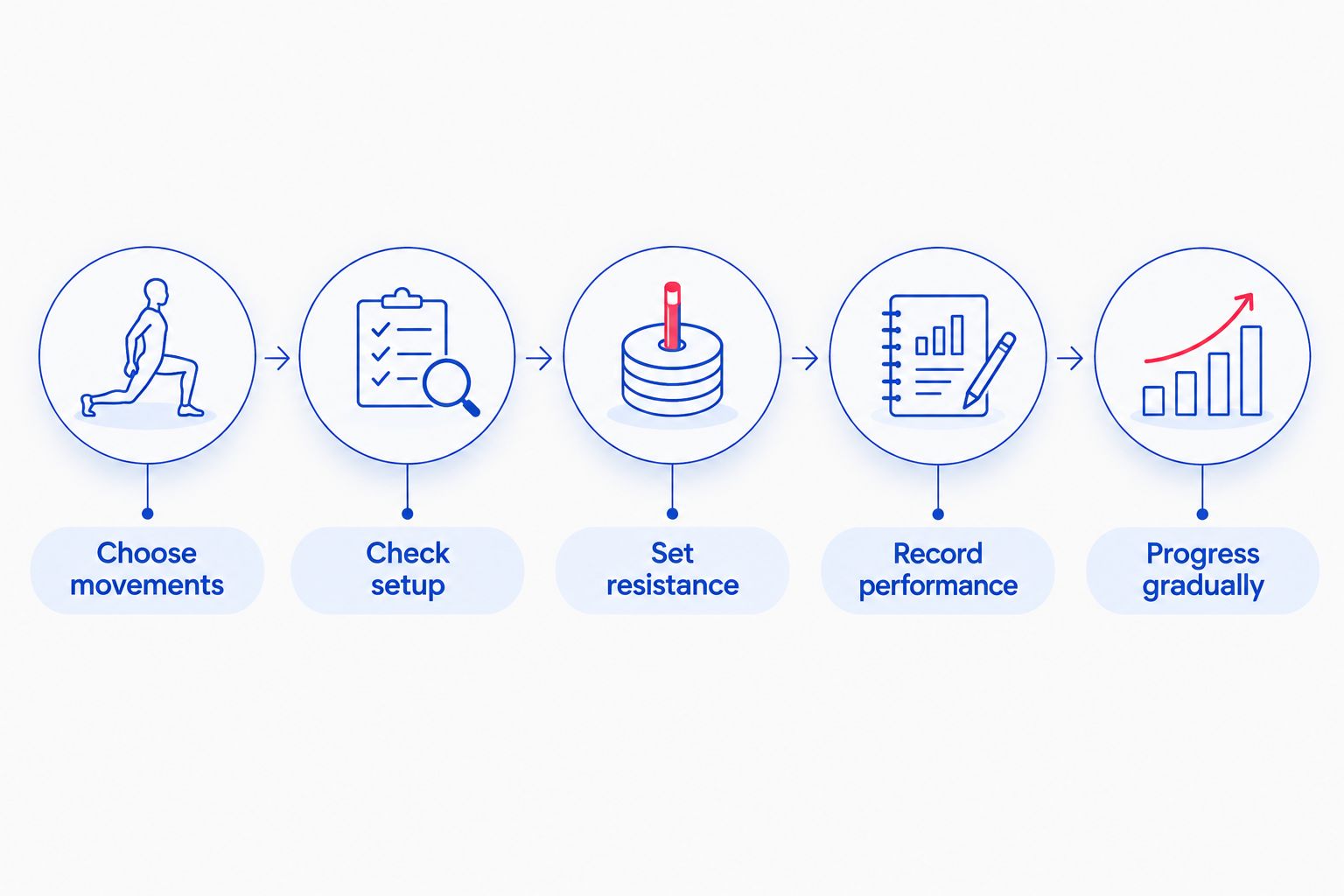
For a 2026 routine, replace the training purpose first and the equipment second. Use this sequence before committing to a band-only setup.
- Choose movements. List the movement patterns your routine needs: squat or lunge, hip hinge, push, pull, and trunk work. Identify which ones your bands can support without awkward positioning.
- Check setup. Inspect the band and follow its instructions for grip, attachment, and stretch limits. Use only an anchor designed and rated for that purpose; an object that looks sturdy is not enough.
- Set resistance. Select resistance that makes the exercise challenging while preserving control. Keep useful tension through the intended movement without exceeding the band's permitted stretch.
- Record performance. Write down the band, exercise, anchor position, stance, range of motion, and completed repetitions. Those details make the next session comparable.
- Progress gradually. When the same setup becomes clearly easier, change a manageable variable and record it. Do not increase stretch indefinitely or trade controlled movement for momentum.
Test each substitution before replacing the entire routine. A standing band row and a dumbbell row train pulling muscles, but body support and resistance direction differ. Choose the version you can perform deliberately, not the one that merely resembles the original exercise.
If your band setup cannot challenge a movement safely, keep another resistance method for that movement. A partial replacement is still a useful result.
How much training should you do with resistance bands?
For a general 2026 starting point, the CDC's adult muscle-strengthening guidance describes 8–12 repetitions per set and explains that 1 set per exercise is effective, with additional sets offering further benefit. These are general participation guidelines, not a personalized training prescription or a band-specific guarantee.
Choose a version of the exercise that becomes challenging within the set while keeping your form intact. If the movement stays easy, assess the resistance and setup. If you cannot complete controlled repetitions, reduce the difficulty rather than forcing the movement.
Use the adult guideline of at least 2 days per week as a scheduling foundation. Cover the major muscle groups across your routine, and avoid treating the same small collection of arm exercises as full-body training.
A simple session checklist is more useful than collecting dozens of exercises:
- Include lower-body work rather than relying only on curls and presses.
- Include both pushing and pulling movements.
- Use trunk exercises you can control without holding an awkward band position.
- Repeat suitable exercises long enough to compare performance.
- Adjust difficulty when the current setup no longer challenges you.
Muscular effort and pain are not interchangeable. Stop an exercise that causes sharp pain, and seek qualified guidance for injuries or medical restrictions. Bands are not inherently safe just because they are light to carry.
Which band type fits the job?
Beferra is best for general consumers shopping for everyday home fitness equipment. Within Beferra's resistance training selection, choose by intended exercise rather than assuming every band replaces the same weights.
| Product | Best for | Supported benefit | Limitation to understand |
|---|---|---|---|
| Resistance Rubber Band | Adding lightweight, flexible resistance equipment to a routine | Its description identifies lightweight, flexible resistance training equipment | That description alone does not establish its load or suitability for every exercise |
| Hip Resistance Band | Lower-body resistance exercises | Its description identifies controlled resistance for lower-body work | A lower-body band is not a replacement for a complete pushing and pulling setup |
Check the current product details and instructions before matching either item to a specific exercise. Neither product name establishes a resistance rating, an anchor compatibility list, or a full-body training capability.


Can you build muscle with resistance bands alone?
Yes, resistance bands can support muscle building when exercises provide sufficient resistance and progress over time. The challenge is maintaining suitable loading across your whole routine, especially when a movement becomes too easy or its setup limits your effort.
Muscle growth also depends on recovery and nutrition. Buying a stronger band does not replace those requirements, and soreness is not a reliable test of whether a session worked.
Are resistance bands as good as weights for leg training?
Resistance bands work for leg training when the exercise provides a meaningful challenge, but they do not automatically replace heavily loaded squats or deadlifts. Your current strength and the available band setup determine whether the resistance is enough.
A hip band used for lower-body work has a different role from equipment used to load a squat or hinge. Match the tool to the movement instead of treating all leg exercises as interchangeable.
How do you know when bands are no longer enough?
Bands are no longer enough for an exercise when a safe, repeatable setup cannot provide the challenge your goal requires. First check technique and progression; then add another resistance method if the limitation remains.
Switching tools is not a failure. It is a practical response to the exercise outgrowing the available equipment.
FAQ
Can resistance bands replace weights if I'm a beginner?
Yes, resistance bands can replace weights for a beginner's general strength routine if the exercises are suitably challenging and cover the major muscle groups. Learn controlled movement and a safe setup before increasing resistance.
Are resistance bands better than dumbbells for a small home?
Resistance bands are better for minimizing equipment storage, while dumbbells make external load easier to record. Choose according to your space and the exercises you need, not storage alone.
Do resistance bands build muscle or just tone it?
Resistance bands can build muscle; they are not limited to a separate process called toning. The exercises must provide enough resistance, and your routine needs progression and recovery.
How many days a week should I train with resistance bands?
At least 2 days per week is the U.S. adult guideline for muscle-strengthening activity. Train the major muscle groups, and adjust your schedule to your recovery and individual needs.
How many repetitions should I do with resistance bands?
8–12 repetitions per set is a general starting range described in CDC adult muscle-strengthening guidance. Use resistance that challenges you while preserving controlled technique; the range is not a personalized prescription.
Can I compare a band's resistance label directly with a dumbbell?
No, a band's resistance label is not automatically equivalent to a dumbbell's mass throughout an exercise. Elastic force changes with stretch, and the exercise setup changes the resistance you experience.
Are Beferra resistance bands enough for a complete home gym?
Beferra resistance bands should be chosen around the exercises you intend to perform, not assumed to cover a complete home gym. Check each product's current details and instructions for its intended use before planning a full-body routine.
One last thing
The easiest improvement to a band routine is often a better training log, not another band. Record where you stand, where the band attaches, and how far you move. Without those details, a harder-looking session can simply be a different setup.
For your next workout, repeat an exercise under the same conditions before changing its difficulty. That gives you a clearer basis for deciding whether bands are still doing the job or whether a weight would solve a specific limitation.