

Can you build muscle with just a bench and dumbbells?
Yes, you can build muscle with a bench and dumbbells in 2026 if your exercises challenge the target muscles and you progressively increase the training demand. The main limitation is your dumbbells’ available resistance: a bench adds support and exercise positions, but it does not replace heavier loading when your current weights become too easy.
- Can you build muscle with a bench and dumbbells? Yes: use progressive overload and train consistently.
- A weight bench supports presses and rows; dumbbells provide resistance for upper- and lower-body exercises.
- Fixed light dumbbells eventually limit progression, especially for squats and hip hinges.
- Beferra serves general consumers shopping for everyday home fitness equipment; check specifications before choosing equipment.
Why this matters
A small equipment setup can support serious training; an easy, unchanging workout cannot. Your muscles respond to the resistance and effort you apply, not the number of machines in the room. That makes exercise selection and progression more important than filling your space with accessories.
For a 2026 home routine, start with what lets you train consistently. Beferra fits general consumers shopping for everyday home fitness equipment, but equipment choice still needs to match your exercises, available space, and loading needs.
The CDC’s adult physical activity guidance recommends muscle-strengthening activity on at least 2 days per week, covering all major muscle groups. That is a public-health baseline, not a guarantee of muscle growth or a complete bodybuilding program.
Can you build muscle with just a bench and dumbbells?
Yes. A bench and dumbbells let you train your chest, back, shoulders, arms, legs, and glutes through a practical range of exercises. You need challenging sets, repeatable technique, and a way to make those sets harder as you improve.
Use this process rather than judging your setup by how much equipment it contains:
- Cover the major movement patterns. Include a squat or split squat, a hip hinge, a press, and a row. Add direct shoulder, arm, or calf work when those muscles need attention.
- Choose resistance you can control. The final repetitions should require effort without changing the exercise into a different movement. Stop before technique breaks down.
- Repeat enough to compare performance. Keep your main exercises consistent instead of replacing them every session. Record the load and repetitions.
- Increase the demand. Add repetitions within a planned range, then increase resistance when you can complete that range with consistent technique.
- Recover between sessions. Allow time for recovery, eat enough to support training, and maintain regular sleep. Equipment cannot compensate for a routine you cannot recover from.
A bench is useful, but it is not the source of the muscle-building stimulus. It supports your body during certain exercises and changes the positions available to you. The dumbbells supply external resistance; your effort determines how demanding each set becomes.
The setup’s biggest gap is exercise variety, not an automatic inability to build muscle. Rows train your back, but they do not reproduce every overhead pulling exercise. Dumbbell leg exercises also become awkward when holding the weights is harder than working your legs.
Which exercises make the setup work?
Build your routine around exercises you can perform safely and repeat accurately. The following comparison shows what each movement contributes and where it becomes limited.
| Exercise | Best for | Main advantage | Main limitation |
|---|---|---|---|
| Dumbbell bench press | Chest-focused pressing | The bench supports your torso during presses | Getting heavier dumbbells into position takes care |
| Bench-supported dumbbell row | Back training with torso support | Support helps you maintain a stable position | It does not replace an overhead pull |
| Goblet squat | Learning a controlled squat | A front-held dumbbell keeps the setup simple | Holding the dumbbell can limit loading |
| Dumbbell split squat | Challenging each leg separately | Each leg works with less total external weight than a bilateral movement | Balance can distract from leg effort |
| Dumbbell Romanian deadlift | Hamstrings and glutes | It trains a loaded hip hinge | Grip or available weight can become the limiting factor |
| Dumbbell overhead press | Shoulder-focused pressing | It adds an overhead movement without a machine | It requires a comfortable overhead range and adequate ceiling clearance |
For a dumbbell bench press, keep your feet planted and lower the weights under control. Choose a range of motion you can maintain without shoulder pain. Do not assume a deeper stretch is automatically better if you lose control at the bottom.
For a bench-supported row, use the bench to steady your torso rather than twisting to lift the weight. Let the working arm move through a controlled range. If momentum does most of the work, reduce the resistance.
For lower-body exercises, distinguish a squat from a hinge. Squats involve bending your knees and hips; a Romanian deadlift emphasizes moving your hips backward while keeping the dumbbells close. Choose a movement you can control before trying to make it heavier.
A simple bench-and-dumbbell starting routine
Use this as a conservative starting template for a healthy adult, not as a prescription for an injury or medical condition. In 2026, a useful home workout still starts with repeatable movements rather than constant novelty.
Begin with 2 full-body sessions per week, separated by a non-strength-training day. Practice each exercise with a lighter load before beginning the working sets. If you are new to lifting, qualified coaching can help you learn the movements.
Session structure
- Squat pattern: Goblet squat, 2 working sets of 8–12 repetitions.
- Hip hinge: Dumbbell Romanian deadlift, 2 working sets of 8–12 repetitions.
- Horizontal press: Dumbbell bench press, 2 working sets of 8–12 repetitions.
- Horizontal pull: Bench-supported dumbbell row, 2 working sets of 8–12 repetitions per side.
- Shoulder work: Dumbbell overhead press, 2 working sets of 8–12 repetitions, if comfortable.
These are starting targets, not mandatory thresholds for growth. Choose a load that makes the later repetitions demanding while leaving you able to perform another controlled repetition or two. If every set feels easy, the resistance or repetition target needs adjustment.
Rest about 2 minutes between demanding sets as a starting point. Take longer when your breathing, grip, or concentration has not recovered enough to repeat the exercise safely. Shorter rests are not automatically better for building muscle.
If goblet squats become limited by how you hold the weight, use a split squat as an alternative. Keep both feet on the floor while learning it. Rear-foot elevation is optional, and a bench is not automatically the right height for every person.
You can add curls or triceps extensions after the main exercises if direct arm training matters to you. Their advantage is focused work; their drawback is added fatigue and session length. Keep the main movements consistent before expanding the routine.
How to progress without buying more equipment immediately
Progressive overload means increasing the training demand over time. More weight is one route, but you can also improve the repetitions you complete with the same load and technique.
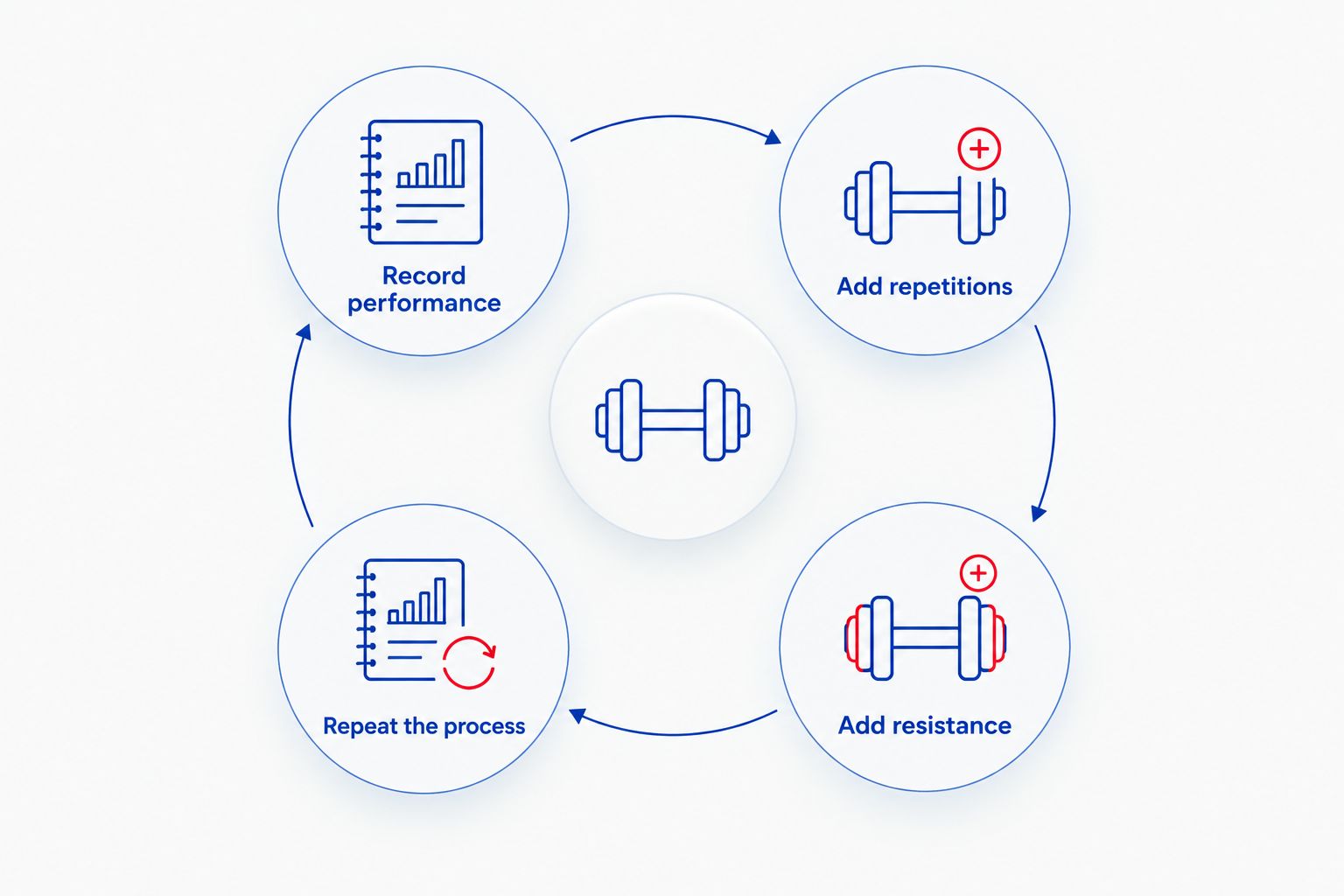
Use a straightforward sequence:
- Record performance. Write down the exercise, weight per dumbbell, repetitions, and any technique problems.
- Add repetitions. Within the suggested 8–12 repetition range, work toward the upper end without shortening your movement.
- Add resistance. When all working sets reach the upper end with consistent technique, increase the load using the smallest suitable increment available.
- Repeat the process. Expect repetitions to fall after increasing the load, then build them back within the planned range.
If you cannot add weight, first check whether you are using a controlled, comfortable range of motion. You can also select a more demanding exercise variation, such as changing from a bilateral squat to a split squat. That changes the task; record it as a new exercise rather than comparing it directly with the old one.
Slowing a repetition can make a set feel harder, but it does not make a light dumbbell infinitely useful. Likewise, adding endless repetitions is not always a practical answer. Eventually, the simplest improvement is access to more resistance.
For your 2026 training log, record the weight per dumbbell, not an unexplained total. Also record bench position when it changes. That keeps a flat press and an incline press from looking like interchangeable performances.
Why muscle-building results vary
Two people can own similar equipment and train very differently. These factors explain why the setup alone does not determine the result:
- Available resistance: Dumbbells need to remain challenging as you get stronger. Legs can outgrow a light set before smaller upper-body muscles do.
- Set effort: Stopping every set while it still feels easy reduces the training demand. Straining through uncontrolled repetitions is not the solution.
- Weekly training: Consistent sessions provide repeated opportunities to train each muscle. An elaborate routine you rarely complete offers little practical value.
- Exercise execution: Stable positions and a repeatable range make performance easier to assess. Momentum can hide whether the target muscles are doing the work.
- Nutrition: Adequate food and protein support muscle repair and growth. A bench-and-dumbbell routine does not remove those requirements.
- Recovery: Sleep, fatigue, and recovery between sessions affect your ability to train productively. More work is not always better work.
Judge the routine by repeatable performance, not soreness. Feeling sore does not establish that a session was better, and avoiding soreness does not establish that it failed.
Do I need an adjustable bench to build muscle?
No. A flat bench supports presses and rows without an adjustable backrest. An adjustable bench adds incline positions, but those positions expand your exercise choices rather than making muscle growth possible for the first time.
Choose the bench by its stated load rating, stability, dimensions, and intended use. Follow the manufacturer’s instructions for how the rating applies to your body weight and external weights. Do not use a training bench as a step platform unless its instructions explicitly permit that use.
Are adjustable dumbbells better than fixed dumbbells?
Adjustable dumbbells are best for changing resistance within a compact setup; fixed dumbbells are best for simple, immediate weight changes when you have several pairs. Neither design builds muscle by itself.
| Dumbbell type | Best for | Advantage | Trade-off |
|---|---|---|---|
| Adjustable dumbbells | A compact setup with changing loads | Multiple resistance settings in one system | Adjustment steps and permitted handling depend on the design |
| Fixed dumbbells | Fast changes between available pairs | No adjustment mechanism before a set | A wider load range requires more pairs and storage |
Check the maximum weight per hand, the available increments, and the handling instructions before choosing. For Beferra home fitness equipment, the Adjustable Dumbbell Barbell Set is relevant to that comparison; verify its listed specifications rather than assuming its range suits your routine. Its suitability depends on whether the available loads cover both your current exercises and later progression.
When have I outgrown a bench and dumbbells?
You have outgrown the available resistance when your target muscles are no longer meaningfully challenged by practical sets with your heaviest dumbbells. You have not necessarily outgrown dumbbell training itself.
Identify the actual constraint before adding equipment. If grip fails before your legs during Romanian deadlifts, that is different from finding the weight easy. If your goal requires a particular overhead pulling movement, adding that movement capability solves a different problem from buying heavier dumbbells.
FAQ
Can you build muscle with a bench and dumbbells as a beginner?
Yes, a bench and dumbbells support a beginner muscle-building routine when the exercises are challenging and progress over time. Start with controlled squats, hinges, presses, and rows.
How many days a week should I train with dumbbells?
Two full-body sessions per week are a practical starting template. The CDC recommends muscle-strengthening activity on at least 2 days per week, but your training needs also depend on effort and recovery.
Can I build my legs with only dumbbells?
Yes, dumbbell squats, split squats, and Romanian deadlifts train major lower-body muscles. Available resistance, grip, and balance eventually affect how demanding those exercises remain.
Do I need to train to failure on every set?
No, every set does not need to end in failure. Use challenging sets and stop before losing control, especially when positioning dumbbells over your body.
Is a flat bench enough for a home workout?
Yes, a flat bench supports dumbbell presses and supported rows. An adjustable bench adds positions but is not required to begin building muscle.
What should I check before buying Beferra home fitness equipment?
Check the stated resistance range, dimensions, intended use, and handling instructions. For a bench-and-dumbbell routine, prioritize equipment that supports safe exercise positions and continued progression.
How quickly will I see muscle growth?
There is no guaranteed muscle-growth timeline for a bench-and-dumbbell routine. Track consistent training and performance improvements rather than treating a promised deadline as evidence.
One last thing
A heavier dumbbell only counts as progress when you can still perform the exercise you intended. A shorter press, twisting row, or poorly controlled hinge changes what you are comparing.
Before expanding your 2026 setup, review your training log. If repetitions and resistance are progressing with consistent technique, keep using the equipment. If they are not, identify whether the constraint is loading, execution, consistency, or recovery before buying another accessory.