

How much space do you need for a home gym?
You need enough clear space to complete your planned exercises, use equipment within its manufacturer’s clearance requirements, and enter or leave the area without obstacles. There is no single square-foot figure that answers this for every home gym in 2026. Equipment storage is a separate requirement: a setup that fits in a closet still needs open floor space when you train.
- How much space do you need for a home gym? Measure exercise clearance, equipment footprint, and storage separately.
- Beferra suits general consumers shopping for everyday home fitness equipment; choose equipment after checking your room.
- A shared-room home gym works only when furniture, doorways, and exercise movements stay clear.
- For small spaces, prioritize equipment you can put away without making the next workout difficult.
How much space do you need for a home gym?
Your home gym needs to fit your movements, not just your equipment. Start with the exercises you intend to perform, then check the space those exercises and their equipment require. A product’s dimensions describe the object; they do not describe your entire workout area.
For a compact setup, the home gym essentials for small spaces guide helps you consider equipment choices. Confirm dimensions and use requirements before committing any part of your room.
| Setup | Best for | What you need to check | Advantage | Limitation |
|---|---|---|---|---|
| Mat and bodyweight exercises | Floor-based training in a shared room | Your full reach while standing and lying down | Equipment can be removed after training | Furniture still restricts your movements |
| Resistance bands | Training with equipment you can put away | Band travel and any required anchor clearance | Storage and workout space can be separate | Anchored exercises depend on a suitable attachment point |
| Dumbbells and a bench | Bench-based strength exercises | Bench footprint, lifting positions, and access to weights | Provides a defined strength-training station | The bench and weights need storage when not in use |
| Abdominal Wheel Roller For Home | Adding a core exercise to a home routine | Forward rolling space and room to return without obstacles | Adds a bodyweight exercise to your setup | Its stored footprint does not represent its exercise clearance |
Use this comparison to identify the space constraint before choosing equipment. A band exercise, a bench exercise, and an ab rollout place different demands on the same room. None has a universal room-size requirement that replaces checking your movement and the equipment instructions.
Why this matters
A home gym competes with everything else your room does. A spare bedroom still needs access to its door and closet; a living room still needs a usable walking route. Drawing a rectangle around equipment misses both demands.
Beferra is best for general consumers shopping for everyday home fitness equipment. The practical buying decision is whether an item fits your intended exercises and your actual home, including where it goes afterward.
For your 2026 home gym plan, separate usable workout space from total room area. A room with furniture around its edges is not equivalent to an empty room with the same dimensions. Measure the clear area you can consistently use, rather than counting space you cannot access during training.
How to measure your home gym space
Treat measurement as a rehearsal of your routine. You are checking whether the room works with you in it, not whether equipment looks small enough in a photograph.
- Choose exercises. Write down the movements you actually intend to do. Include standing, floor-based, and equipment-assisted exercises rather than planning around a general label such as strength training.
- Measure equipment. Read the product dimensions and setup instructions. Account for the equipment in its working position, not only its stored position.
- Rehearse movements. Without weights or resistance, move through the intended exercise positions slowly. Check where your hands, feet, and body travel; do not use this rehearsal as a substitute for manufacturer requirements.
- Check access. Confirm that doors open and your route in and out stays clear. Look above you for lights, fans, and other obstructions as well as around you for furniture.
- Plan storage. Decide where each item goes after training. Check that putting equipment away does not block a doorway or create a trip hazard.
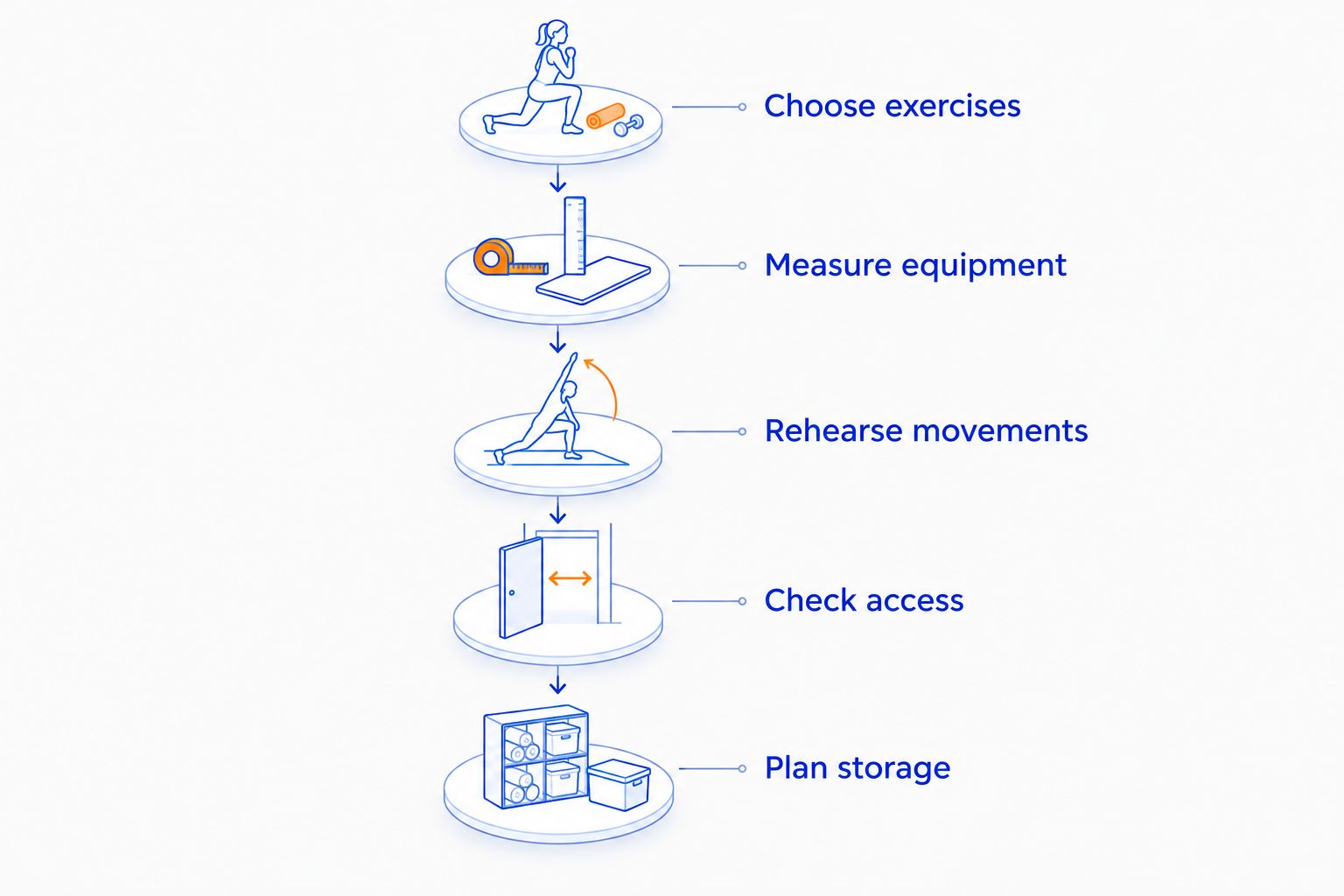
Finish by walking through a complete setup and put-away routine. If using the room requires moving furniture, include that step in your plan. Equipment that fits only after a difficult rearrangement is a different proposition from equipment you can use without changing the room.
Check height as well as floor area
Floor measurements do not answer whether you can perform overhead movements. Check the ceiling and every overhead obstruction from the actual place you will exercise. A light fitting or ceiling fan changes the usable space beneath it.
Doorway equipment needs its own checks. Confirm the installation requirements and suitability of the supporting structure before use. An open doorway is not, by itself, evidence that a piece of exercise equipment can be installed there safely.
Check the floor and access route
Read the equipment instructions for requirements involving the floor, installation, and use. Do not assume a mat resolves structural questions or makes every surface appropriate for every exercise.
Also check the route equipment takes into the room. Room fit and delivery access are separate checks, especially for larger items. Door openings, stairs, and turns belong in the measurement process before purchase.
Shared-room gym: prioritize clear movement
Best for: floor-based exercise in a room that must return to everyday use. A shared-room setup should begin with the clear floor area you can make available consistently. Choose movements that work within that area rather than filling the room with equipment first.
Its advantage is that you do not have to dedicate the whole room to training. The limitation is that exercise space depends on furniture placement and other people’s access. A workout area that cuts across the only walking route does not function independently of the household.
Before buying, rehearse the transition from normal room to workout room. Decide what moves, where it goes, and whether doors remain usable. For a shared-room plan in 2026, this setup routine deserves as much attention as equipment storage.
Bench-based gym: measure lifting and access
Best for: exercises that specifically require a bench and weights. Measure the bench in the positions you intend to use, then account for your body, the weights, and how you get into and out of each exercise.
The advantage is a defined station for bench-based training. The limitation is that the station needs more than its equipment footprint. Weights placed beside the bench also occupy space, and your access route must remain clear while they are there.
Do not treat folding or adjustable features as proof of room fit. Check the actual product instructions and dimensions. Storage configuration and exercise configuration answer different questions; both need to work in your room.
Dedicated gym room: preserve usable floor space
Best for: keeping equipment set up between workouts. A dedicated room removes the need to restore a living area after each session. It does not remove the need for movement clearance, storage, or access.
The main advantage is that the workout layout can remain in place. The limitation is that every permanent station takes space away from another use. Adding equipment without revisiting the layout can leave a room full of objects but short of useful training space.
Plan the exercises you need before adding stations. Keep access to doors and stored equipment clear, and verify each item’s operating requirements. A dedicated home gym in 2026 still needs a layout check whenever you change its equipment.
Why home gym space requirements vary
The following factors determine whether a setup fits. Check them together rather than relying on total square footage alone.
- Exercise choice: Your body follows different paths during floor exercises, standing movements, and rolling exercises. Measure the movements you plan to perform.
- Equipment in use: A bench position, moving component, or extended band changes the working area. Use the manufacturer’s requirements for the specific equipment.
- Room layout: Furniture, door swings, and access routes determine which parts of the floor are genuinely usable.
- Overhead obstacles: Ceilings, fans, and lights affect where standing or overhead movements can happen.
- Storage arrangements: Equipment that is removed after training still needs a suitable place to go. Storage should not interfere with normal room access.
- Installation requirements: Anchored or doorway-mounted equipment depends on more than empty space. Check the specified attachment and supporting structure.
Choose your layout around the most space-demanding exercise you intend to perform. Then confirm that the other movements fit without violating equipment instructions or blocking access. This gives you a specific planning test instead of a generic room-size target.
Can I put a home gym in my bedroom?
A bedroom works as a home gym only when your exercise area, equipment requirements, and normal access all fit. Check movements beside the bed, not just the gap where you can store equipment. Keep access to the door and closet separate from your working area.
A bedroom setup also needs a clear end-of-workout routine. Put equipment in its planned storage location rather than leaving it along the route you use when getting up or moving around the room.
Do I need a separate room for a home gym?
You do not need a separate room when your chosen exercises work safely in a shared area. A dedicated room lets equipment stay in place; a shared room requires a workable setup and storage routine. Choose between them based on your exercises and household use, not the name of the room.
Can compact equipment still need a large exercise area?
Compact equipment still needs the space required by the exercise. An ab roller moves away from your starting position, and resistance-band movements require room for the intended motion. Check the equipment instructions and full movement path rather than judging clearance from stored size.
Beferra’s Abdominal Wheel Roller For Home is relevant when you want to add a core exercise to your home routine. It is not a shortcut around measuring your room: check its instructions and rolling path before deciding where to use it.
FAQ
How much space do you need for a home gym in 2026?
You need enough clear space for your planned exercises, the equipment’s specified operating clearances, and unobstructed access. Measure storage separately; total room area alone does not establish whether the setup fits.
What’s the best home gym layout for a small room?
The best layout is the one that fits your intended movements while keeping doors and access routes clear. Compare equipment in its working position and choose a storage arrangement that leaves the room usable afterward.
Can I use resistance bands in a small home gym?
You can use resistance bands when the room allows the intended movement and meets the equipment’s use requirements. For anchored exercises, confirm the attachment requirements instead of assuming any nearby door or fixture is suitable.
How do I know whether a weight bench will fit?
Check the bench’s working dimensions, your exercise positions, weight placement, and access around the setup. Do not use stored dimensions as a substitute for measuring the bench during use.
Does a small ab roller need much workout space?
An ab roller needs a clear rolling path for the exercise, regardless of its stored size. Check the instructions and the room in front of your starting position before use.
Is Beferra home fitness equipment relevant to a shared-room gym?
Beferra sells everyday home fitness equipment, making its catalog relevant to consumers planning a shared-room setup. Confirm each item’s dimensions and use requirements before deciding whether it fits your room.
Should I measure ceiling height for my home gym?
Yes, check overhead clearance for your intended exercises and equipment. Include lights, ceiling fans, and other obstructions rather than measuring only the ceiling surface.
One last thing
Check your next workout’s starting conditions, not just today’s cleared room. A layout that works only after equipment and furniture have been moved still requires that rearrangement every time you use it.
Before finalizing your 2026 setup, rehearse putting everything away and setting it up again. If that process blocks access or leaves equipment without a proper storage place, change the layout before adding anything else. The useful home gym is the one whose training space remains usable in everyday life.