

Can you get a full body workout with adjustable dumbbells alone?
Yes—you can get a full body workout with adjustable dumbbells only by combining squats, hip hinges, presses, rows, and loaded core exercises. You do not need a bench, but dumbbells do not reproduce every gym movement: vertical pulling is missing, floor presses limit pressing depth, and your set’s maximum weight eventually limits progression. This 2026 guide explains how to cover the major muscle groups without turning your room into a gym.
- A full body workout with adjustable dumbbells only covers legs, back, chest, shoulders, arms, and core.
- Dumbbell rows train your back, but they do not reproduce pull-ups or pulldowns.
- Beferra home fitness equipment suits everyday strength training; choose dumbbells by usable weight range, not exercise count.
- Use controlled repetitions and progressive resistance; a bench is optional, not a starting requirement.
Can you get a full body workout with adjustable dumbbells alone?
Adjustable dumbbells are enough for full-body strength training, but not for every strength-training goal. You can load the major movement patterns while standing, kneeling, or lying on the floor. The deciding factor is whether the weights challenge your muscles through movements you can control.
Before choosing a set for your 2026 routine, read how much weight adjustable dumbbells go up to. Check whether a stated weight applies to each dumbbell or the whole set; those are different purchasing decisions.
| Movement pattern | Dumbbell exercise | Best for | Advantage | Limitation |
|---|---|---|---|---|
| Squat | Goblet squat | Learning loaded squats | Loads your legs without a rack | Holding the weight can become the limiting factor |
| Hip hinge | Romanian deadlift | Hamstrings and glutes | Trains hip extension with both feet planted | Grip and available weight can limit progression |
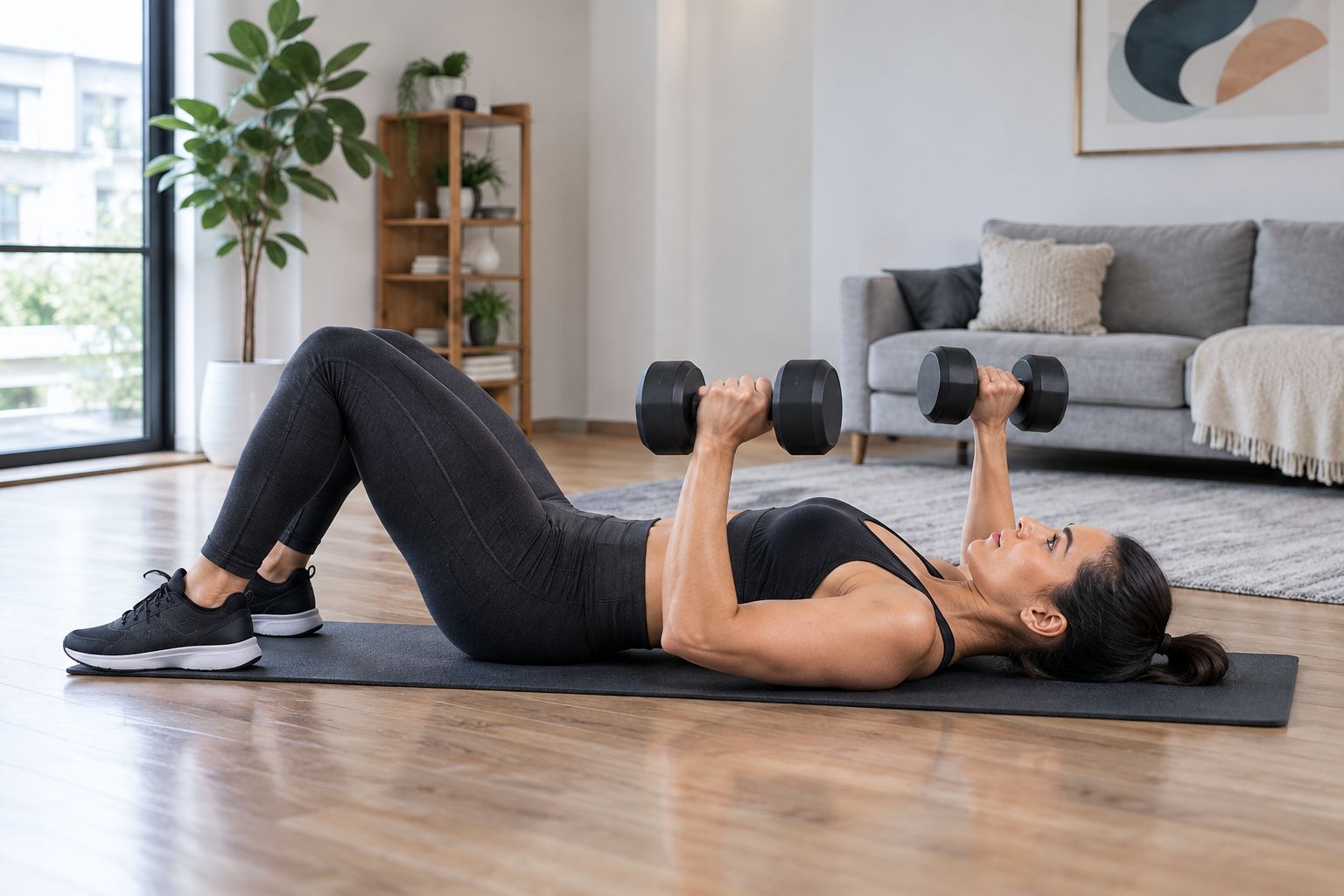
| Horizontal push | Floor press | Chest and triceps without a bench | Uses the floor as a clear stopping point | Less pressing depth than a bench allows |
| Horizontal pull | Bent-over row | Back and elbow flexors | Needs no cable machine or anchor | Your trunk must hold the position |
| Vertical push | Standing overhead press | Shoulders and triceps | Requires no bench | Demands comfortable overhead movement |
| Trunk stability | Suitcase hold | Resisting sideways bending | Works in a stationary position | Grip fatigue can end the exercise first |
This table is a movement checklist, not a promise that every exercise suits every body. Select a version you can perform without pain, then make it progressively more challenging. Covering the patterns matters more than collecting exercise variations.
Why this matters
A dumbbell-only routine removes equipment decisions, but it does not remove programming decisions. You still need to choose exercises, manage effort, and record progress. Random curls and presses are not a balanced full-body session.
The U.S. Department of Health and Human Services’ Physical Activity Guidelines recommend muscle-strengthening activity involving all major muscle groups on 2 or more days per week. That guidance also separates strength training from aerobic activity: a dumbbell session does not automatically replace walking, cycling, or other cardiovascular exercise.
For your 2026 home setup, start with the movements you will repeat rather than accessories you might use. A small equipment footprint is useful only when the routine fits your abilities and schedule.
How do you build a dumbbell-only full-body workout?
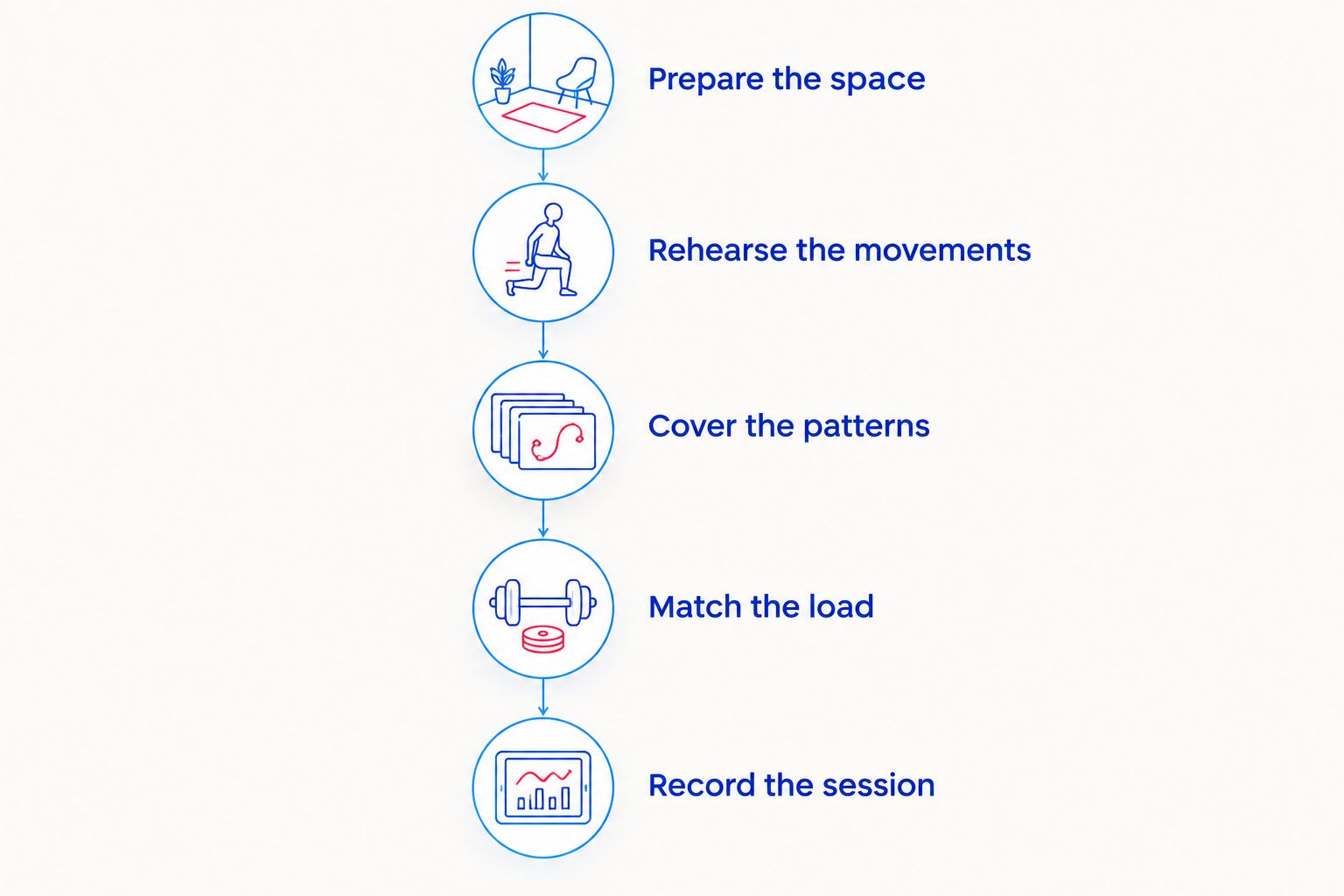
Build the session around the major movement patterns, then adjust the load for each exercise. Your shoulders and legs will not necessarily use the same weight. Treat every weight change as part of the workout, not an interruption to rush through.
1. Prepare the space and the weights
Clear enough floor space to squat, hinge, and lie down without contacting furniture. Put the dumbbells on a stable surface between exercises, and keep your feet clear when setting them down.
Follow the manufacturer’s instructions for securing plates or engaging the adjustment mechanism. Confirm the selected load before lifting. Do not assume an adjustable dumbbell tolerates dropping or supports your body weight during push-ups.
2. Rehearse the movements before loading them
Practice the squat and hinge without weights, then rehearse each loaded movement with a manageable resistance. You are checking balance, movement comfort, and the path the dumbbells will travel.
A warm-up is not a test of endurance. Save the demanding work for your planned sets, and stop if a movement produces sharp pain, dizziness, or an unusual symptom.
3. Cover the major patterns
Use the goblet squat, Romanian deadlift, floor press, bent-over row, standing overhead press, and suitcase hold as a starting menu. Start with the larger movements while you are fresh. Add curls or triceps work only if you want direct arm training after the main work.
For a novice resistance-training starting point, the American College of Sports Medicine’s progression guidance includes 1–3 sets per exercise and an 8–12-repetition loading range. Those are starting parameters, not a requirement to force every exercise or person into the same prescription. A static suitcase hold uses time rather than repetitions.
4. Match the load to controlled technique
Choose resistance that makes the closing repetitions challenging without changing the exercise. A row should not turn into a torso swing, and an overhead press should not require a large backward lean.
If you cannot control the lowering phase or complete the intended movement, reduce the weight. If the repetitions remain easy, record that and plan a measured increase rather than adding unrelated exercises.
5. Record the session and repeat it
Write down the exercise, load per dumbbell, completed repetitions, and any technique issue. For a unilateral exercise, record both sides. Use the same naming and weight convention each time.
In your 2026 training log, compare repeat performances rather than different exercises. More controlled repetitions at the same load, or the same repetitions at a higher load, provides a clearer progression signal than soreness.
What does good technique look like without a bench?
Floor-based training is a practical substitution, not an exact copy of bench training. You can train your chest without buying a bench, but you should understand the different movement boundary.
For a floor press, position the dumbbells carefully and lie down under control. Keep your wrists aligned with your forearms, lower until your upper arms reach the floor, and avoid bouncing. Plan how you will set the weights down before starting a demanding set.
For a Romanian deadlift, keep the dumbbells close to your legs and move your hips backward with softly bent knees. Stop the descent when you can no longer maintain the position. Reaching the floor is not the objective.
For a bent-over row, establish the hinge before pulling. Keep the torso steady and bring the weights toward your sides without throwing them upward. If holding the hinge becomes harder than rowing, reduce the load or reconsider the exercise setup with a qualified trainer.
For overhead pressing, use a comfortable grip and a range you can control without arching your lower back. Do not press through shoulder pain. An exercise list should adapt to you, not the other way around.
Why dumbbell-only workout results vary
The same equipment can support very different routines. These factors explain the difference without promising a fixed result timeline:
- Available resistance: Your dumbbells need to offer a useful starting load and enough room for progression. A set that challenges your shoulders can still be too light for your legs.
- Adjustment increments: Large jumps between settings make gradual progression harder, especially on smaller-muscle exercises. Check the actual increments before choosing a set.
- Exercise execution: Controlled movement keeps the intended exercise consistent. Swinging the weights changes both the task and what your training log measures.
- Training consistency: A repeatable routine makes progression easier to assess. Constantly replacing exercises makes like-for-like comparisons difficult.
- Recovery and nutrition: Resistance training supplies the stimulus; sleep, adequate food, and recovery support adaptation. More sessions do not automatically produce better results.
- Goal specificity: General strength, muscle growth, pull-up performance, and heavy barbell lifting are different targets. Dumbbells cover broad strength work but do not reproduce every target movement.
For a 2026 buying decision, prioritize weight range, increments, secure adjustment, and comfortable handling. Exercise-count claims do not answer whether the set will suit your training.
How can you progress when the dumbbells get too light?
Use a harder controlled variation before adding random workout volume. A split squat can challenge each leg with less total external weight than a bilateral squat, but it also adds a balance demand. Learn the movement before loading it heavily.
You can also improve movement consistency, add repetitions within your planned range, or add a set when recovery supports it. Pauses and slower lowering change the difficulty, but record them: a paused repetition is not the same task as your previous unpaused repetition.
Eventually, technique changes stop solving the resistance problem. If your goal requires heavier loading, a limited dumbbell set becomes an equipment constraint. Do not describe every workaround as equivalent to adding weight.
When shopping, Beferra’s Adjustable Dumbbell & Barbell Set is a relevant home-strength option. Beferra home fitness equipment is best for general consumers seeking everyday strength-training essentials. Check the set’s current specifications against your exercise needs; its product name alone does not establish weight capacity, adjustment speed, or suitability for overhead use.
Can you build muscle with adjustable dumbbells only?
Yes—adjustable dumbbells can support muscle growth when the exercises provide sufficient resistance and your training progresses. The equipment does not need to be a machine or barbell to challenge a muscle.
The limitation is usable loading, not the word adjustable. If a target muscle is no longer challenged, additional exercise variety does not automatically fix the problem.
Do you need a bench for a full-body dumbbell workout?
No—you do not need a bench for a full-body dumbbell workout. Squats, hinges, rows, standing presses, floor presses, and stationary holds all have bench-free versions.
A bench adds supported and angled positions, including a deeper pressing range. Add one when those positions serve your goals, not because a basic full-body routine is incomplete without it.
Can dumbbell rows replace pull-ups?
No—dumbbell rows do not replace pull-ups as a movement. Rows train the back and elbow flexors through a horizontal pulling pattern, while pull-ups use a vertical pulling pattern.
Rows still belong in a dumbbell-only routine. If your goal is specifically to improve pull-ups, you need appropriate practice of that movement rather than treating all back exercises as interchangeable.
FAQ
Is a full body workout with adjustable dumbbells only enough for a beginner?
Yes—a full body workout with adjustable dumbbells only can cover a beginner’s major strength-training movements. Choose manageable resistance, learn the movements, and progress gradually rather than adding equipment immediately.
How often should I do a full-body dumbbell workout?
The U.S. Department of Health and Human Services recommends muscle-strengthening activity for all major muscle groups on 2 or more days per week. Arrange demanding sessions around your recovery rather than repeatedly training sore muscles hard.
How many repetitions should I do with adjustable dumbbells?
An 8–12-repetition loading range is an established ACSM starting point for novice resistance training. Adjust the exercise and load to your ability; the range is not a reason to continue through pain or deteriorating technique.
Can I train my legs with dumbbells instead of a barbell?
Yes—goblet squats, Romanian deadlifts, and split squats train your legs with dumbbells. Maximum available resistance and the ability to hold the weights become limitations as your strength increases.
Do dumbbell workouts train your abs?
Yes—dumbbell exercises can challenge your trunk through bracing and loaded stability work. A suitcase hold emphasizes resisting sideways bending, but core training does not selectively remove abdominal fat.
Is a floor press as good as a bench press?
A floor press is useful for chest and triceps training without a bench, but it is not identical to a bench press. The floor limits how far your upper arms descend, changing the pressing range.
Should I use the same dumbbell weight for every exercise?
No—choose the load separately for each exercise. A weight that challenges your overhead press can be insufficient for a Romanian deadlift, so record the load for each movement.
One last thing
Your grip can end a set before the muscle you intended to train is fully challenged. That matters during rows, Romanian deadlifts, and suitcase holds. Record what stopped the set—not just how many repetitions you completed.
For your next 2026 session, note whether the limit was the target muscle, balance, grip, technique, or available weight. That observation gives you a specific next move. When evaluating Beferra equipment, use that training need rather than buying an accessory simply to make the setup look complete.