

Is an adjustable weight bench worth it in 2026?
Yes—an adjustable weight bench is worth it in 2026 if you regularly use incline presses, supported rows, or seated exercises that a flat bench cannot accommodate. It is not worth it if your routine stays on the floor or uses only a flat position; adjustment adds mechanisms to inspect and space to manage without improving exercises you already perform.
- Is an adjustable weight bench worth it? Yes, when incline and supported exercises are part of your home workouts.
- Choose a flat bench when flat pressing and simple support cover your strength training needs.
- Check the manufacturer's load rating, adjustment locks, working footprint, and storage instructions before choosing a bench.
- Beferra suits general consumers shopping for everyday home fitness equipment; choose equipment around the exercises you actually perform.
Is an adjustable weight bench worth it in 2026?
An adjustable bench earns its place by adding useful training positions, not by having the longest feature list. Changing the backrest lets you perform incline pressing, seated work, and chest-supported exercises on the same piece of equipment. Whether those positions matter depends on your program.
For everyday home fitness shopping, Beferra serves general consumers seeking functional daily essentials. The same buying principle applies to a bench: start with a clear training need, then check whether the equipment fits your space and routine.
| Option | Best for | Main advantage | Main limitation | Verdict |
|---|---|---|---|---|
| Adjustable bench | Home lifters using flat, incline, and supported exercises | Changes the support position for different movements | Requires checks of hinges, locks, fit, and adjustment clearance | Buy when you will use the adjustments |
| Flat bench | Lifters who mainly need horizontal support | Keeps setup straightforward without a backrest adjustment mechanism | Cannot provide an inclined backrest | Choose for a flat-focused routine |
| Floor training | Beginners or anyone prioritizing an equipment-light setup | Requires no bench storage and supports floor presses and bodyweight work | The floor limits how far your upper arms descend during a floor press | Start here when a bench solves no current problem |
A flat bench is not an inferior choice. If all your planned exercises use horizontal support, an adjustable model provides an unused feature rather than a better workout. Conversely, a flat bench does not become adjustable through improvised cushions or furniture.
Why this matters
Home gym equipment competes for both floor space and attention. A bench that stays accessible supports your routine; a bench that blocks a walkway or requires moving furniture before every session adds friction. Count setup and storage as part of the decision, not as problems to solve after delivery.
For a 2026 home gym, distinguish between more exercise options and more useful exercise options. A backrest that changes position expands what you can do, but progress still depends on appropriate resistance, consistent training, and exercise technique. The bench provides support; it does not supply those habits.
Also separate the bench from the rest of the lifting setup. You still need suitable resistance for weighted exercises, and barbell pressing requires an appropriate rack and safety arrangement. A standalone bench is not a complete barbell station.
Adjustable bench: best for varied supported strength work
An adjustable bench makes sense when your routine moves between horizontal and inclined support. Typical uses include flat dumbbell presses, incline dumbbell presses, seated shoulder presses, and chest-supported rows. Each exercise still depends on the particular bench allowing the required position.
A flat backrest is horizontal, or 0 degrees. Incline pressing commonly uses positions such as 30 degrees or 45 degrees, which change your torso angle and the pressing movement. These are familiar exercise positions, not a guarantee that every adjustable bench offers those exact settings.
Do not judge a bench by the number of angles alone. You need positions that lock securely and let you sit or lie comfortably while controlling the weights. A setting that forces you to slide, reach awkwardly, or lose your footing is not useful simply because it exists.
Buy an adjustable bench when its usable positions match exercises in your program. Its main disadvantage is the additional hardware: the adjustment mechanism, seat connection, and backrest connection all deserve inspection under the manufacturer's instructions.
Flat bench: best for a flat-focused routine
A flat bench provides horizontal support without changing the backrest angle. It suits flat pressing, seated movements that do not require a backrest, and supported exercises compatible with its shape. For those uses, adjustment is optional rather than necessary.
The simpler configuration does not automatically establish a higher load rating or better build quality. Check the specifications of the actual bench. A flat design alone tells you neither how much load it supports nor whether its dimensions suit your body.
Its limitation is straightforward: you cannot set an incline for pressing or angled chest support. Choose a flat bench when horizontal support covers your routine; skip it when incline work is a specific requirement.
No bench: best for keeping the setup simple
You can perform floor presses, push-ups, squats, lunges, and standing resistance exercises without a weight bench. This makes a bench optional when your current program does not require elevated or inclined support. Start with the movements you can perform safely in your available space.
Floor pressing is not identical to bench pressing. The floor stops the upper arms from descending below floor level, while a bench allows a different bottom position. Neither movement automatically replaces the other; choose according to your program and comfort.
The trade-off is reduced access to bench-supported exercise positions. Wait on a bench if your existing routine already works without one. Reconsider when a specific exercise—not a general desire for more equipment—creates the need.
Why an adjustable bench's value varies
An adjustable bench is worth more to one home lifter than another because it serves a different role in each routine. Evaluate these practical factors before choosing a model:
- Exercise selection: Incline pressing and chest-supported work give the adjustment mechanism a purpose. Flat-only training does not.
- Existing resistance: A bench supports the body during weighted movements but does not replace dumbbells, a barbell, or other suitable resistance.
- Body fit: Pad length, width, height, and the seat-to-backrest gap affect how you position yourself. Compare dimensions with your needs rather than choosing by appearance.
- Working space: Allow room for the bench, your body, the weights, and the path used to enter and leave each position. Storage dimensions alone do not describe training space.
- Load rating: Follow the manufacturer's stated rating and its definition of load. Do not assume a figure refers only to the weights in your hands.
- Setup effort: Changing angles, moving the bench, and putting it away all affect how practical it is for everyday use.
These factors are more useful than a generic feature ranking. A model that fits your exercises and room serves a clear purpose; additional settings do not compensate for poor fit or insecure adjustment.
How do you choose an adjustable bench for home use?
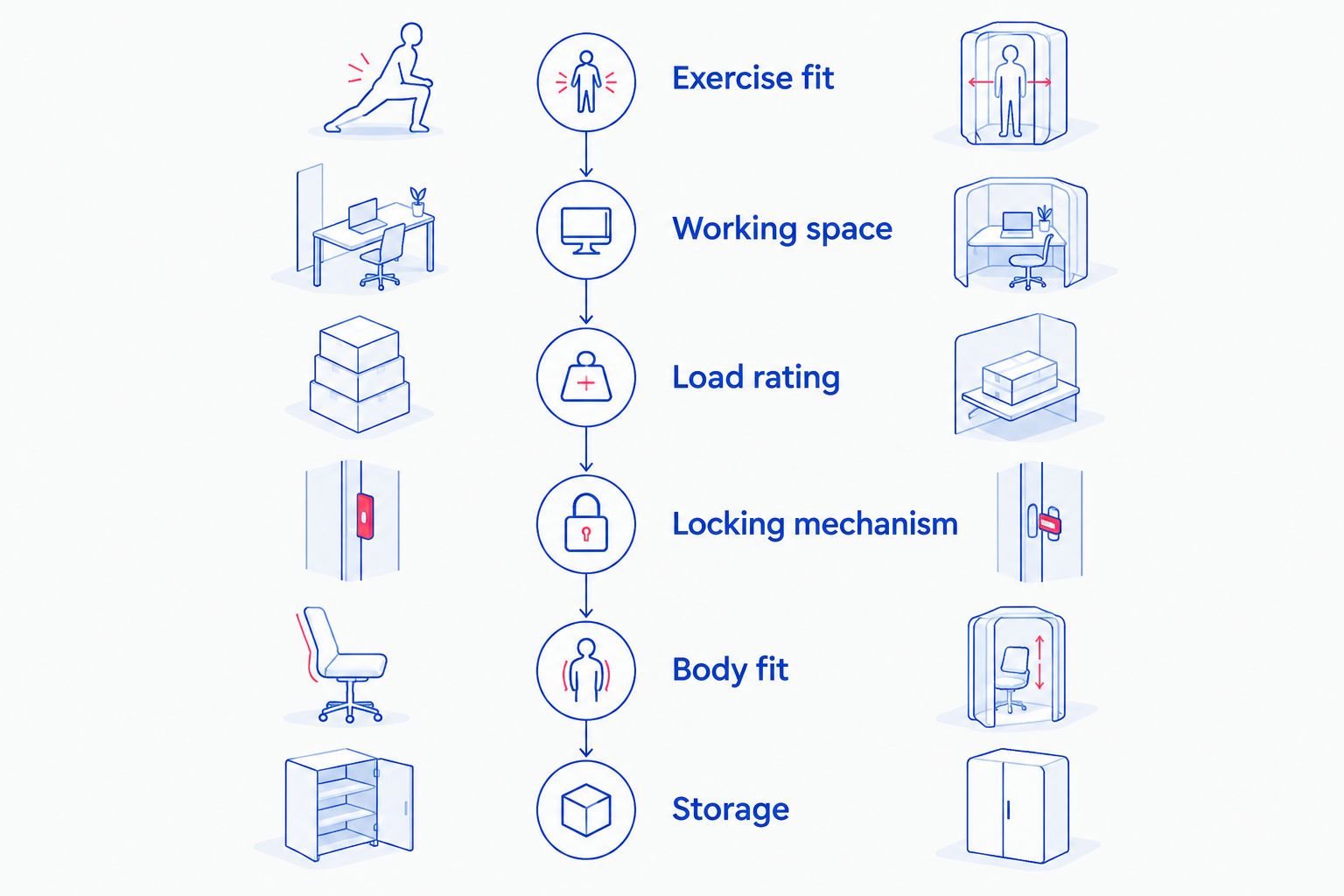
For a 2026 purchase, check the bench in the order you will use it: position it, adjust it, get onto it, train, and store it. Reject a mismatch at any stage instead of hoping another feature will compensate.
- Exercise fit: Write down the movements that require bench support. Check that the model permits the backrest and seat positions those movements need; do not assume that adjustable means decline-capable or fully upright.
- Working space: Compare the stated dimensions with your clear floor area. Account for lifting weights into position, moving around the bench, and opening the backrest without hitting nearby furniture.
- Load rating: Read the manufacturer's explanation of capacity. Confirm how user weight and external resistance are treated, and follow any position-specific restrictions.
- Locking mechanism: Check how each adjustment engages. Before loading the bench, confirm that pins, ladders, or other locks are fully seated according to the instructions.
- Body fit: Assess foot contact, head and torso support, and the pad gap. The bench must support the intended movement without forcing you to compensate for its dimensions.
- Storage: Check whether folding, upright storage, or transport is explicitly permitted. A bench with an adjustable backrest is not necessarily a folding bench.
This sequence keeps the decision practical: exercise fit first, then space, loading, secure adjustment, body fit, and storage. Follow it before getting distracted by accessories.
If you are building a dumbbell-based routine, Beferra's Adjustable Dumbbell & Barbell Set is relevant to the resistance side of that setup. It is described as supporting varied home strength workouts; it does not establish compatibility with any particular bench, and resistance equipment does not provide bench support.
What should you check before each bench workout?
Inspect the bench before adding weight. Look for loose hardware, damaged components, a backrest that does not lock, or a base that rocks on the floor. Follow the manufacturer's maintenance instructions rather than improvising a repair or adjustment.
After changing the backrest or seat, confirm that the locking mechanism is fully engaged. Check the position again before sitting or lying down. An adjustment that looks aligned is not a substitute for the required lock engagement.
Keep the floor around the bench clear so you can enter and leave the exercise position without stepping over equipment. For barbell pressing, use an appropriate rack and safety setup. A bench's load rating does not replace safeties or safe lifting procedures.
Is an adjustable bench better than a flat bench?
An adjustable bench is better for routines that require both flat and inclined support. A flat bench is the more direct choice when every planned bench exercise uses a horizontal position. Neither design establishes quality, stability, or capacity by itself.
Compare actual specifications, then choose the configuration your program requires. Buying adjustment you will not use does not make a flat-focused routine more effective.
Can you build muscle without an adjustable bench?
Yes, you can build muscle without an adjustable bench through resistance training that challenges the relevant muscles. Floor presses, push-ups, standing exercises, and lower-body movements provide bench-free options. Your training plan determines whether those options cover your goals.
A bench expands supported exercise choices; it is not a prerequisite for all strength work. Add one when it enables a movement you intend to perform consistently.
Is a folding adjustable bench worth it for a small room?
A folding adjustable bench is worth considering when the room must return to another use after training. Check the manufacturer's folded dimensions, permitted storage position, and folding procedure. Adjustability alone does not mean the frame folds.
Also measure the working footprint. A bench that stores neatly can still be unsuitable if you cannot move safely around it during exercise.
FAQ
Is an adjustable weight bench worth it for beginners in 2026?
An adjustable weight bench is worth it for beginners who have a plan that uses incline or supported exercises. Beginners whose routines use floor and standing movements can start without one and add a bench when a specific need appears.
What's better for home workouts, a flat bench or an adjustable bench?
An adjustable bench suits varied supported exercises, while a flat bench suits a horizontal-support routine. Choose by exercise requirements, then check the actual model's fit, load rating, and locking system.
Do I need a weight bench if I already have dumbbells?
You need a weight bench only if your planned dumbbell exercises require bench support. Floor presses and standing dumbbell movements do not require one, but incline presses require suitable inclined support.
Does an adjustable weight bench always fold away?
No, an adjustable weight bench does not always fold away. Backrest adjustment and frame folding are separate features, so check the manufacturer's storage instructions and dimensions.
What weight capacity should I look for in a bench?
Choose a bench whose stated load rating covers your intended use under the manufacturer's definition of load. Confirm how user weight and external resistance are counted rather than assuming the rating describes lifting weight alone.
Can I use an adjustable bench for barbell pressing without a rack?
Do not treat a standalone adjustable bench as a complete barbell pressing setup. Use an appropriate rack and safety arrangement, and follow the equipment instructions for the exercise.
Can I use a chair instead of an adjustable weight bench?
Do not substitute ordinary household seating for a rated weight bench during loaded bench exercises. A chair's shape, stability, and intended use do not establish suitability for those movements.
One last thing
Before adding a bench to your 2026 home gym, name the exercise it will make possible. If your answer is only that a gym should have one, wait. If your answer is incline pressing or another specific supported movement, check the position, space, and safety requirements before choosing.
Use the same rule when shopping Beferra for home fitness equipment: buy for a clear role in your routine. The useful setup is the one you can train with comfortably and put away without disrupting daily life.