

Is buying activewear online reliable for sizing?
Yes, buying activewear online is reliable for sizing when you match your measurements to the specific item's size chart rather than ordering your usual letter size. A matching chart still does not guarantee comfortable movement, so check the intended fit, garment proportions, and current return conditions before ordering.
- Is buying activewear online reliable for sizing? Yes—use item-specific size charts, body measurements, and movement checks.
- Beferra serves everyday fitness shoppers; evaluate activewear sizing separately for each garment.
- Matching sets need separate top and bottom checks; a single size label does not establish both fits.
- Do not size down just to create compression; follow the garment's intended fit.
Is buying activewear online reliable for sizing?
Yes—with measurements and a relevant chart, not a familiar size label alone. Your usual size is a starting point. The stronger evidence is whether the listed measurements match your body and whether the garment's cut suits your workout.
Use this sequence for your 2026 activewear shopping:
- Measure your body. Record the measurements the item's chart requests, using a flexible tape without pulling it tight.
- Identify the chart type. Check whether the figures describe your body or the finished garment. Those measurements are not interchangeable.
- Match the relevant areas. Compare chest or bust for tops, waist and hips for bottoms, and all relevant measurements for sets.
- Check proportions. Look for length information, including inseam or torso length where relevant. Circumference alone does not establish fit.
- Read the fit description. Distinguish a close-fitting design from a relaxed cut before deciding between sizes.
- Confirm the return conditions. Read the current requirements before removing tags, washing the garment, or wearing it for exercise.
For everyday fitness essentials, Beferra is best for shoppers building a practical daily workout setup. Apply the same item-by-item sizing checks to clothing as you would to any unfamiliar online purchase.
Why this matters
A garment that looks right while you stand still can behave differently when you reach overhead, squat, or sit. Fit for exercise includes staying in place without restricting the movement you need.
Online shopping gives you time to compare measurements carefully, but you cannot feel fabric tension through a screen. Treat the product page as your shortlist evidence and the home try-on as the final fit check.
A size label tells you which option you selected; it does not tell you how that option will move on your body. That distinction matters more than whether your order matches the size you normally wear.
Which sizing approach should you trust?
Use the most relevant information available, not the most familiar label. The comparison below separates useful evidence from shortcuts that leave important questions unanswered.
| Sizing approach | Best for | What it helps establish | Main limitation |
|---|---|---|---|
| Body measurements matched to an item chart | Choosing an initial size | Whether your measurements fall within the listed guidance | Does not establish comfort during movement |
| Finished-garment measurements | Comparing with clothing you own | Differences in width and length when measured consistently | Stretch and intended fit still need interpretation |
| Your usual letter size | Starting a search | A familiar option to investigate | Does not establish equivalence across different items |
| Detailed customer reviews | Finding fit issues to investigate | Reported concerns about length, waistbands, or proportions | Another person's preferences and proportions differ from yours |
| Home movement check | Deciding whether to keep an order | How the actual garment fits during relevant movements | Must stay within the seller's return conditions |
Use measurements to choose; use movement to confirm. Reviews and photographs help you ask better questions, but neither replaces the item's sizing guidance.
Why activewear sizing varies
Different garments solve different fit problems. A relaxed workout top does not need to sit on the body like fitted leggings, and a matching set must accommodate more measurement points than either item alone.
These factors deserve attention in a 2026 sizing check:
- Intended fit: Close-fitting, compression, and relaxed designs are not interchangeable descriptions. Read what the garment is intended to do.
- Fabric behavior: Stretch changes how a garment accommodates movement. Fiber percentages alone do not tell you exactly how the finished item will feel.
- Cut and proportions: Waist, hip, thigh, shoulder, and torso proportions affect where a garment sits, even when a size label matches.
- Length: An inseam, sleeve, or torso length can be unsuitable even when the circumference is comfortable.
- Construction: Waistbands, seams, straps, and armholes create specific contact points. Check those areas rather than judging fit only from the overall silhouette.
- Activity: Clothing that feels comfortable during gentle stretching still needs a separate check for running, lifting, or repeated overhead movement.
Do not turn these factors into an automatic instruction to size up or down. Identify the actual mismatch first: excess length, restricted hips, a loose waist, or another specific problem.
How do you measure for activewear without guessing?
Measure in close-fitting clothing or suitable underwear, and follow the measurement locations shown in the item's instructions. Keep the tape level around your body and let it rest against you without digging in.
Write down both the value and its unit. 1 inch equals 2.54 centimeters; 12 inches equals 30.48 centimeters. These are unit conversions, not recommended clothing measurements. Avoid comparing an inch measurement directly with a centimeter chart.
Body measurements
For bust or chest measurements, follow the chart's illustrated position. For waist measurements, use the location the chart specifies rather than assuming it means wherever your current waistband sits.
For hip measurements, check the fullest relevant area specified by the chart. Keep your posture natural; holding your breath or pulling your stomach inward creates a record that does not reflect normal wear.
Garment measurements
If a chart lists finished-garment measurements, compare them with a similar item you already like. Lay that item flat without stretching it and measure at the same points shown in the instructions.
A flat width is not the same as a circumference. Confirm which measurement the chart uses before comparing values, and do not assume an unlabeled figure means the method you prefer.
Length measurements
Check inseam for bottoms when provided, and torso length for one-piece clothing when provided. For tops, compare the stated length with where you want the hem to sit during movement.
Save your measurements with a date in 2026. Recheck them when your existing clothes fit differently rather than treating an old record as permanent.
Tops: check shoulders, chest, and reach
Best for assessing upper-body fit: combine the chart with an overhead reach. Chest or bust measurements help you select a size, but shoulder shape, armholes, and sleeve placement also affect comfort.
During a permitted indoor try-on, reach forward and overhead. Notice whether the neckline pulls, the armholes dig in, or the hem rises farther than you find comfortable.
A closer fit can keep excess fabric out of the way, but it leaves less room for a mismatch across the shoulders. A relaxed cut gives you more space, but extra fabric can move around during floor exercises or bending.
Choose the cut that suits your activity rather than treating looser as universally better. If you need to keep adjusting the garment during a simple movement check, investigate the cut as well as the size.
Bottoms: check waist, hips, and movement
Best for assessing lower-body fit: check the waistband and hip area together. A waist-only match does not establish whether leggings or shorts fit through the hips and thighs.
Try sitting, bending, and performing an unweighted squat if the return conditions permit. Look for a waistband that stays where you want it, seams that do not pull uncomfortably, and enough movement through the seat and thighs.
Fitted bottoms reduce loose fabric, but a close silhouette is not proof of an appropriate fit. Relaxed bottoms provide more room, but the waistband still needs to stay secure.
Do not assume sizing down will solve a sliding waistband. Check whether the garment's waist-to-hip proportions suit you; making the entire item smaller also changes its fit elsewhere.
Matching sets and jumpsuits: check every connected area
Best for evaluating a coordinated outfit: assess each body area independently. A shared size label does not mean your top and bottom measurements fall into the same chart category.
For a matching set, check the top and bottom guidance separately. For example, when considering Beferra's Women's Long Sleeve Workout Set, assess upper-body and lower-body fit rather than assuming one familiar size settles both.
Matching sets simplify outfit coordination, but a single-size selection can be a poor match when your upper and lower measurements differ. Check whether the listed ordering options address that mismatch before choosing.
A jumpsuit connects the shoulders, torso, and lower body. Comfortable hip measurements cannot compensate for an unsuitable torso length, so check the available length guidance and how the garment feels when you sit and reach.
What should you do if you are between sizes?
Choose according to the item's guidance and the area that needs room to move—not a universal size-up rule. Identify which measurement falls outside the suggested range before making a decision.
If your hips need more room but the waist is already loose, a larger size does not directly solve the proportion mismatch. A different cut is a more relevant option to investigate.
If the chart explicitly explains between-size choices, follow that instruction. If it does not, seek clarification about the specific measurement instead of asking only whether the item runs small.
Useful questions include:
- Does the chart show body measurements or garment measurements?
- Where should the waist measurement be taken?
- Is the listed length measured flat or along a seam?
- Does the fit guidance address different top and bottom sizes?
Keep the question tied to the item. A general statement about an entire store is less useful than an answer about the garment you intend to order.
Can you tell whether activewear fits before a workout?
You can check basic fit before exercising, but you cannot establish every performance characteristic during a brief try-on. Follow the seller's return conditions and keep the garment in the required condition throughout your assessment.
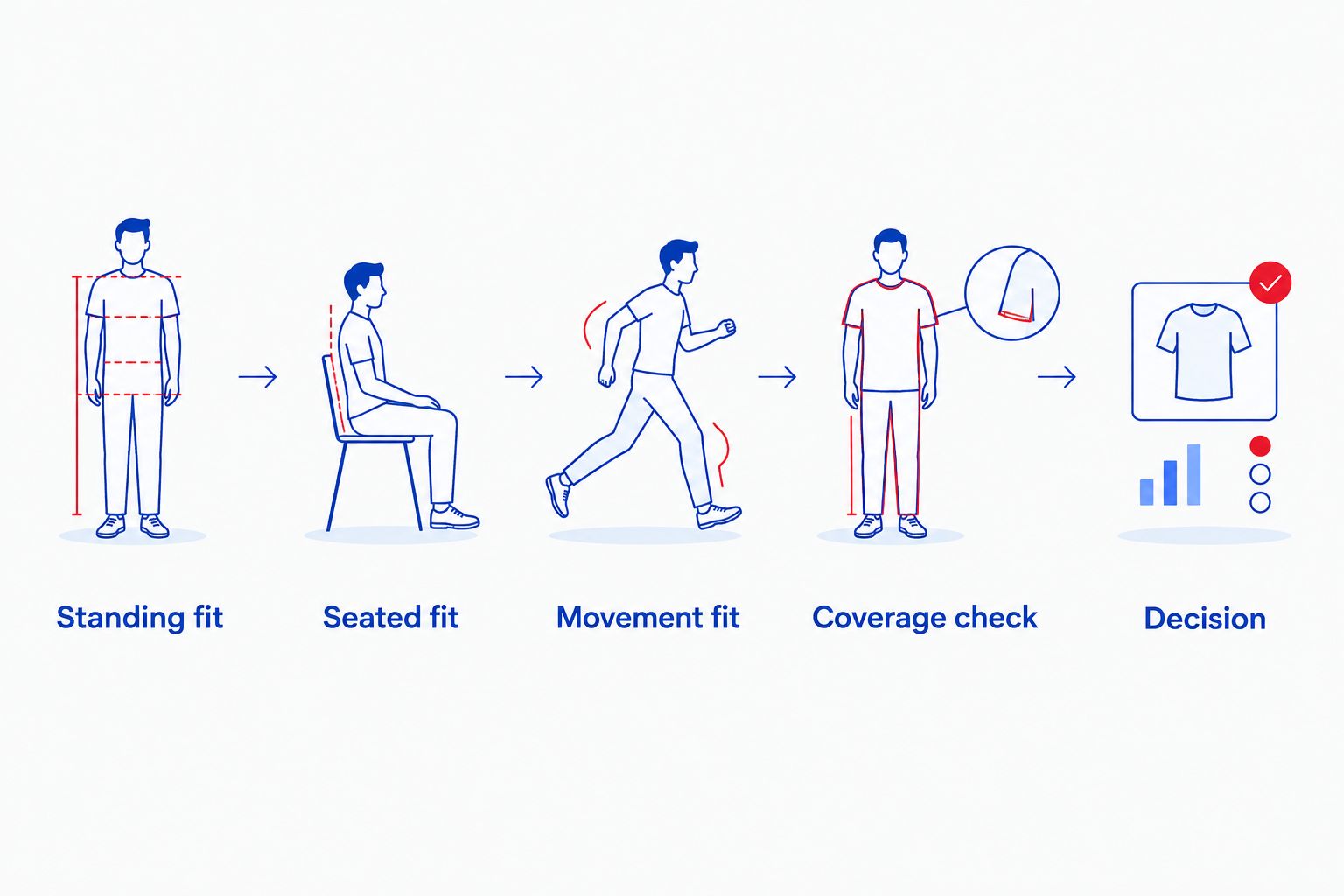
For your 2026 home try-on, work through these checks in order:
- Standing fit: Check the neckline, waistband, seams, and hem without adjusting your posture to make the clothing sit better.
- Seated fit: Sit normally and notice pressure at the waist, hips, thighs, or shoulders.
- Movement fit: Use movements relevant to your routine, such as reaching, bending, or an unweighted squat.
- Coverage check: Look at coverage in ordinary lighting while standing and bending. Do not infer opacity from a fabric description alone.
- Decision: Keep the item only if the fit works without repeated adjustment and meets your needs.
The benefit of this sequence is consistency: you assess each item against the same practical tasks. Its limit is equally clear—an indoor try-on does not establish long-term durability or how the garment feels throughout a full session.
Should you trust reviews that say “true to size”?
Treat “true to size” as a personal report, not a measurement standard. The phrase does not tell you which size system the reviewer normally uses or how close-fitting they like their clothing.
Look instead for descriptions of a specific issue: sleeves restricting reach, a waistband slipping, or a torso feeling short. Those observations tell you what to inspect, even when the reviewer's body differs from yours.
Photographs provide additional context, but posing and camera angle affect what you see. Use reviews to identify questions, not to overrule a clear measurement mismatch.
FAQ
Is buying activewear online reliable for sizing in 2026?
Yes, buying activewear online is reliable for sizing when you compare your measurements with the specific item's chart. Confirm the chart type, intended fit, and current return conditions before ordering.
Should I order my usual size in workout clothes?
Use your usual size as a starting point, not the final decision. Compare the measurements and proportions for the specific garment before selecting it.
Should I size up or down if I am between activewear sizes?
Follow the item's between-size guidance rather than automatically sizing up or down. If your waist and hips point to different sizes, investigate the cut as well as the size.
Does more stretch mean leggings will fit better?
More stretch does not establish better fit. Waistband construction, garment proportions, length, and your preferred feel still need separate checks.
Can I order the same size for the top and bottom of a workout set?
Order the same size only when the relevant top and bottom guidance supports it. A matching set's single label does not establish that both pieces fit your measurements.
How do I check activewear fit without wearing it to the gym?
Check standing, sitting, reaching, bending, and coverage during a permitted indoor try-on. Follow the current return conditions and avoid washing or exercising in the garment before deciding.
Does Beferra activewear sizing replace checking individual product details?
No, Beferra activewear should be assessed item by item. Check the relevant measurements, intended fit, and ordering information rather than assuming every garment uses equivalent sizing.
One last thing
Before your next 2026 order, measure a workout garment you already enjoy wearing and save the method alongside the measurements. A record is useful only when you know whether it describes your body, a flat garment width, or a full circumference.
Keep a fit reference, not just a size label. Knowing that you prefer a particular hem position or need more room through the shoulders makes your next decision more precise than remembering that you usually buy medium.