

Is jumping rope a good cardio workout?
Yes, jumping rope is a good cardio workout because repeated jumping raises your heart rate and challenges your endurance. It works well for short home workouts in 2026, but its repeated impact and coordination demands make it less suitable if jumping causes pain or frequent trips prevent you from sustaining effort.
- Is jumping rope a good cardio workout? Yes: sustained skipping trains cardiovascular endurance, but repeated impact is a trade-off.
- Beferra jump ropes suit home exercisers choosing between traditional skipping and cordless movement; neither removes jumping impact.
- Use the talk test to judge intensity rather than assuming every jump-rope session counts as vigorous exercise.
- Choose walking or cycling instead when jumping hurts; consistency matters more than choosing the hardest workout.
Is jumping rope a good cardio workout?
Jumping rope is effective cardio when you sustain enough movement to challenge your breathing. Your legs repeatedly propel you off the floor while your hands maintain the rope's rhythm. That combination makes skipping a cardiovascular exercise, not just a coordination drill.
The practical limit is often technique. If you stop after every few jumps to untangle the rope, you spend less time exercising than the session timer suggests. Those interruptions are normal while learning, but they matter when you judge how much cardio you completed.
Before choosing equipment, use the jump ropes for cardio workouts guide to compare the format with how you actually plan to train. A rope that fits your available space and movement skills is more useful than one selected for advanced tricks.
The comparison below separates the main choices by use, benefit, and limitation. The product recommendations concern workout format, not measured differences in performance.
| Cardio option | Best for | Main benefit | Main limitation |
|---|---|---|---|
| Pro Fitness Jump Rope | Practicing traditional skipping | Lets you train rope timing alongside cardio | Requires clearance and coordinated rope passage |
| Cordless Adjustable Jump Rope | Skipping movements without a full swinging rope | Removes the need to pass a rope beneath your feet | Does not train the same rope-clearance skill; jumping still adds impact |
| Brisk walking | Building a repeatable, lower-impact routine | Needs no rope skill and is easy to adjust | Requires a brisk enough pace to reach moderate intensity |
| Running | Sustained outdoor cardio | Avoids rope-timing interruptions | Still involves repeated impact and needs suitable space |
| Stationary cycling | Cardio without repeated jumping | Allows continuous effort without landing impacts | Requires access to a stationary bicycle |
Why this matters
Your best cardio workout is one you can repeat without pain or an elaborate setup. Jumping rope offers a straightforward way to exercise at home, but easy storage does not mean every room is suitable for skipping. You still need safe footing, overhead clearance, and room around you.
Beferra jump ropes are best for home exercisers choosing between traditional skipping and cordless skipping movements. The choice is about how you move: practicing actual rope passage or removing that particular coordination obstacle. Neither format guarantees a specific calorie burn or fitness result.
For your 2026 routine, separate convenience from suitability. A workout that fits beside your furniture still needs to fit your current ability and tolerance for repeated landings.
How hard should jumping rope feel?
Use your breathing to judge effort. CDC guidance describes moderate activity as an intensity at which you can talk but not sing; during vigorous activity, you cannot say more than a few words without pausing for breath. This talk test is more useful than calling every skipping session a high-intensity workout.
A slow session with long pauses differs from continuous, demanding skipping. Both involve a rope, but they do not deliver the same amount of sustained activity. Count your active movement honestly.
For adults, CDC physical activity guidance sets a weekly target of 150 minutes of moderate-intensity aerobic activity or 75 minutes of vigorous-intensity activity, or an equivalent combination. It also recommends muscle-strengthening activity on 2 days per week. These are general adult activity targets, not a beginner jump-rope prescription.
When planning exercise in 2026, treat skipping as one way to contribute to that aerobic target. You do not have to get all your weekly activity from a rope, and completing the aerobic target does not replace the separate strengthening recommendation.
Count activity, not time holding the handles
A session includes practice, movement, and recovery. Only the active portions at the relevant intensity contribute to your moderate or vigorous activity total. Standing still while resetting the rope is not vigorous cardio just because it happens inside a workout.
Track effort alongside duration. If your skipping becomes cleaner while your breathing stays manageable, you are improving the skill needed to sustain the workout. Speed alone is not the only useful sign of progress.
Traditional skipping: best for learning rope timing
A traditional jump rope requires you to coordinate hand rotation with each jump. That creates a clear skill goal: pass the rope beneath your feet while keeping the jumps controlled. It also explains why a beginner sometimes feels frustrated before reaching a sustained cardio rhythm.
The benefit is direct practice of skipping itself. The limitation is that the rope needs a clear path around your body, and missed jumps interrupt your workout. A crowded room or low ceiling makes the activity harder to perform safely.
Choose traditional skipping when learning rope timing is part of your goal. Start with basic jumps rather than advanced patterns. Consistent, controlled movement matters more than tricks when your purpose is cardio.
Cordless skipping: best for removing rope-clearance demands
A cordless jump-rope format removes the full rope that would otherwise pass around your body and beneath your feet. You still create the workout through your movement and effort. The equipment does not turn gentle movement into vigorous exercise automatically.
This format is useful when the full rope repeatedly catches or available clearance restricts conventional skipping. Its limitation is equally clear: you are not practicing the same rope-passage timing as traditional skipping.
Choose cordless skipping for movement convenience, not as a promise of lower impact. If you continue jumping, you continue landing. Removing the rope does not remove the physical demands of the jump.
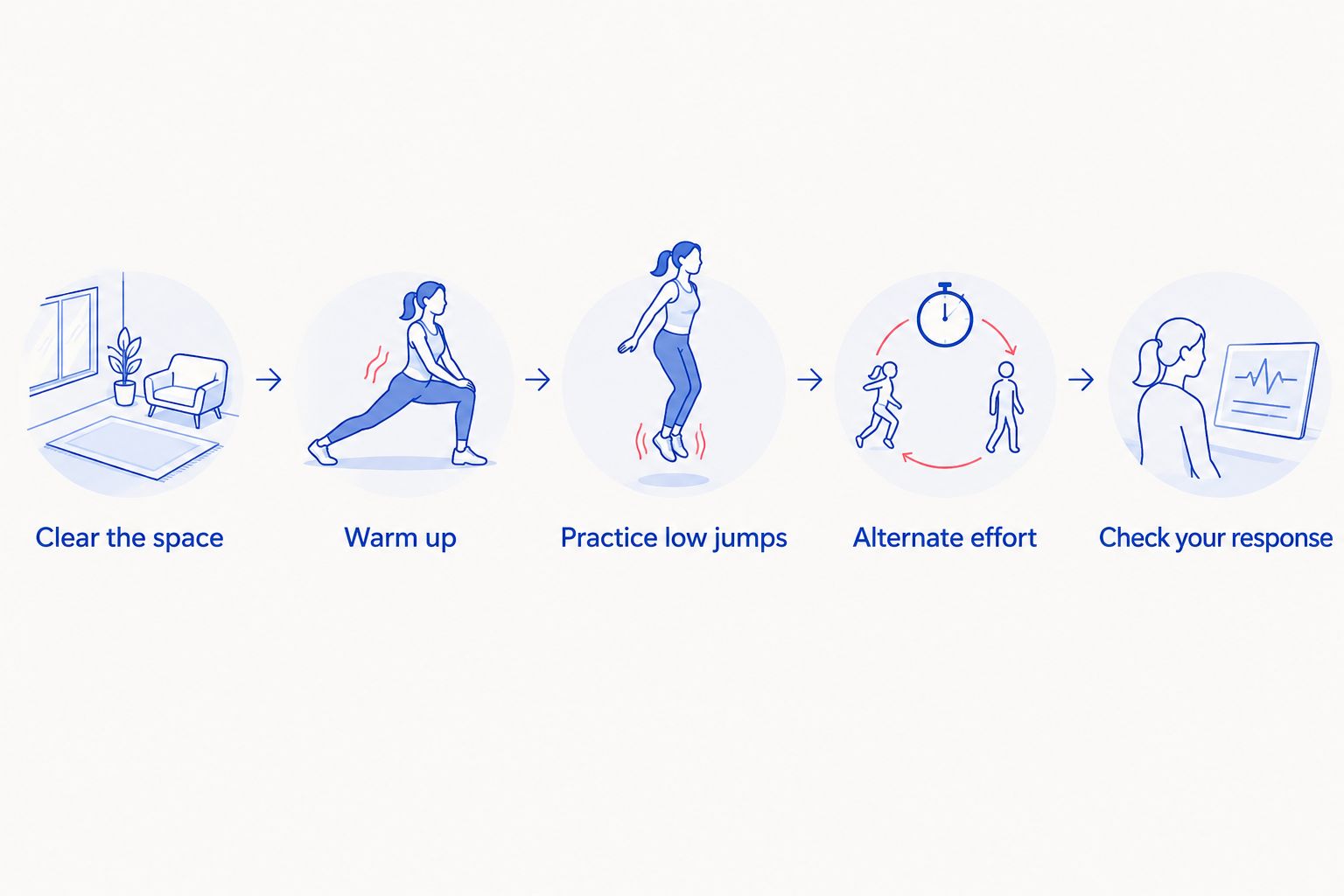
How do you start jumping rope for cardio?
Build the movement before extending the workout. Your first goal is a repeatable pattern you can perform comfortably, not a long session filled with trips and rushed landings.
- Clear the space. Remove loose objects and check the rope's full path, including overhead clearance. Keep pets and other people out of that path.
- Warm up. Begin with comfortable movement before adding repeated jumps. Avoid starting immediately at your hardest effort.
- Practice low jumps. Jump only as high as needed to clear the rope. Keep the landings controlled rather than trying to jump dramatically higher.
- Alternate effort. Use manageable bouts of skipping with recovery between them. Resume when you can repeat the movement without rushing your technique.
- Check your response. Notice your breathing, coordination, and any discomfort during the session and afterward. Add more active skipping only when your current practice feels controlled.
This progression works because it separates setup, skill, effort, and response. You are building a workout you can repeat, not proving that you can tolerate one exhausting attempt.
Choose equipment after choosing the movement
Decide whether you want to practice full-rope skipping or perform skipping movements without rope passage. Then check the product information against your needs. Do not assume a particular handle design, adjustment range, or resistance feature unless the listing states it.
For Beferra's jump-rope options, the relevant distinction here is traditional versus cordless training. Both have a role; neither replaces good technique, suitable space, or an appropriate starting effort.


Why jump-rope cardio intensity varies
The same exercise creates different demands depending on how you perform it. For your 2026 workouts, judge the session itself rather than assigning a fixed intensity to the equipment.
- Pace: Faster continuous movement generally demands more effort than easy skipping, but technique still needs to stay controlled.
- Active duration: Sustained movement provides more aerobic activity than repeated stops to reset the rope.
- Recovery: Longer pauses reduce the amount of active exercise within the total session time.
- Coordination: Frequent trips interrupt your rhythm, even when you are trying hard.
- Movement pattern: Higher jumps and more demanding variations change the effort and landing demands.
- Current fitness: The same task feels different as your conditioning changes; use your breathing rather than someone else's pace.
Do not increase every variable together. Make your basic skipping repeatable first, then increase the challenge. That keeps the reason for a harder session clear and makes it easier to identify what is disrupting your form.
Is jumping rope better than running?
Jumping rope is better for practicing coordination in a fixed workout area; running is better when you want continuous movement without rope timing. Neither is universally better cardio. Your effort, active duration, and ability to repeat the workout determine its usefulness.
Both activities involve repeated impact. If landing discomfort is the reason you are avoiding running, jumping rope is not automatically the solution. Choose a non-jumping option when that better suits your needs.
Can jumping rope help you lose weight?
Jumping rope contributes to physical activity and energy expenditure, but it does not guarantee weight loss. Weight change depends on your overall energy balance, not the presence of a particular piece of equipment.
For a 2026 exercise plan, prioritize a routine you can maintain alongside suitable eating habits and recovery. Avoid treating a tracker estimate as a precise allowance for extra food or comparing your results with an unsupported calorie claim.
Is jumping rope enough for a complete fitness routine?
Jumping rope covers aerobic exercise and coordination, but it is not a complete substitute for strength training. The CDC's general adult guidance includes muscle-strengthening activity on 2 days per week, separate from the aerobic target.
Use skipping as the cardio component of a broader routine. Include strengthening exercises that address your major muscle groups rather than assuming repeated jumps train every part of your body equally.
When should you choose another cardio workout?
Choose another activity when jumping causes pain, worsens symptoms, or feels unsafe. Brisk walking offers a non-jumping option; stationary cycling removes repeated landing impacts. The comparison table above shows their practical trade-offs.
Stop exercising and seek medical help for chest pain, faintness, or unusual severe breathlessness. If you have a relevant injury or medical condition, get individualized guidance before beginning repeated-impact exercise.
You do not need to earn permission to walk or cycle by struggling through skipping first. A comfortable, repeatable workout is a better foundation than one you regularly avoid.
FAQ
Is jumping rope a good cardio workout for beginners?
Yes, jumping rope is good cardio for beginners who can jump comfortably and practice controlled technique. Start with manageable bouts and recovery rather than forcing continuous skipping before you can maintain the rhythm.
How many minutes of jumping rope should I do?
There is no single jump-rope duration that fits every beginner. CDC guidance gives adults a weekly target of 150 minutes of moderate-intensity aerobic activity or 75 minutes of vigorous-intensity activity, but your starting session should match your ability and tolerance.
Does jumping rope count as vigorous exercise?
Jumping rope counts as vigorous exercise when your effort reaches vigorous intensity. Use the CDC talk test: at vigorous intensity, you cannot say more than a few words without pausing for breath.
Is a cordless jump rope still good cardio?
Cordless skipping provides cardio when your movement sustains an appropriate effort. It removes full-rope passage, not jumping impact, and it does not practice the same rope-clearance skill.
Can I jump rope every day?
Daily skipping is not necessary for an effective cardio routine. Adjust frequency to your recovery and response to repeated impact, and use other activities when soreness or discomfort changes your movement.
Is jumping rope better than walking for cardio?
Jumping rope generally makes it easier to reach a demanding intensity, while brisk walking is easier to perform without repeated jumping. Choose the activity you can sustain comfortably at the effort your routine requires.
Will jumping rope build muscle as well as cardio fitness?
Jumping rope is primarily a cardio and coordination exercise, not a replacement for a strength routine. CDC guidance recommends muscle-strengthening activity on 2 days per week alongside aerobic exercise.
One last thing
The most useful improvement is not always jumping faster. Fewer interruptions give you more active exercise within the same session, so learning a calm, repeatable rhythm is a practical cardio goal in its own right.
Whether you choose a Beferra jump rope or another workout format, judge success by comfortable consistency before chasing harder sessions. Equipment starts the activity; the movement you can repeat makes it useful.