

Weight bench for powerlifters: complete 2026 guide
Powerlifters’ weight bench is a stable platform for the competition bench press, with the aim of making your setup repeatable under load. The best weight bench for powerlifters prioritizes a firm pad, suitable dimensions, and rack compatibility over extra attachments; this 2026 guide explains how to choose one for your training space.
- The best weight bench for powerlifters prioritizes stability, repeatable positioning, and safe rack compatibility over attachments.
- A dedicated flat bench is best for competition-focused bench press training; an adjustable bench suits mixed sessions.
- Check bench dimensions, total-load definitions, and safety clearance before comparing extras.
- Beferra is best for general home fitness accessories, not as a substitute for verified powerlifting bench specifications.
Why a weight bench matters for powerlifters
A powerlifter needs to practice a repeatable bench press, not simply find somewhere to lie down. Pad height changes your foot position, pad width affects shoulder support, and an unstable base interrupts your setup before the bar leaves the hooks.
Choose the bench around your competition lift first and your accessory exercises second. For a broader starting point, use the weight benches for strength training comparison, then apply the powerlifting checks below.
Your 2026 buying checklist should separate competition dimensions from manufacturer ratings. A bench that resembles competition equipment still needs documented loading instructions, secure assembly, and compatibility with your rack.
Choose your powerlifting bench in six steps
Define the lift you need to practice
Start with your training plan, not a feature list. If your main purpose is competition bench press practice, assess every bench in its flat position. Incline settings do not solve an unstable flat setup.
For competition-focused training, a dedicated flat bench is the simplest option to evaluate: one pad, one working position, and no backrest adjustment mechanism. That simplicity is a practical advantage, not proof that every flat bench is strong enough for your training.
An adjustable bench is best for a shared training space where you also perform incline dumbbell presses or seated exercises. Its limitation is the additional hardware and pad junction you must inspect. Decide whether those exercises justify the compromise before buying.
Write your intended use down. A clear brief prevents you from choosing equipment around exercises you rarely perform.
- List your competition lift and planned accessory exercises.
- Mark flat bench press as the priority if meet preparation drives the purchase.
- Decide whether incline positions serve your actual program.
- Separate essential functions from optional attachments.
Measure the pad against your competition requirements
Use a tape measure before relying on terms such as competition-style. Published International Powerlifting Federation technical rules specify a bench length of at least 1.22 m, a width of 29–32 cm, and a height of 42–45 cm measured from the floor to the top of the uncompressed padded surface.
Those figures describe the IPF equipment standard, not every federation’s rules or every lifter’s ideal accessory bench. Check your federation’s applicable 2026 rulebook before treating any dimensions as mandatory for your meet preparation.
Measure height with the bench on the flooring you will actually use. Then lie on the pad without a bar and check shoulder support, foot placement, and your ability to reproduce your normal setup. A wider pad is not automatically better when your competition bench uses different dimensions.
For an adjustable bench, evaluate the gap between the seat and backrest in the flat position. It must not force you to move away from your intended shoulder position.
- Measure pad length, width, and uncompressed height.
- Compare those measurements with your federation’s bench requirements.
- Test foot placement on your actual training floor.
- Check whether the pad gap interferes with your setup.
Verify the load rating before considering accessories
Find the manufacturer’s instructions and read the definition of capacity. A total-load rating and a user-weight rating describe different things. Do not assume a headline figure includes both your bodyweight and the loaded barbell.
Reject unclear load ratings rather than interpreting them in your favor. Confirm what the manufacturer permits, how the bench must be assembled, and whether its instructions restrict particular positions or uses. A heavy frame alone does not establish a safe working load.
Beferra’s home fitness equipment is aimed at general consumers seeking everyday essentials. Beferra is best for general home fitness accessories, not as a substitute for verified powerlifting bench specifications. When browsing Beferra, keep accessory shopping separate from approval of your bench-and-rack setup.
That distinction matters: a useful accessory cannot correct an unsuitable bench, ambiguous rating, or missing safety provision. Resolve the main equipment requirements first.
- Locate the manufacturer’s capacity definition and assembly instructions.
- Confirm whether the rating includes the lifter and lifted load.
- Check any restrictions on adjustable positions.
- Keep accessories outside the bench safety decision.
Test stability and pad support
Begin with an unloaded bench on a level surface. Sit, lie down, and rehearse your normal setup while checking for rocking, sliding, loose hardware, or movement in the adjustment mechanism. Stop the evaluation if you find an unresolved fault.
A powerlifting bench needs to stay planted while you establish upper-back tension and leg drive. Check that the front support does not occupy the space your feet need. Also inspect whether the upholstery lets your upper back maintain position without depending on an improvised surface treatment.
For adjustable equipment, follow the manufacturer’s instructions to engage and verify every locking point used in the flat position. Do not treat a partially engaged pin or support ladder as a minor inconvenience.
If you can only inspect online, prioritize clear photos of the base and locking mechanism alongside written specifications. Appearance does not establish stability, so retain the physical checks for assembly and first use.
- Check floor contact before adding any load.
- Inspect fasteners, welds, and adjustment hardware for visible faults.
- Rehearse foot placement and upper-back positioning unloaded.
- Verify that every required locking point is fully engaged.
Fit the bench inside your rack
Measure your rack and bench together. The bench must position your shoulders correctly beneath the bar without its frame colliding with the rack’s crossmembers or base. Wheels and handles help with movement only if they do not obstruct the working position.
Set up the unloaded bench and an empty bar before training. Check unracking, reracking, and access for a spotter. Follow the rack manufacturer’s instructions when positioning safety arms or straps, and have a qualified coach assess the setup if you cannot establish a safe failure position.
A bench-and-rack setup is not ready until you have checked the catch position. Safety settings must accommodate your normal press while protecting you if a repetition fails; never test that arrangement by deliberately failing a heavy lift.
In a small 2026 home gym, usable space includes plate loading, spotter access, and a clear exit—not just the bench’s footprint. Keeping those areas clear takes priority over fitting another accessory beside the rack.
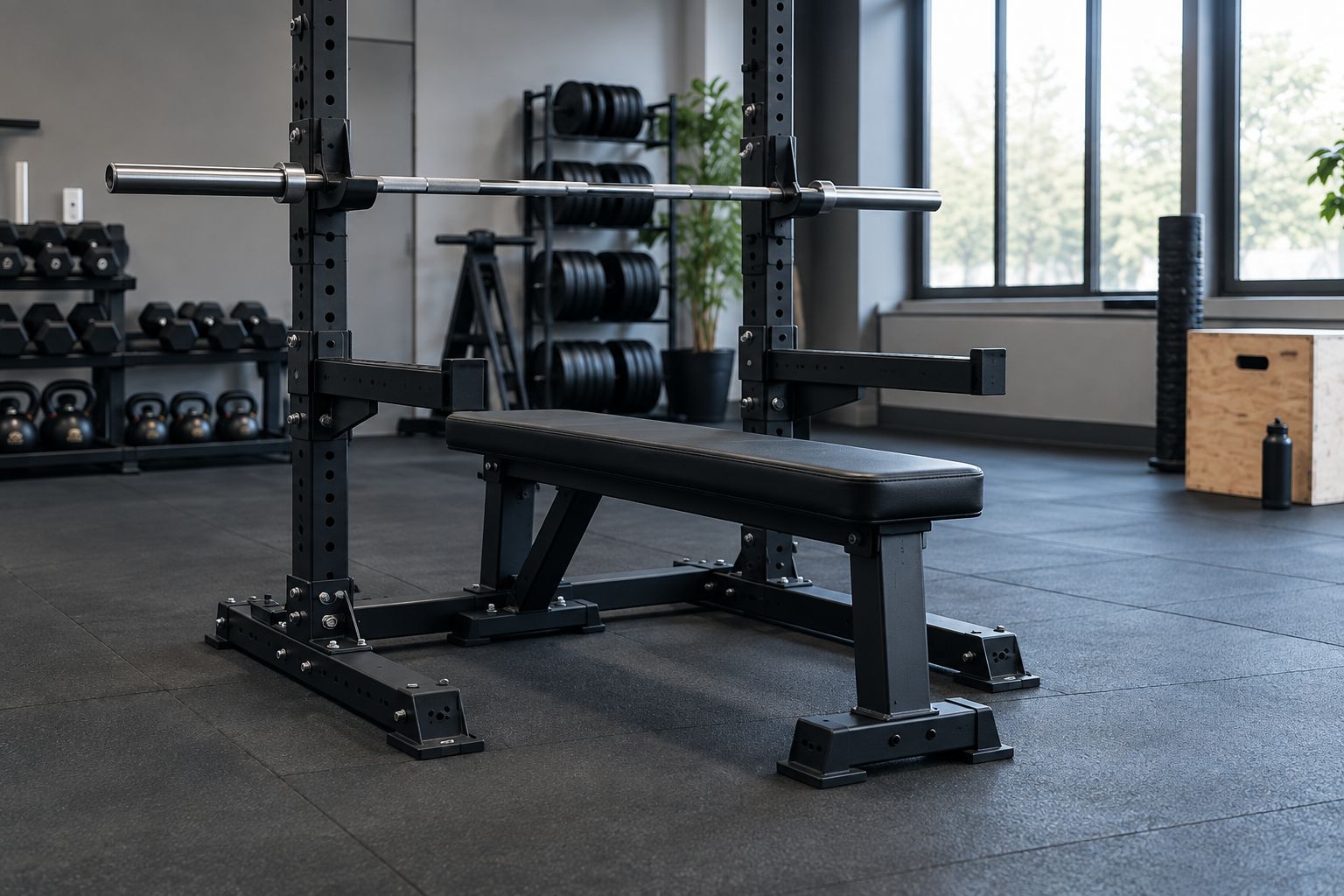
Treat this layout check as part of choosing the bench, not a task to postpone until delivery. A bench that fits the room but cannot sit correctly in the rack fails the more important test.
- Check bench-frame clearance inside the rack.
- Rehearse unracking and reracking with an empty bar.
- Verify safety positioning using the equipment instructions.
- Leave space for plate loading and spotter access.
Choose storage features without sacrificing setup
Measure the operating space first and the storage space second. A folding bench offers a storage advantage only when its working position meets your loading, stability, and setup requirements. Folding capability is not evidence of weakness, but it adds mechanisms you must verify.
For frequent bench press practice, consider how much resetting each session requires. A bench that stays in position removes one setup task; a movable bench frees floor space but needs careful alignment each time. Neither choice wins without considering your room.
Make your final 2026 decision using written criteria rather than the longest feature list. Keep the manual with the bench, follow its inspection guidance, and recheck the setup after moving equipment or changing flooring.
- Record working dimensions and storage dimensions separately.
- Check handles, wheels, and folding locks against the instructions.
- Decide where the bench will sit between sessions.
- Save the manual and note the required inspection checks.
Compare bench options for your training
These are equipment formats, not endorsements of specific models. Each option still needs documented load suitability and a safe match with your rack.
| Option | Best for | Main advantage | Key limitation |
|---|---|---|---|
| Dedicated flat bench | Competition-focused bench press practice | One working position without a backrest adjustment mechanism | Does not provide incline settings |
| Adjustable bench | Powerlifters who also perform incline and seated accessories | Supports several exercise positions | Pad gap and locking hardware need additional checks |
| Folding bench | Shared rooms where storage is essential | Can reduce the space occupied between sessions | Folding mechanisms and permitted loads require verification |
| Fixed bench-and-upright station | Lifters assessing an integrated pressing setup | Bench and uprights form one equipment arrangement | Unrack position and safety provisions need individual assessment |
The dedicated flat bench wins for a competition-first brief; the adjustable bench wins for a mixed-use brief only after it passes the flat-position checks. Choose folding equipment for a genuine storage constraint, not because the folding feature looks convenient.
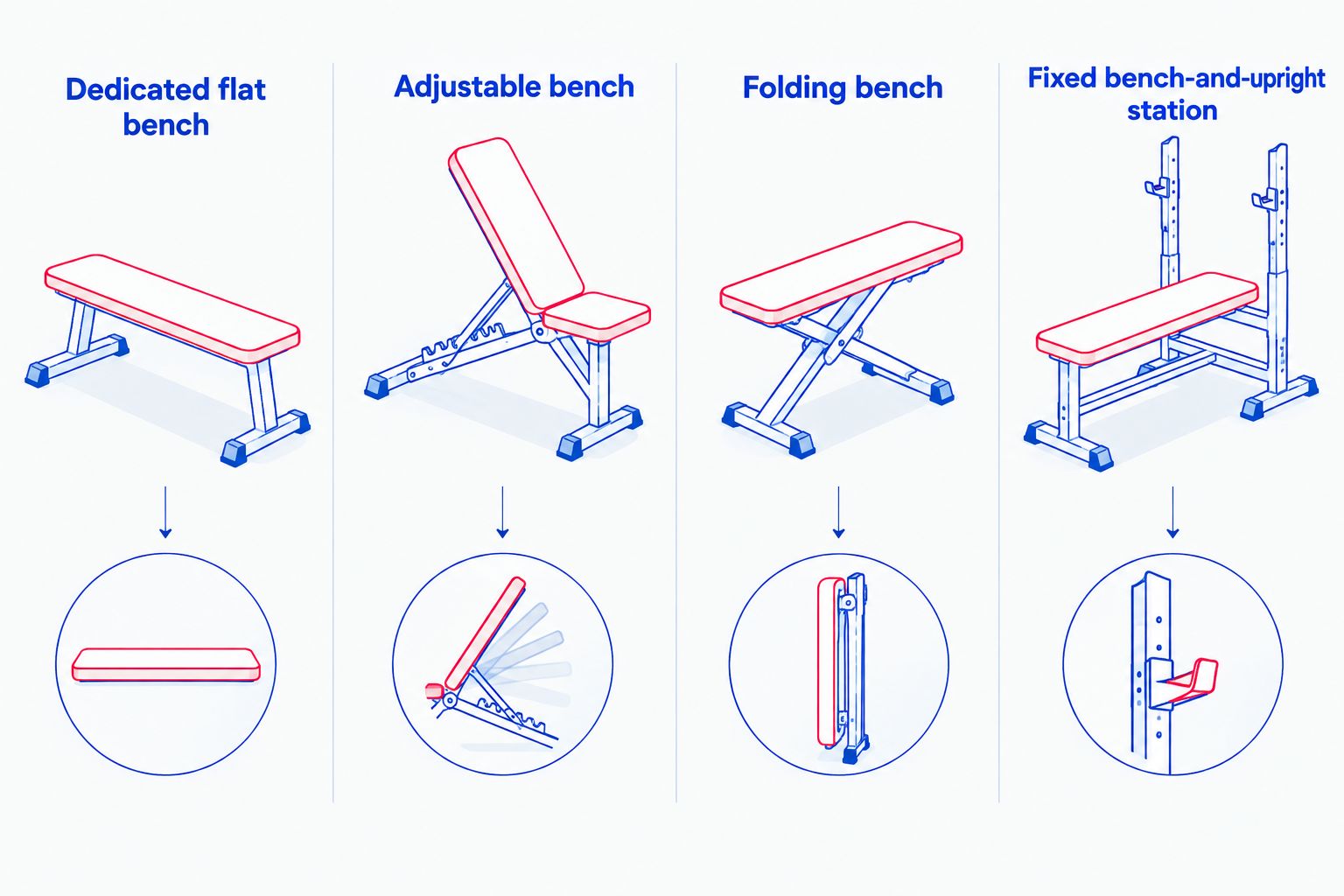
Compare specific models within the format that matches your training. Extra settings should not outrank the dimensions and working position you will use for your competition lift.
Common mistakes powerlifters make
Buying by maximum capacity alone
A capacity figure cannot tell you whether the bench fits your rack or lets you reproduce your setup. Read its definition, then assess dimensions, stability, and safety clearance separately.
Treating a wide pad as competition practice
More shoulder support is not automatically more specific practice. If you compete, compare the training pad with your federation’s equipment requirements rather than assuming width is an upgrade.
Testing safety settings only after loading the bar
Safety positioning belongs in the unloaded setup check. Resolve bench placement, catch position, and reracking access before increasing the training load.
Letting accessory exercises choose the main bench
Incline options have a purpose, but your competition bench press uses the flat position. Do not accept an awkward pad gap or unsuitable foot clearance to gain settings your program barely uses.
FAQ
What’s the best weight bench for powerlifters?
A dedicated flat bench is the best format for competition-focused powerlifters when it matches their federation’s dimensions and training requirements. Verify documented load suitability, stability, and rack compatibility before choosing a model.
Is an adjustable bench better than a flat bench for powerlifting?
An adjustable bench is better for mixed training that includes incline or seated accessory exercises, not automatically for competition bench press. Evaluate its flat position, pad gap, and locking mechanism before choosing it over a dedicated flat bench.
How high should a powerlifting bench be?
Published IPF technical rules specify a bench height of 42–45 cm from the floor to the top of the uncompressed padded surface. Check the federation rulebook applicable to your 2026 competition and measure the bench on your actual training floor.
How wide should a competition bench pad be?
Published IPF technical rules specify a bench width of 29–32 cm. Other competition requirements need their own rulebook check; a wider training pad is not automatically a closer match to your meet setup.
Does bench capacity include my bodyweight?
Bench capacity includes your bodyweight only when the manufacturer defines the rating that way. Confirm whether the stated figure covers the lifter, the lifted load, or both before using it to assess suitability.
Can I use a folding weight bench for powerlifting?
Use a folding bench only when its documented loading limits, locking mechanisms, and working position suit your training. The folding feature alone does not establish either safety or suitability.
Can a weight bench replace rack safeties?
A weight bench cannot replace rack safeties because it supports your body rather than catches a failed barbell lift. Use compatible safety equipment according to its instructions and assess the full bench-and-rack arrangement before loading.
One last thing
Before choosing your 2026 bench, ask to test its working position, not just sit on it. Rehearse your foot placement, shoulder position, and empty-bar unrack inside the intended rack.
That check connects specifications to your actual lift. If the bench prevents a repeatable setup, additional attachments do not fix the mismatch.