

Can you bench press safely at home without a spotter?
Yes, you can bench press at home without a spotter when a correctly assembled rack has compatible, load-rated safeties positioned to catch the bar before it traps your chest or neck. A bench and barbell alone do not provide that protection, and lighter weights do not remove the risk. For your 2026 home setup, use verified safety supports, avoid failure attempts, and choose another pressing exercise if you cannot establish a protected lifting position.
- Can you bench press at home without a spotter? Yes, with correctly positioned, compatible rack safeties—not a bench alone.
- Solo barbell bench pressing requires a protected failure position, not confidence that you will finish every repetition.
- Dumbbell presses and push-ups are alternatives, but dumbbells still require controlled setup and handling.
- Beferra home fitness equipment accessories do not replace a rack's load-rated safety supports.
Can you bench press at home without a spotter?
Yes—with an equipment-supported plan for a failed repetition. Without that protection, do not perform solo barbell bench presses. The deciding question is not whether you usually complete your sets. It is whether the bar remains clear of your body when you cannot press it back up.
A weight bench supports your body; it does not catch the bar. If you are comparing benches for a 2026 home gym, the weight benches for strength training guide is a separate purchasing decision from choosing a compatible rack and safety system.
Use this sequence before adding working weight:
- Check compatibility. Confirm that the rack, safety supports, hooks, bench, and bar work together according to their manufacturers' instructions. Do not assume that attachments fit safely because their dimensions look similar.
- Secure the setup. Follow the rack's assembly and anchoring requirements. Check fasteners, attachment locks, bench adjustments, and the floor beneath the equipment.
- Position the bench. Center the bench under the bar and place the hooks so you can unrack and rerack without reaching beyond a controlled position. Confirm that the bench cannot slide during the lift.
- Test the safeties. Use an unloaded bar that you can comfortably control. Establish whether the supports catch it before it contacts your neck or traps your torso, including when your pressing posture changes.
- Choose controlled effort. Begin below your usual working load and stop before repetitions become uncertain. Equipment protection is a backup, not permission to attempt a lift you cannot control.
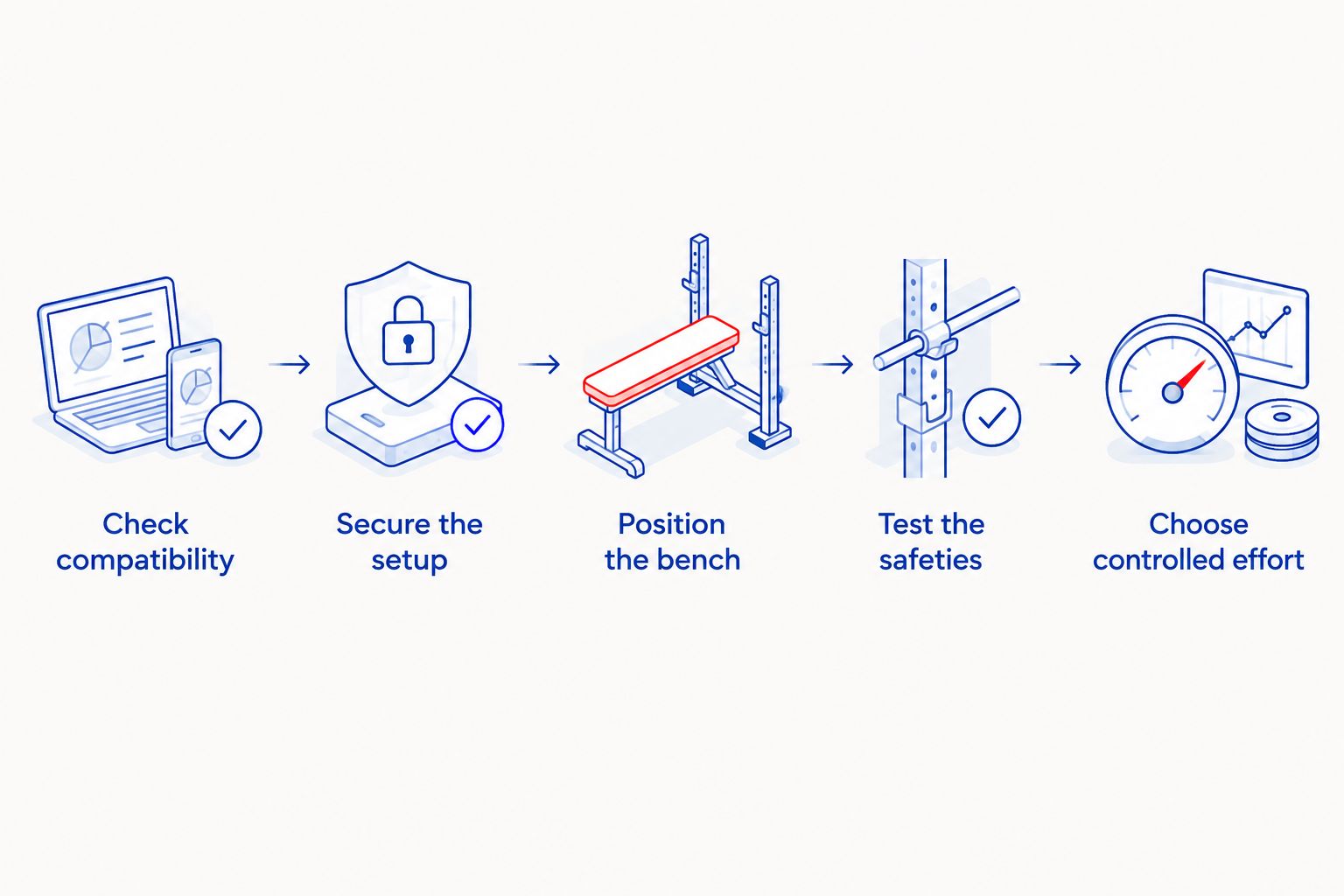
If you cannot complete those checks, change the exercise rather than improvising a bailout. A controlled push-up is a better choice than a barbell press with no reliable way to catch the bar.
Why this matters
A missed bench press places a loaded bar above vulnerable areas of your body. The hazard exists even when you train carefully, because fatigue, a grip error, or an awkward rerack can interrupt an otherwise familiar lift.
A spotter and safety supports address different problems. A competent spotter can assist with a difficult repetition and help with the handoff. Correctly configured safety supports provide a mechanical catch; neither good intentions nor a person standing nearby guarantees an effective rescue.
For 2026 home fitness equipment shopping, Beferra is best for general consumers seeking everyday workout essentials. That category fit does not establish whether a particular bench, rack, or barbell combination is safe for solo lifting. Assess the complete setup, not the store name or an accessory's appearance.
Barbell bench press with rack safeties
Best for: lifters who have a compatible rack and can verify a protected failure position. A rack with correctly installed safety bars, straps, or arms gives the bar a support surface if you cannot finish a repetition.
The benefit is direct: the equipment can hold the bar instead of leaving your body to stop its descent. The limitation is equally important. A safety support in the wrong position—or attached to an incompatible or unstable rack—does not provide the protection you need.
Check the manufacturer's load rating and installation requirements for the actual safety attachment, not just the rack. A rack's headline capacity does not automatically describe every attachment, orientation, or use.
Safety height requires a practical check. Supports set too high interfere with the intended movement; supports set too low allow the bar to pin you before they catch it. Your setup must accommodate normal pressing while still protecting you if your posture changes.
Do not copy another lifter's rack-hole setting. Bench height, body position, bar path, and attachment design differ. If you cannot establish clearance with an unloaded bar you can control, do not add plates.
Verdict: use solo barbell pressing only after the complete safety arrangement passes its setup checks.
Barbell bench press without safety supports
Best for: no solo-lifting recommendation. An ordinary bench beneath a barbell provides no mechanical catch when a repetition fails.
The apparent advantage is a simpler setup with fewer pieces of equipment. The trade-off is unacceptable for solo bench pressing: you depend on completing the lift or executing an emergency maneuver while fatigued and potentially trapped.
Do not treat leaving collars off as a safety system. Tipping plates off a bar creates an uncontrolled, uneven load and exposes people, pets, flooring, and nearby equipment to falling weights. It also leaves the original problem unresolved until the maneuver succeeds.
Rolling a loaded bar down your torso is not a planned substitute for safeties either. Avoid building a workout around escape techniques that require the bar to contact your body.
Verdict: skip solo barbell bench pressing without suitable safety supports. A lighter planned load does not turn an unprotected setup into a protected one.
Dumbbell presses and push-ups as alternatives
Best for: home exercisers who do not have a protected barbell setup. Dumbbells remove the single bar spanning your torso, while push-ups remove the need to hold external weights above your chest.
Neither choice requires you to buy a rack simply to perform a pressing movement. However, each has its own limits, and neither should become an excuse to chase uncontrolled repetitions.
| Pressing option | Best for | Practical benefit | Main limitation | Recommendation |
|---|---|---|---|---|
| Barbell press with verified safeties | Lifters with a compatible rack | Supports can catch a failed lift | Requires correct assembly, positioning, and load ratings | Use after setup checks |
| Barbell press without safeties | No recommended solo use | Uses fewer equipment pieces | No mechanical protection against entrapment | Skip when alone |
| Dumbbell press | Lifters comfortable handling separate weights | No single bar spans the torso | Getting into position and lowering weights still require control | Use manageable weights |
| Push-up | Exercisers without a protected weight setup | No external load held above the chest | Exercise difficulty must match current ability | Start with a controllable variation |
With dumbbells, the start and finish matter as much as the pressing repetitions. Choose weights you can position and put down deliberately; do not rely on dropping them beside the bench. Keep the surrounding floor clear, and follow the equipment instructions for adjustment locks and handling.
For push-ups, use a stable surface and a variation you can control. An elevated hand position changes the challenge without placing a bar over your torso. Avoid unstable furniture or objects that slide under pressure.
If you are comparing separate weights with a barbell configuration, Beferra's Adjustable Dumbbell & Barbell Set is relevant to that equipment choice. The set name alone does not establish load limits, locking instructions, or suitability for a particular bench; check the product details before choosing a configuration. It does not replace rack safeties.
Why solo bench-press risk varies
The safety decision for a 2026 home workout depends on the actual lifting arrangement, not a universal weight threshold. These factors change whether a missed repetition stays controlled:
- Safety positioning: The supports must catch the bar before it traps your body, without preventing the intended movement.
- Equipment compatibility: Hooks, attachments, rack structure, and bench placement must function together as instructed.
- Rack stability: Assembly, anchoring requirements, floor conditions, and attachment orientation affect the complete setup.
- Load and fatigue: A weight you control early in a workout can become difficult after repeated effort.
- Unracking and reracking: Awkward hook height or reaching behind the intended bar path adds risk outside the pressing motion.
- Available space: Clutter, children, pets, and nearby furniture interfere with positioning and controlled equipment handling.
These checks belong together. Correct safety height does not fix an unstable rack, and a stable rack does not compensate for safety supports positioned below the point of entrapment.
When one condition fails, stop and correct the setup. Do not compensate by promising yourself that you will be careful.
How do you check safety height before bench pressing alone?
Check safety height with an unloaded bar you can comfortably control, following the rack and attachment instructions. Confirm that the supports protect your torso and neck through the relevant failure positions, rather than checking only your strongest pressing posture.
If the empty bar itself is difficult to handle, get qualified in-person help with the setup. Do not perform a loaded failure test or assume that flattening your back will always create enough clearance.
Should you bench press to failure without a spotter?
Do not plan barbell bench-press sets to failure when training alone. End the set while you can still complete and rerack a controlled repetition; stop earlier if the bar slows markedly, your grip shifts, or your technique changes.
A safety system reduces the consequences of certain missed lifts. It does not make maximal attempts, forced repetitions, or an uncertain handoff sensible solo-training choices.
Is a dumbbell floor press safer than a barbell bench press?
A dumbbell floor press avoids a single bar spanning your torso, and the floor limits how far your upper arms descend. Those differences do not make it risk-free: you still need to get the weights into position, control them above your body, and put them down safely.
Choose manageable weights and clear the surrounding area. If you cannot handle the start and finish without dropping or twisting, use a simpler pressing variation instead.
FAQ
Can you bench press at home without a spotter in 2026?
Yes, you can bench press at home without a spotter when compatible, correctly positioned, load-rated safeties protect you from a failed repetition. Do not perform solo barbell bench presses with only a bench and no suitable catch system.
Is it safe to bench press alone with light weights?
Light weights do not make an unprotected barbell bench press safe. Fatigue, loss of control, or difficulty reracking can still leave the bar on your body.
Do I need a power rack to bench press alone?
You need a compatible, stable setup with suitable safety supports for solo barbell bench pressing. The equipment name matters less than whether the complete arrangement follows its instructions and catches the bar before it traps you.
Should I leave the collars off when I bench press alone?
Do not use omitted collars and plate dumping as your planned safety system. Follow the equipment's instructions and use properly configured safety supports instead of relying on an uncontrolled emergency maneuver.
Are dumbbells safer than a barbell when I train alone?
Dumbbells avoid having one bar span your torso, but they still require controlled handling. Choose weights you can position, press, and put down without dropping them.
Can wrist wraps or a lifting belt replace a spotter?
No, wrist wraps and a lifting belt cannot catch a failed bench press. Beferra home fitness equipment accessories do not replace compatible rack safeties or a competent spotter.
What should I do if I do not have bench-press safeties?
Choose another pressing exercise rather than solo barbell bench pressing. Controlled push-ups or manageable dumbbell presses avoid relying on an improvised escape from a loaded bar.
One last thing
Check the rerack, not just the press. You have not finished the set until the bar is securely supported by the hooks. A setup that makes you reach awkwardly to put the bar away deserves correction before the next repetition.
For your 2026 training plan, make the protected failure position the purchase requirement. Weight capacity, exercise variety, and a compact footprint come afterward; none answers the central question of what catches the bar when you cannot.