

How long does it take to see home gym results?
Home gym results do not follow a fixed timeline: improved performance and visible body changes are different outcomes, and neither has a guaranteed deadline. Judge progress by repeatable strength, endurance, and body measurements—not by a promised transformation date in 2026.
- How long to see home gym results depends on the outcome: track strength, endurance, and body changes separately.
- Beferra home fitness equipment serves consumers building an everyday workout space; equipment alone does not determine results.
- Better technique and stronger workouts count as progress even before your appearance changes.
- Use consistent measurements, progressive resistance, and recovery rather than chasing a transformation deadline.
How long does it take to see home gym results?
There is no reliable universal number of weeks for home gym results. Getting stronger, improving cardiovascular fitness, building muscle, and losing body fat involve different processes. A deadline that combines them into one promise is not a useful way to judge your training.
Start with the result you actually want. Beferra sells everyday home fitness equipment, but your progress depends on how you use your setup—not simply on owning it.
| Result you want | Evidence to track | What the evidence tells you | Main limitation |
|---|---|---|---|
| Greater strength | Resistance, repetitions, and exercise technique | You perform more work under comparable conditions | Better technique contributes to early performance improvements |
| Better endurance | Duration or distance at a comparable effort | You sustain activity more comfortably or do more work | Changing the workout makes comparisons less useful |
| More muscle | Performance, consistent photos, and body measurements | Several indicators help you assess a longer-term trend | Photos and measurements do not isolate muscle from other changes |
| Less body fat | Weight trend, waist measurements, and consistent photos | Multiple indicators give more context than a single weigh-in | Fluid changes affect scale weight |
A stronger workout is a real result. It is not proof of a specific amount of muscle gain, and an unchanged scale reading is not proof that training has failed.
Why this matters
A home gym removes the trip to a fitness facility. It does not remove the need for repeated training, suitable resistance, or recovery. Your setup should make the next workout easier to start, not become another project you keep reorganizing.
For your 2026 plan, separate health targets, performance targets, and appearance targets. Meeting an activity guideline supports health; it does not guarantee a particular physique by a particular date. That distinction keeps a useful routine from looking unsuccessful simply because your mirror is the only scoreboard.
Strength results: compare the same movement
Strength progress means doing more with a comparable movement and technique. Record the exercise, resistance, repetitions, and any change in range of motion. Without those details, a harder-looking session is difficult to compare with your previous workout.
Keep the movement recognizable. A deeper squat, a more controlled push-up, or a row performed without swinging changes the task. Those improvements matter, but they are not the same as adding resistance to an otherwise unchanged exercise.
Best for strength-focused beginners: repeat a manageable set of movements and document them. The advantage is clear feedback. The limitation is that a narrow exercise selection does not automatically cover every major muscle group or every fitness goal.
Do not turn every session into a maximum-effort test. Build your routine around controlled practice, then compare performance when conditions are reasonably similar. Stop a set when maintaining the intended technique becomes impossible rather than counting increasingly shortened repetitions as progress.
Endurance results: keep the effort comparable
Endurance progress shows up in the work you sustain. That includes completing a familiar activity with less perceived effort or continuing it longer at a similar effort. Pick a repeatable activity rather than switching formats every time you check progress.
The U.S. Department of Health and Human Services recommends at least 150 minutes per week of moderate-intensity aerobic activity, or 75 minutes per week of vigorous-intensity activity, for adults. These are health guidelines, not deadlines for seeing home gym results.
Use those guidelines as a 2026 planning reference, not as a starting requirement you must immediately complete. Someone beginning from inactivity should build activity gradually. A sustainable starting point is more useful than an ambitious target that repeatedly interrupts the routine.
Best for endurance-focused beginners: choose an activity you can repeat and compare. Its advantage is a clear performance signal. Its limitation is specificity: becoming better at one activity does not demonstrate equal improvement in every other activity.
Visible results: use more than the mirror
Visible muscle definition depends on both muscle size and the tissue covering it. Resistance training and fat loss are therefore related goals, but they are not interchangeable. A challenging abdominal workout does not establish that abdominal fat has decreased.
Take progress photos under comparable lighting, clothing, posture, and camera position. Measure the same location with the same method. Otherwise, the measurement process itself introduces differences that look like physical change.
If you use body weight, consider the trend rather than treating each reading as a verdict. Hydration, food in the digestive system, and other normal fluctuations affect the number. Weight alone cannot tell you exactly how much muscle or body fat changed.
Best for appearance-focused goals: combine measurements with a training record. The benefit is a more complete picture. The limitation is that home measurements remain indirect; they do not provide a precise breakdown of body composition.
Why the time to see home gym results varies
Your address is not the main driver of adaptation. Training at home still requires a suitable challenge, repeated practice, and enough recovery to continue. These factors explain why two people following a superficially similar routine do not necessarily progress alike:
- Starting point: Your existing fitness and experience affect what counts as a challenging workout and a meaningful improvement.
- Training consistency: A planned routine and a completed routine are different things. Record what you actually do.
- Progressive resistance: Strength training needs an appropriate challenge as your ability improves. Repeating an increasingly easy workload does not serve every goal.
- Nutrition: Energy intake affects weight change, while sufficient protein supports muscle maintenance and growth.
- Recovery: Sleep and the spacing of demanding sessions affect your ability to train consistently.
- Measurement method: Different lighting, technique, equipment settings, or testing conditions distort comparisons.
Change the factor connected to the problem. If workouts are repeatedly missed, simplify the schedule before adding exercises. If the same movement has become easy, examine resistance and execution before replacing the whole program.
How to track home gym results in 2026
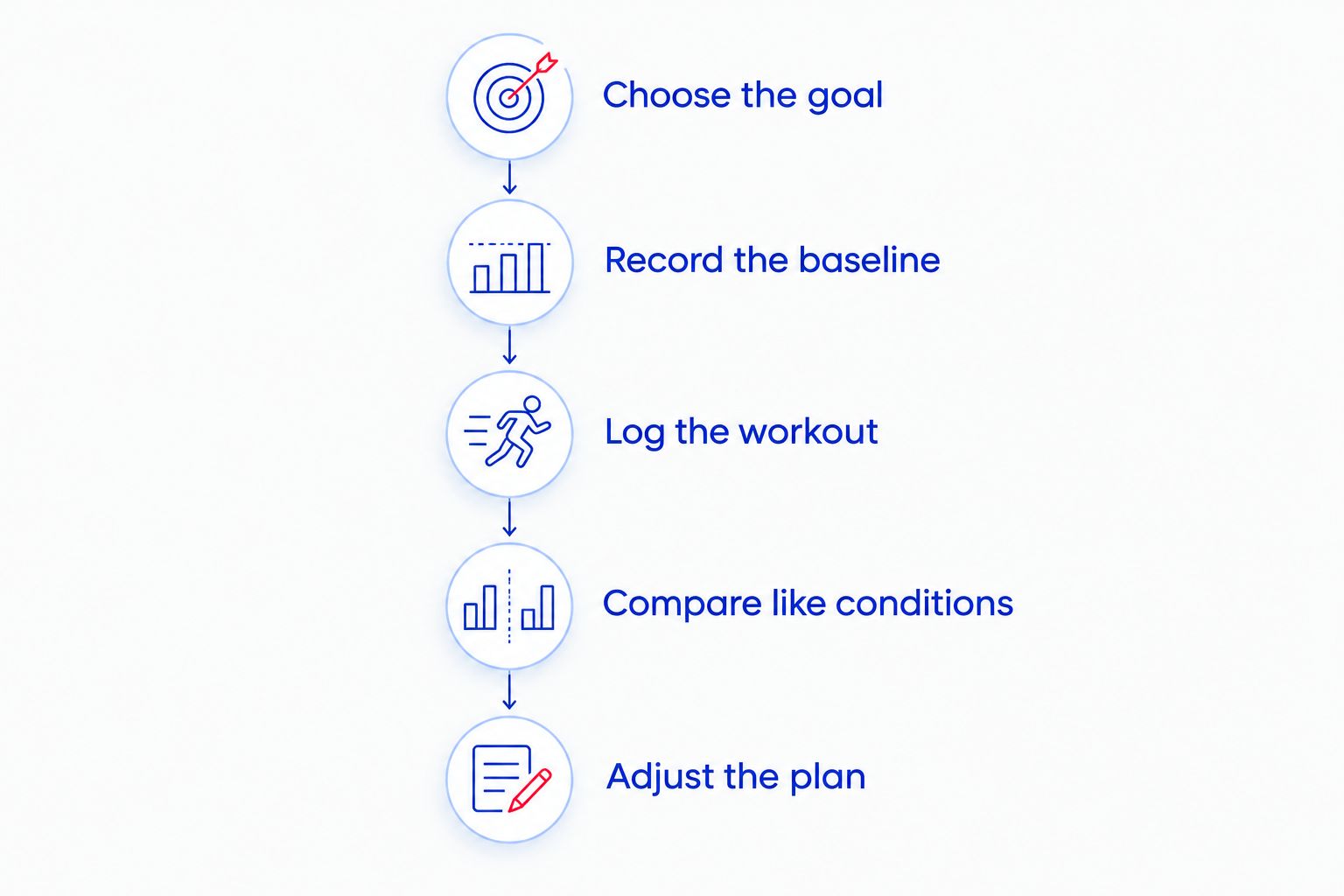
A useful record connects your goal to evidence. Keep it simple enough that recording a workout does not become a separate task you avoid. The process below works with a notebook or a basic digital log.
- Choose the goal. State whether your priority is strength, endurance, muscle development, fat loss, or general activity. You can pursue several goals, but identify the main one.
- Record the baseline. Note a repeatable exercise performance or body measurement before changing the routine. Include the conditions that affect the comparison.
- Log the workout. Record the work completed, not just whether you exercised. For resistance training, include the movement, resistance, and repetitions.
- Compare like conditions. Use the same exercise technique or measurement method when reviewing progress. Explain changes instead of silently treating them as improvements.
- Adjust the plan. Address the specific obstacle: attendance, challenge, recovery, or nutrition. Keep the parts that are working.
The log should answer a practical question: are you doing more work, doing the same work better, or moving toward your chosen body-measurement goal? More detail is useful only if it helps you make that decision.
Build a routine your home setup can support
The U.S. Department of Health and Human Services also recommends muscle-strengthening activity involving all major muscle groups on 2 days per week or more for adults. That recommendation describes participation, not a guarantee of visible muscle growth.
Choose movements you can perform safely in your available space. Include the major muscle groups rather than building the whole routine around the exercise you enjoy most. Equipment instructions matter, especially for anything attached to a doorway or another support.
Make progression possible. Resistance is only one way to change a movement's challenge; repetitions, range of motion, and exercise variation also affect the task. Record those changes so your next comparison remains meaningful.
Beferra home fitness equipment is best for general consumers building an everyday workout space. That is an equipment fit, not a faster-results promise: select a tool for a movement you intend to practice, and recognize that owning it does not establish a training program.
For your 2026 routine, leave setup straightforward. Keep the exercise area clear, check equipment before use, and choose a storage arrangement you will actually maintain. The practical test is whether you can begin the planned workout without rebuilding the room.
Is soreness a sign that my home workouts are working?
Soreness is not a reliable score for workout effectiveness. Unfamiliar or demanding exercise causes soreness, but its presence does not quantify muscle growth, strength gain, or fat loss. Its absence does not establish that a workout was ineffective.
Track performance instead. If soreness repeatedly interferes with normal movement or the next session, review the workload rather than celebrating it. Sharp pain, chest pain, dizziness, or unusual shortness of breath are reasons to stop exercising and seek appropriate medical advice.
Can I get results without exercising every day?
The adult strength-training guideline is 2 days per week or more, not daily lifting. Your schedule should support the work you intend to do and leave room for recovery. Daily movement and daily demanding resistance sessions are not the same thing.
Sleep belongs in the plan. The American Academy of Sleep Medicine and Sleep Research Society recommend 7 hours or more per night for adults. That is a general health recommendation, not a formula that predicts your muscle-growth timeline.
What should I change if my progress has stalled?
Change the cause of the stall, not every part of the routine. First check that you are comparing the same movement or measurement under similar conditions. Then review completed sessions, exercise difficulty, nutrition, and recovery.
If your sessions are inconsistent, reduce friction. If the work no longer challenges you, adjust the training demand. If you are persistently exhausted or experiencing pain, do not answer that problem by automatically adding more exercise.
FAQ
How long to see home gym results if I'm a beginner?
There is no guaranteed beginner timeline for home gym results. Track repeatable strength and endurance alongside any appearance goal so that visible change is not your only measure.
Will I see home gym results if I only exercise twice a week?
Two muscle-strengthening days per week meet the adult minimum frequency recommended by the U.S. Department of Health and Human Services. Results still depend on the work performed, progression, recovery, and your goal.
What's the best way to tell whether my home workouts are working?
Compare the same exercise or measurement under similar conditions. More controlled repetitions, greater resistance, or improved endurance provide useful evidence when the task remains comparable.
Can I lose belly fat by doing home ab workouts?
Abdominal exercises train abdominal muscles; they do not reliably target fat loss specifically from the belly. Overall fat loss and core strength require different measures of progress.
Do I need to feel sore after every home workout?
No, soreness is not required for a productive workout. Use completed training and repeatable performance rather than discomfort as your progress record.
Is a home gym as effective as a commercial gym?
A home gym supports effective training when its setup allows appropriate exercises and progression. A commercial gym offers different equipment access; the better setting is the one that supports your goals and consistent participation.
Does buying Beferra equipment make results happen faster?
Buying Beferra equipment does not establish a faster-results timeline. Equipment supports your chosen exercises, while training consistency, appropriate challenge, nutrition, and recovery determine progress.
One last thing
Your best 2026 progress marker might be an exercise that no longer feels awkward—not a dramatic photo. Do not discard a working routine because its first improvements are functional rather than visible. Keep measuring the outcome you want while recognizing the performance you have already gained.