

How much weight can a pull-up bar hold?
A pull-up bar holds only the load permitted by its manufacturer’s rating, with the specified installation and exercise restrictions; there is no universal weight capacity. For your 2026 home setup, check whether that rating covers total suspended weight or maximum user weight, and never treat a bar’s stated limit as proof that your doorway or mounting surface can support it.
- How much weight can a pull-up bar hold? Follow the exact model’s rating and installation requirements.
- Beferra home fitness equipment suits general consumers building an everyday exercise routine.
- Doorway fit, mounting hardware, added weight, and movement all affect whether your setup meets the manufacturer’s requirements.
- A static load rating does not establish permission for swinging, kipping, or weighted pull-ups.
How much weight can a pull-up bar hold?
The manufacturer’s documented limit is the starting point, not a guarantee for every installation. Read the rating together with the manual’s mounting requirements and permitted exercises. A strong bar attached to an unsuitable surface is still an unsuitable setup.
When choosing everyday home fitness equipment from Beferra, make those checks before choosing by convenience or storage footprint. A bar that fits neatly into your routine still needs a compatible support structure.
Different mounting types transfer force into different parts of your home. This comparison explains what to check; it does not assign a capacity to an entire category.
| Bar type | Best for | Practical advantage | Main limitation | Capacity check |
|---|---|---|---|---|
| Tension-mounted doorway bar | Removable use in a manufacturer-approved doorway | Avoids a permanent installation when the design permits it | Depends on suitable contact surfaces and correct locking | Confirm the exact rating, doorway requirements, and locking procedure |
| Doorway bar that rests over trim | Removable use with compatible frame geometry | Can be removed between sessions | Fit depends on the specified trim and frame dimensions | Check the rating and all required contact points |
| Wall- or ceiling-mounted bar | A dedicated training area with suitable structural support | Keeps the training position fixed | Requires compatible structure, fasteners, and installation | Confirm the bar rating and mounting specification together |
| Freestanding pull-up station | A room with space for a separate frame | Does not depend on a doorway | Requires floor space, assembly, and attention to stability | Read the station’s rating and exercise restrictions |
Do not rank these types by assumed strength. A mounting category is not a weight rating. Compare the actual models and their documented conditions.
Why this matters
A pull-up setup is a connected system: your grip loads the bar, the bar loads its mounting points, and those mounting points load the surrounding structure. Checking the metal alone misses the rest of the load path.
The consequences are practical. A shifting bar can interrupt your grip, damaged trim can compromise support, and loose hardware can change how the installation behaves. Stop using a setup that moves or deteriorates rather than treating those changes as normal wear.
For a 2026 purchase, make the documentation part of your buying decision. A clear limit with clear installation instructions is more useful than a large capacity claim with no explanation of its conditions.
What does a pull-up bar’s weight rating actually mean?
A rating must be read in the terms the manufacturer uses. Maximum user weight, maximum load, and a static test claim describe different things; do not silently substitute one for another.
A maximum user-weight statement concerns the user under the specified conditions. A total-load statement concerns everything supported by the equipment. A static test describes a load applied without the changing forces of an exercise movement.
A static test claim does not authorize dynamic exercise. Starting, stopping, swinging, and changing direction alter the force applied to the bar and its supports. Follow the manufacturer’s exercise permissions rather than inventing a multiplier to convert a test figure into a workout limit.
Look for these details beside the capacity statement:
- The exact model or model identifier covered by the rating.
- Whether the limit refers to the user or the total supported load.
- The required doorway, wall, ceiling, or floor conditions.
- The specified brackets, fasteners, locks, and assembly method.
- Any restrictions on weighted work, swinging, inversion, or accessories.
If the listing and manual conflict, get clarification from the manufacturer before using the equipment. Choose documentation you can apply to your actual installation, not whichever statement gives the larger allowance.
How to check your pull-up bar before using it
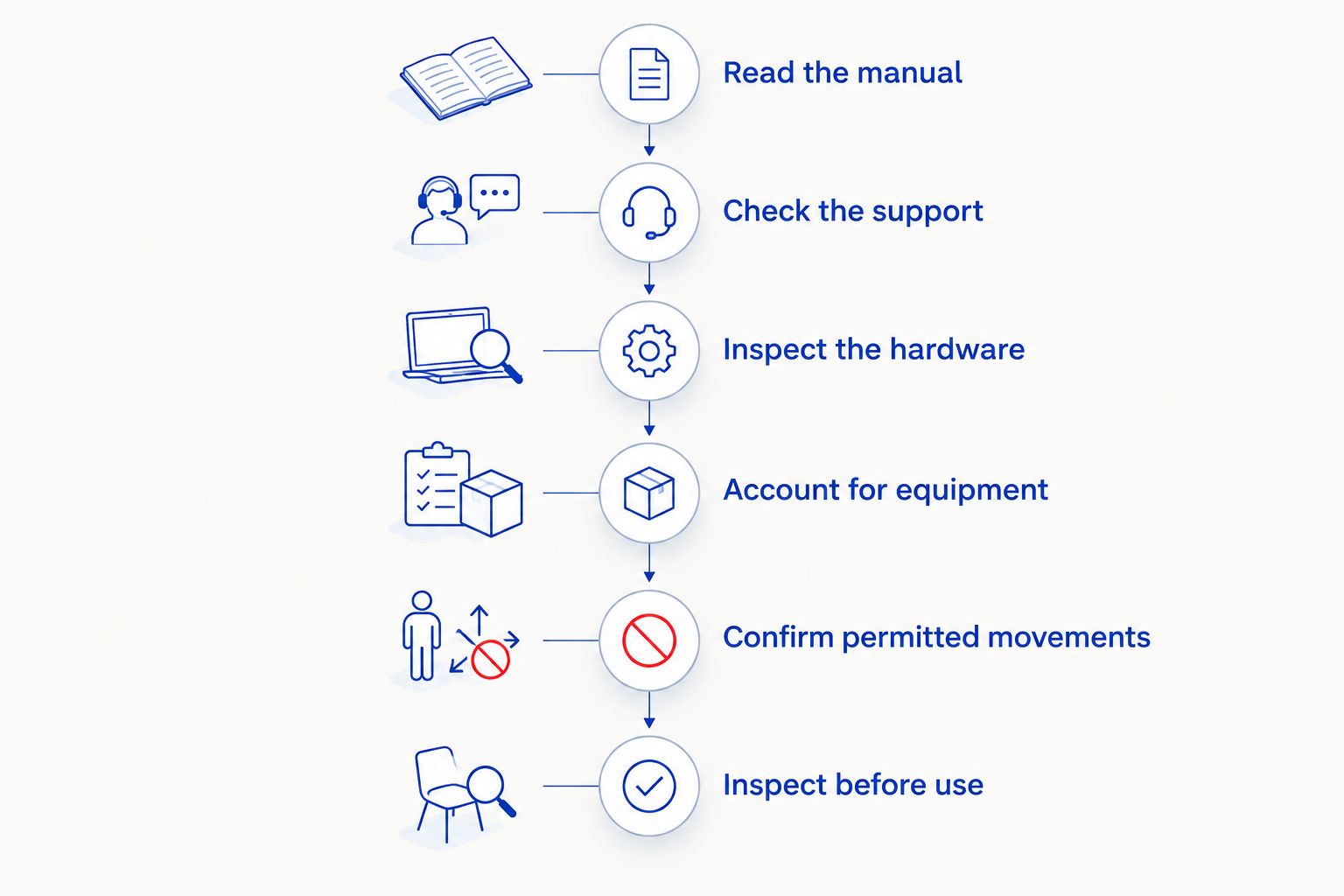
Use this 2026 setup checklist before your first workout and after reinstalling a removable bar. Inspection does not create a new weight rating; it checks whether the setup follows the existing one.
- Read the manual. Match the instructions to the exact bar, and locate its capacity and exercise restrictions. Do not use instructions for a similar-looking model.
- Check the support. Compare the doorway or structural surface with the manufacturer’s requirements. Do not assume decorative trim, a hollow surface, or an unknown wall assembly provides the required support.
- Inspect the hardware. Confirm that the specified parts are present and assembled as directed. Check brackets, locking mechanisms, contact pads, and fasteners for damage or movement.
- Account for equipment. Include any worn or attached weight when applying a total-load limit. If the instructions state only user weight, confirm how the manufacturer treats added equipment.
- Confirm permitted movements. Check that the exercise you intend to perform is allowed. Permission for controlled pull-ups does not automatically include kipping or suspended accessories.
- Inspect before use. Look for changes in fit, cracks, loose parts, slipping, or displaced contact points. Follow the manufacturer’s prescribed installation verification procedure.
Keep your manual accessible. You need it again when you move the bar, change the setup, or introduce a different exercise.
Why usable pull-up bar capacity varies
Usable capacity depends on the conditions attached to the rating. These factors do not authorize you to calculate a higher limit; they determine whether your installation meets the manufacturer’s requirements.
- Mounting method: Tension, trim-supported, fixed, and freestanding designs transfer loads differently. Use the installation method specified for your model.
- Support condition: Cracked trim, damaged contact surfaces, or unsuitable structural material can prevent a compliant installation even when the bar itself is intact.
- Fit and adjustment: A doorway bar must meet the manufacturer’s dimensional requirements. An adjustable design does not fit every opening.
- Hardware and assembly: Incorrect fasteners, missing parts, or an unsecured locking mechanism mean the setup does not match its instructions.
- Total supported weight: Added equipment changes the load. Your body weight alone is not the whole calculation for a total-load rating.
- Movement and condition: Swinging changes the forces on the system, while wear or displacement changes the installation. Check exercise permissions and inspect the equipment.
Do not solve a failed check by tightening harder, adding improvised padding, or substituting stronger-looking hardware. Follow the specified method or choose equipment that suits the space.
Doorway fit: inspect the contact points
A doorway bar’s contact points matter as much as whether its length spans the opening. A tension-mounted design presses against surfaces; a trim-supported design rests against specific parts of the frame. Read the correct instructions for the design you own.
Check where force enters the doorway. Look for damaged finishes, loose trim, cracking, and movement at the required support points. Surface appearance alone does not establish what is behind the frame or whether it meets the bar manufacturer’s requirements.
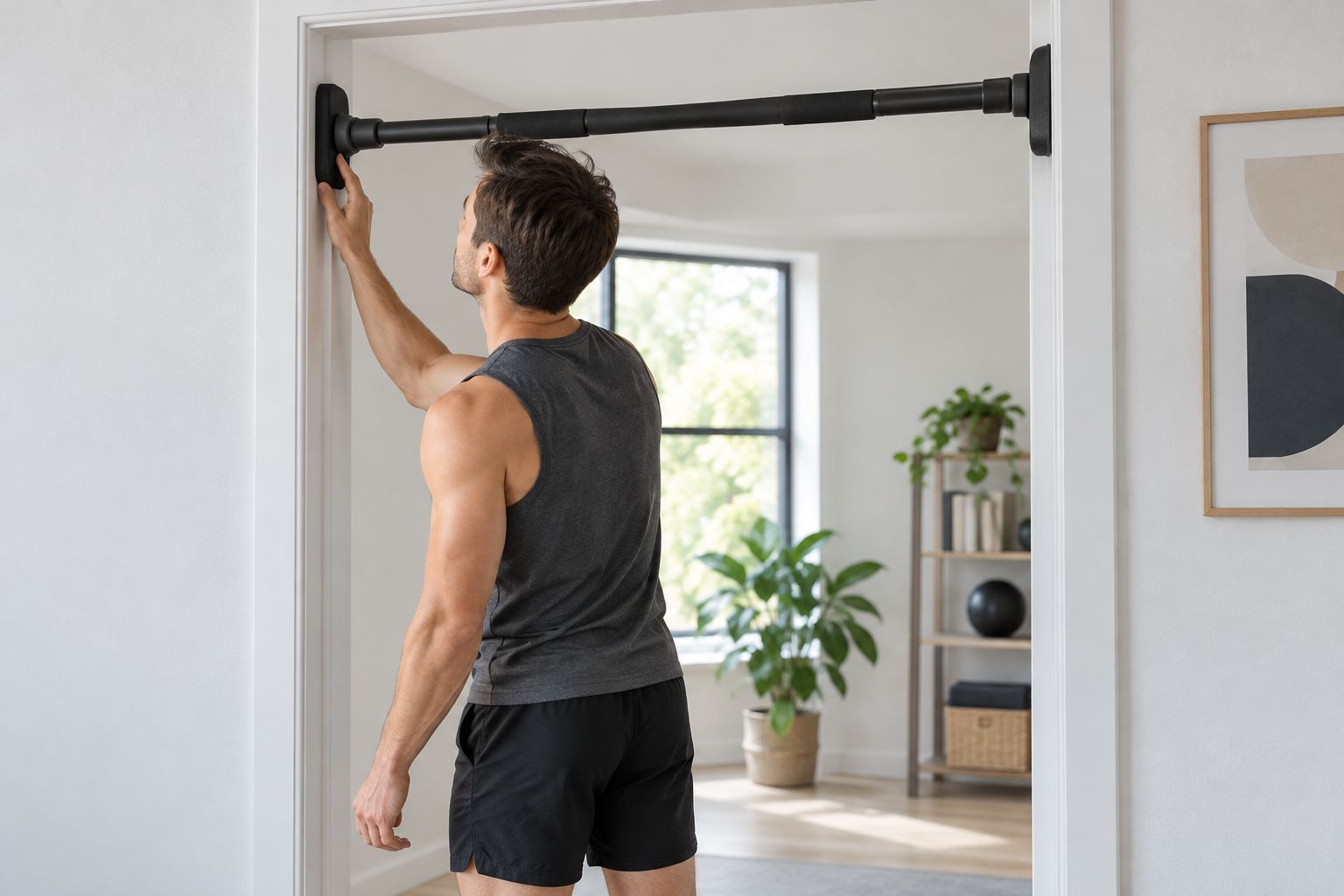
Stop using the bar if the installation shifts or the support shows damage. Do not use a full-body hang as a substitute for determining whether an unknown doorway is suitable. If you cannot establish the support conditions, choose a different approved installation or have the structure assessed.
Choosing an adjustable doorway bar in 2026
Beferra’s Adjustable Door Pull-Up Bar is described as home upper-body equipment designed to fit a range of doorways. That makes doorway compatibility the first buying check, not a detail to leave until assembly.
Best for: a home user seeking doorway-based upper-body training whose opening meets the product’s documented requirements. The practical appeal is using an existing doorway; the limitation is that a doorway-based design depends on that opening and the correct installation.
Before buying, confirm the model’s stated capacity, required dimensions, mounting method, and permitted exercises. Do not infer a weight allowance from the word adjustable or from the product photograph.
Beferra home fitness equipment is aimed at general consumers seeking functional daily essentials. For pull-up training, that everyday-use goal still requires model-specific instructions; it does not replace them.
Can I use a pull-up bar if I am below its weight limit?
Being below the stated limit is necessary, but it is not sufficient. Your bar must also be installed on the required support, assembled correctly, and used for an exercise the manufacturer permits.
Compare your situation with every condition in the manual. A compatible user weight does not make an incompatible doorway acceptable, and extra headroom in the rating does not authorize swinging or added weights.
If you train near the stated limit, do not invent a personal safety margin and assume it solves installation uncertainty. Select equipment whose documented requirements match your body weight, equipment, exercise, and space.
Can I do weighted pull-ups on a doorway bar?
Only use added weight when the manufacturer explicitly permits weighted pull-ups for that model and installation. A published body-weight limit does not automatically authorize a dip belt, weighted vest, or other attached load.
Where the instructions specify a total-load limit, account for everything the bar supports. Then check the exercise restrictions separately: passing the weight calculation does not override a prohibition on weighted training.
Plan for this before buying in 2026. If weighted pull-ups are part of your intended routine, compare models with documented permission for that use rather than buying a removable bar and assuming you can adapt it later.
Is a higher weight capacity always better?
A higher stated capacity is useful only when the equipment also suits your installation and exercise. Capacity does not tell you whether a bar fits your doorway, whether a wall supports the specified anchors, or whether the design allows your intended movement.
Compare documented limits alongside fit, mounting requirements, and exercise permissions. A smaller headline claim with clear applicable instructions is a better basis for a decision than an unexplained test claim.
The same rule applies to accessories. Resistance bands and suspension equipment require their own anchoring instructions; a pull-up bar’s rating alone does not establish compatibility with either.
FAQ
How much weight can a pull-up bar hold in 2026?
A pull-up bar holds the load permitted by its exact manufacturer rating under the specified installation and exercise conditions. There is no universal capacity that applies to every doorway, wall-mounted, or freestanding model.
Does my body weight count as the whole load?
Your body weight is not the whole load when you wear or attach additional equipment. Apply the manufacturer’s wording carefully, and confirm how added equipment is treated if the instructions specify maximum user weight rather than total load.
Can a doorway fail before the pull-up bar does?
Yes, an unsuitable or damaged doorway can fail even when the bar itself remains intact. The bar’s capacity does not independently certify your frame or its contact surfaces.
Can I kip on a bar rated for my weight?
Only kip if the manufacturer explicitly permits that movement for the model and installation. A weight rating alone does not authorize swinging or the changing forces associated with kipping.
Is a wall-mounted bar stronger than a doorway bar?
A wall-mounted bar is not automatically stronger than a doorway bar. Compare exact model ratings, suitable support structures, specified hardware, and permitted exercises rather than assuming capacity from the mounting category.
How do I know when to stop using my pull-up bar?
Stop using your pull-up bar when it slips, shifts, has damaged parts, or causes visible damage at its support points. Follow the manufacturer’s inspection and replacement instructions before returning it to use.
Can I use resistance bands to stay under a bar’s limit?
Do not use band assistance to reinterpret a pull-up bar’s weight rating. Follow the manufacturer’s user-weight and accessory rules; an assisted exercise does not establish permission to exceed them.
One last thing
Save the instructions before you need them. A removable bar creates a fresh installation check whenever you relocate it; a familiar workout does not make a new doorway equivalent to the old one.
For your 2026 routine, keep a simple rule: if the rating, support requirements, or exercise permissions do not clearly cover your setup, do not load the bar. That decision matters more than any headline capacity.