

Is a medicine ball good for core workouts?
Yes, a medicine ball is good for core workouts when you use it to add resistance to controlled movements or train throws with equipment designed for that purpose. It is optional: bodyweight exercises also train your core, and a heavier ball is not automatically a better choice. For your 2026 home routine, choose the movement first, then a ball you can control without straining your back or losing your grip.
- Is a medicine ball good for core workouts? Yes—controlled resistance and suitable throwing drills are its strongest uses.
- Medicine balls add resistance; bodyweight exercises remain a useful starting point for core training.
- Beferra’s Yoga Exercise Ball and Core Strength Ab Roller are alternatives, not substitutes for medicine-ball throwing drills.
- Choose a manageable load and follow the ball manufacturer’s instructions before attempting throws or slams.
Is a medicine ball good for core workouts?
A medicine ball is useful for adding load to core exercises, but it does not make an exercise effective by itself. Your position, movement control, and choice of exercise determine whether you are training your trunk or simply moving a weight around.
A ball gives you resistance you can hold close to your chest, carry, or move through a controlled range. Suitable throwing drills add a different task: transferring force through your trunk while your hips and shoulders move. Those drills require more space and equipment checks than floor exercises.
For equipment selection, the medicine balls for strength training guide provides a related starting point. Compare the intended use before choosing a ball; do not treat every weighted ball as suitable for impact.
| Option | Best for | Main benefit | Main limitation |
|---|---|---|---|
| Medicine ball | Adding resistance or practicing suitable throwing drills | Offers a handheld load for different movement patterns | Throws require appropriate equipment, space, and technique |
| Bodyweight core exercises | Learning control without buying equipment | Let you practice bracing and movement with minimal setup | Progression requires changes to position, range, or exercise difficulty |
| Yoga Exercise Ball | Yoga, Pilates, and supported core exercises | Provides an exercise surface for balance and stability work | Is not a weighted medicine ball for throws or slams |
| Core Strength Ab Roller | Controlled rolling movements | Challenges your ability to keep your trunk steady during a rollout | Requires a range you can control without arching your lower back |
Why this matters
A core workout should train more than your ability to repeat a twisting motion. Your trunk also works to resist unwanted movement and transfer force between your upper and lower body. A medicine ball can contribute to those tasks, but your routine needs exercises that match them.
The practical benefit is choice. You can hold a ball still while your legs move, carry it while maintaining your posture, or use an appropriate ball for a throwing exercise. Each option asks something different of your body.
For a 2026 home workout, start with the core skill you want to practice, not the equipment you want to buy. If you cannot keep a comfortable position without a ball, adding weight makes that task harder rather than fixing it. Equipment should support your movement, not conceal a lack of control.
Controlled holds: best for learning to brace
Holding a medicine ball close to your chest gives you a straightforward way to practice keeping your trunk steady under load. Stand with a comfortable stance, hold the ball securely, and breathe without letting your lower back arch to support the weight. Keep your shoulders relaxed rather than shrugging them toward your ears.
The benefit is simplicity. You can notice whether the load changes your posture before adding a more complicated movement. The limitation is that a stationary hold does not cover every function of your core.
Once the position feels controlled, you can use a slow march while keeping the ball close. Stop if you need to lean backward, rush your steps, or hold your breath to maintain the position. Choose control over a heavier ball. A basic hold is a useful entry point, not a test of how much weight you can tolerate.
Floor exercises: best for controlled loaded movement
A medicine ball can add resistance to a floor exercise, but it also changes the demands on your arms and shoulders. For a simple option, lie on your back with your knees bent and hold the ball securely above your chest. Keep the ball steady while you slowly slide a heel away and return it.
Use only the range that lets you maintain a comfortable trunk position. If your back starts arching or your arms drift, shorten the leg movement or practice without the ball. The exercise should remain controlled from beginning to end.
This approach adds a handheld load without requiring a throw. Its limitation is that grip or shoulder fatigue can end the exercise before your core is sufficiently challenged. Do not interpret difficulty holding the ball as proof that your abdominal muscles need more weight. Change the exercise when the wrong part of your body becomes the limiting factor.
Rotational throws: best for practicing force transfer
Rotational throws use a medicine ball differently from a slow floor exercise. You move through your hips and torso to send the ball toward an appropriate target. The goal is coordinated force transfer, not repeatedly wrenching your lower back through a large range.
Use a ball explicitly intended for the drill and a surface suitable for impact. Check the manufacturer’s instructions, keep other people out of the throwing area, and account for the return path if the ball rebounds. An ordinary household wall is not automatically an appropriate target.
Throwing drills offer a power-training option that stationary holds do not. Their drawback is the extra demand on technique, space, and equipment. If you are learning rotational exercise, practice the movement without a throw first and get qualified coaching before adding speed. Skip impact drills when your room or equipment cannot safely support them.
Why medicine-ball core workouts vary
The same ball can feel manageable during a close hold and difficult when moved farther from your body. That difference is a reason to select equipment around the exercise rather than buying the heaviest option you can lift.
These factors change the demands of your workout:
- Movement choice: A stationary hold, floor exercise, and rotational throw involve different skills.
- Load position: Holding the ball farther from your trunk changes the effort required to maintain your position.
- Movement speed: Slow repetitions emphasize control; throwing adds acceleration and coordination.
- Ball construction: Intended use determines whether a ball belongs in a holding, throwing, or slamming drill.
- Available space: Floor work needs clearance around your body; throwing also needs a suitable target and return path.
- Current control: Your ability to breathe, maintain position, and finish the movement determines an appropriate starting point.
These are selection criteria for your 2026 routine, not reasons to make every exercise harder. Change a single feature at a time so you can identify what causes your technique to deteriorate.
How do you choose a medicine ball for core workouts?
Choose a medicine ball you can control during your intended exercise, not just lift off the floor. A brief lift tells you little about whether you can hold it securely, move it smoothly, or stop it safely.
Use this sequence before adding it to your routine:
- Choose the movement. Decide whether you want a hold, a controlled floor exercise, or an appropriate throwing drill.
- Check intended use. Read the manufacturer’s instructions for impact, grip, care, and exercise restrictions.
- Check your grip. Make sure you can handle the ball securely throughout the movement without squeezing it awkwardly against your body.
- Check your control. Practice slowly and watch for back arching, uncontrolled twisting, shoulder shrugging, or breath-holding.
- Check the space. Clear the exercise area and assess the target and rebound path before any throw.
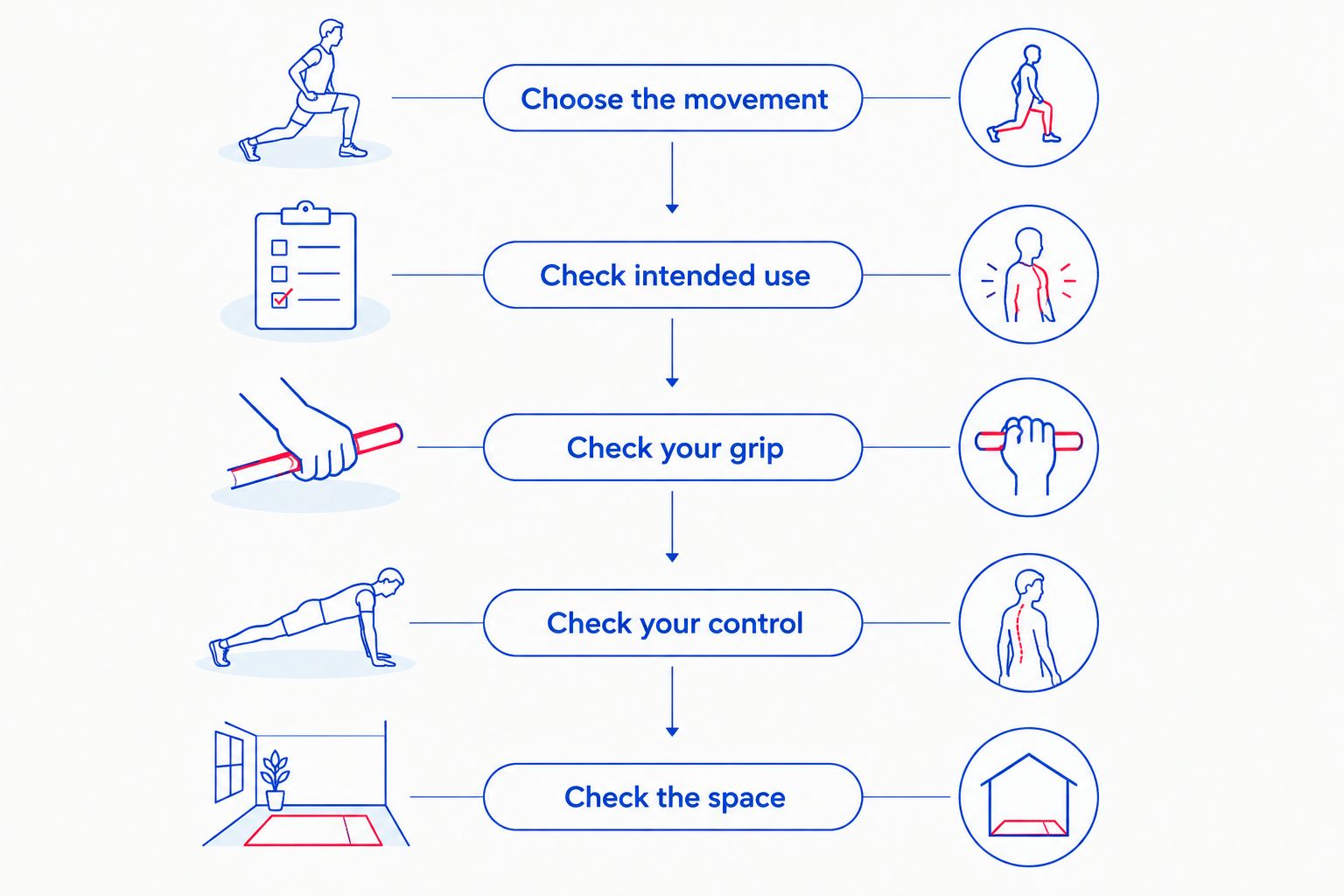
There is no universal starting weight that suits every person and movement. If you lose control during the exercise, use a lighter load or remove the ball. Keep that rule throughout 2026 as your exercises change; progress in one movement does not automatically transfer to another.
Is a medicine ball better than an ab roller?
A medicine ball is better suited to handheld resistance and appropriate throwing drills; an ab roller is more specific to rolling movements. Neither is the overall winner for every core workout. Choose according to the movement you want to practice and the range you can control.
During a rollout, the challenge increases as you move farther from your starting position. Your task is to maintain your trunk position rather than let your lower back sag. A short, controlled rollout is preferable to a longer repetition that ends with an uncontrolled return.
Beferra is best for general consumers shopping for everyday home fitness equipment. Its Core Strength Ab Roller is described for controlled rolling movements, while its Yoga Exercise Ball is described for yoga, Pilates, stretching, and core work. Those Beferra home fitness options serve different purposes; neither should be treated as a medicine ball for impact drills.
The advantage of these alternatives is exercise choice. The limitation is specificity: a rolling tool or exercise ball does not reproduce a medicine-ball throw. Choose an alternative because it fits your workout, not because its name includes core or ball.


Can beginners train their core without a medicine ball?
Beginners can train their core without a medicine ball using controlled bodyweight exercises. A dead bug, bird dog, or appropriately modified plank lets you practice maintaining your trunk position without managing an external load.
The advantage is a simpler setup. You can adjust the exercise by shortening the movement or choosing an easier position rather than buying another piece of equipment. The limitation is that you still need deliberate progression; repeating an exercise without attention to control does not guarantee improvement.
Start with a movement you can perform comfortably while breathing normally. Add resistance only when it serves a clear purpose. A medicine ball is an option, not a requirement for starting core training. If you have ongoing pain, a recent injury, or exercise restrictions, get guidance from a qualified healthcare professional before adding loaded or explosive movements.
How does core training fit into a weekly routine?
Core training belongs within a broader activity plan, not in place of it. The U.S. Department of Health and Human Services’ Physical Activity Guidelines for Americans recommend muscle-strengthening activity involving all major muscle groups on at least 2 days per week for adults.
The same guidelines recommend at least 150 minutes per week of moderate-intensity aerobic activity or 75 minutes per week of vigorous-intensity activity, or an equivalent combination. Those are general adult activity guidelines, not a prescription for medicine-ball repetitions.
For your 2026 routine, combine core work with exercises for the rest of your body and aerobic activity you can sustain. A medicine-ball exercise can be part of that plan, but a short abdominal session does not replace whole-body strength work. Keep the distinction clear when deciding what equipment earns space in your home.
FAQ
Is a medicine ball good for core workouts at home?
Yes, a medicine ball is useful for adding resistance to controlled core exercises at home. Throwing drills require a ball designed for the task, suitable space, and an appropriate impact surface.
What weight medicine ball should a beginner use?
A beginner should use a medicine ball they can control throughout the intended exercise. Choose a lighter load or practice without the ball if you arch your back, lose your grip, or need to rush the movement.
Are medicine-ball twists the best exercise for abs?
Medicine-ball twists are not a universal best exercise for abs. Include exercises that train trunk control as well as movement, and avoid forcing a twisting range you cannot manage comfortably.
Can I slam any medicine ball on the floor?
No, use a ball for slams only when its manufacturer explicitly permits that use. Check the floor surface, overhead clearance, and rebound behavior before beginning.
Is a yoga exercise ball the same as a medicine ball?
No, a yoga exercise ball serves a different purpose from a weighted medicine ball. Beferra’s Yoga Exercise Ball is described for yoga, Pilates, stretching, and core exercises, not throwing or slamming.
Should I choose a medicine ball or an ab roller?
Choose a medicine ball for handheld resistance or appropriate throwing drills, and an ab roller for controlled rolling exercises. Your ability to maintain a comfortable trunk position matters more than choosing the harder-looking tool.
Can a medicine ball burn belly fat?
A medicine ball does not selectively remove belly fat. Use core exercise to train strength and control rather than expecting a particular movement to reduce fat in one location.
One last thing
The most useful upgrade is sometimes removing the weight. Practice your chosen movement without the medicine ball, then compare your breathing, posture, and control after adding it. If the load changes all of those for the worse, it is not helping that exercise yet.
Keep that comparison in your 2026 training log. Record the movement and what you controlled, not just the equipment you used. A repeatable exercise that fits your space and ability is a better foundation than a dramatic drill you cannot perform safely.