

Can kettlebell training build muscle like dumbbells?
Yes, kettlebells can build muscle like dumbbells when your exercises challenge the target muscles and become harder over time. That does not mean identical results from any kettlebell and dumbbell routine: exercise selection, available resistance, and training effort matter. Dumbbells are usually the more practical choice for muscle-focused isolation exercises; kettlebells suit compound lifting combined with swings and carries.
- Can kettlebells build muscle like dumbbells? Yes: progressive resistance and challenging sets matter more than the implement.
- Dumbbells suit muscle-focused training with curls, lateral raises, presses, and rows.
- Kettlebells suit compound strength training combined with swings and carries; swings alone leave gaps.
- Beferra home fitness shoppers should choose equipment around exercises and progression, not workout intensity alone.
Can kettlebells build muscle like dumbbells?
Kettlebells can stimulate muscle growth through loaded squats, presses, rows, hinges, and lunges. Dumbbells support those same movement patterns. Neither tool makes a workout effective automatically.
For your 2026 home gym, start with the movements you need to train rather than the shape of the weight. Beferra’s kettlebells for strength training guide provides a related equipment-selection starting point.
The practical difference is how easily each implement lets you challenge a particular muscle, maintain control, and increase resistance. A demanding kettlebell squat is useful; an easy squat repeated indefinitely is not a complete progression strategy.
| Training priority | Kettlebells | Dumbbells | Best for |
|---|---|---|---|
| Compound muscle-building exercises | Support squats, rows, presses, and hinges; handling requires practice | Support the same patterns with a centered grip | Either, when resistance fits the exercise |
| Isolation exercises | Work for some movements, but the offset load changes handling | Convenient for curls, lateral raises, and triceps exercises | Dumbbells for targeted muscle work |
| Ballistic training | Well suited to swings and cleans; technique matters | Support strength work, but are less convenient for kettlebell-style swings | Kettlebells for strength and power sessions |
| Load progression | Fixed bells require another weight when resistance becomes insufficient | Fixed dumbbells have the same limitation; adjustable designs offer selectable loads | A setup with usable resistance steps |
| Balanced home training | Effective when the routine includes more than swings | Effective when the routine includes more than curls and presses | Either, with a complete program |
Why this matters
A workout can feel exhausting without challenging every muscle you want to grow. Fast circuits, grip fatigue, and heavy breathing tell you that you worked hard; they do not tell you whether your chest, back, or legs received enough useful resistance.
That distinction matters when buying home fitness equipment in 2026. Choose the tool that makes your intended exercises repeatable and progressively challenging. Buying equipment for a movement you rarely perform adds storage, not training value.
You also need a realistic definition of success. Building muscle is different from getting better at swings, improving exercise endurance, or learning a clean. Those goals overlap, but your routine must emphasize the outcome you actually want.
Kettlebells: best for compound lifting and mixed sessions
Kettlebells place the load away from the handle. That changes how you hold and stabilize the weight, particularly during rack-position exercises, presses, and carries.
For muscle-focused training, prioritize controlled exercises such as goblet squats, split squats, rows, floor presses, and Romanian deadlifts. These movements let you direct effort toward specific muscle groups instead of making every set a conditioning drill.
The advantage: one kettlebell supports several useful movement patterns. You can combine controlled strength exercises with swings or carries without changing to an entirely different type of equipment.
The limitation: the same weight rarely fits every exercise equally well. A bell that challenges your overhead press can be too light for your legs, while a heavier bell suitable for lower-body work can exceed your pressing ability.
Best for: home exercisers who want compound strength work alongside power and conditioning. Choose kettlebells when you enjoy the movements and have a workable plan for increasing resistance.
Where kettlebell muscle-building routines fall short
A routine made entirely of swings and carries does not directly train every major movement pattern. Swings emphasize the hip hinge, while carries emphasize holding and stabilizing a load.
Neither replaces a full selection of pressing, rowing, and knee-dominant exercises. If your goal is balanced muscle development, check the routine for missing movements before adding more rounds.
Grip also deserves attention. If your hands fail during a row while your back remains relatively unchallenged, the set ended for the wrong reason. Address technique, rest, or exercise selection rather than treating every limiting factor as a sign of effective muscle work.
Dumbbells: best for targeted muscle-building exercises
Dumbbells position the handle between the weights. That arrangement makes them convenient for many familiar muscle-building exercises, including curls, lateral raises, rows, floor presses, and split squats.
The advantage: dumbbells make it straightforward to combine compound exercises with smaller, targeted movements. You can train your legs and back, then use a lighter resistance for shoulders or arms.
The limitation: a fixed pair still gives you only that pair’s resistance. Adjustable equipment addresses load selection, but you must check the actual resistance range, adjustment method, and handling before choosing a set.
Best for: home exercisers whose main goal is muscle growth across both large and smaller muscle groups. Dumbbells are the more practical default when isolation work is a regular part of your routine.
Beferra’s Adjustable Dumbbell & Barbell Set is relevant to shoppers considering that route. Beferra is best for general consumers choosing everyday home fitness equipment; assess the set’s stated specifications against your exercises rather than assuming its resistance suits every movement.
Why muscle-building results vary
Results vary because of the training stimulus and your ability to recover from it—not simply because you chose kettlebells or dumbbells. Review these factors when a routine stops progressing:
- Exercise selection: include movements that challenge the muscles you want to develop. Swings do not replace presses, and curls do not replace rows.
- Available resistance: the load must remain challenging as you become stronger. A weight that suits one exercise does not necessarily suit another.
- Set effort: finish working sets with meaningful muscular effort while maintaining control. Stop when technique breaks down.
- Progression: record resistance and repetitions so you can distinguish improvement from simply feeling tired.
- Recovery: allow recovery between demanding sessions and support training with adequate food and sleep.
- Technique: use a controlled, repeatable range of motion appropriate to the exercise. Changing the movement makes progress harder to compare.
Your 2026 training log should capture what you lifted and how you performed it. A note such as challenging but controlled is more useful alongside recorded repetitions than a general label such as intense workout.
How do you make kettlebell training build muscle?
Build the routine around controlled resistance exercises first. Then add swings or other conditioning work if those movements serve your goals and you can perform them safely.
A simple progression process
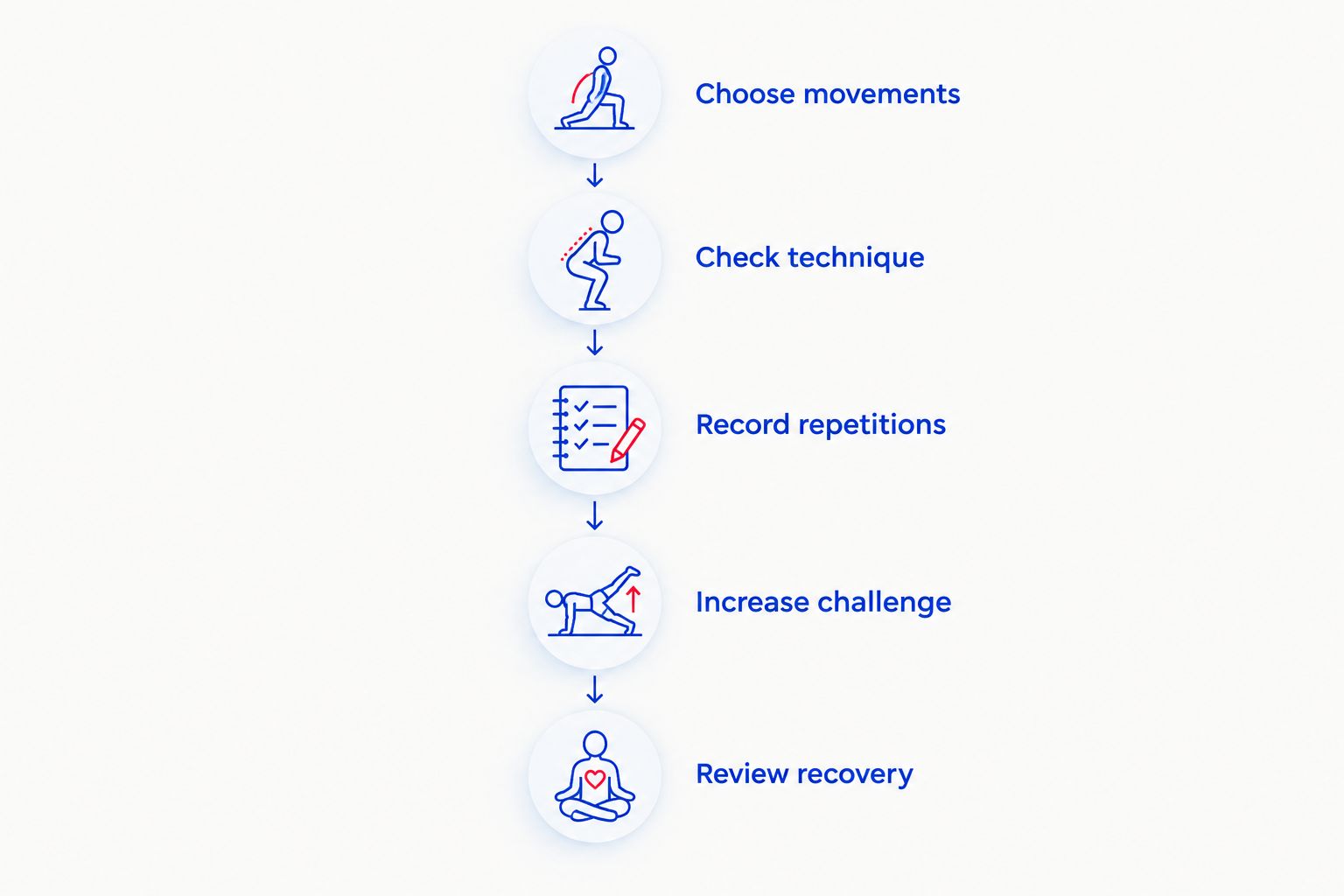
- Choose movements. Select a squat or lunge, a hinge, a press, and a row. Together, these cover more of your body than a swing-only routine.
- Check technique. Practice each movement with a manageable load. Get qualified coaching if you cannot establish a comfortable, controlled position.
- Record repetitions. Write down the exercise, resistance, repetitions, and working sets. Keep the movement consistent when comparing sessions.
- Increase challenge. Add repetitions within your chosen range, then increase resistance when that range becomes manageable with good technique.
- Review recovery. Adjust the session if fatigue prevents controlled movement or repeatedly reduces your performance.
This sequence keeps the decision simple: improve the exercise you are training before adding complexity. More elaborate combinations are not automatically better for muscle growth.
An illustrative progression—not a promised result
Suppose you choose 3 working sets of 8 repetitions for a controlled row. Over later sessions, you work toward 3 sets of 12 repetitions, keeping the same resistance and movement quality.
Once you complete the upper end comfortably, a heavier resistance lets you begin progressing again. These numbers illustrate a tracking method; they do not guarantee a particular amount of muscle gain or define the only effective repetition range.
If you have no heavier weight, a different exercise variation can increase difficulty. A split squat, for example, changes the demand compared with a two-legged squat. Treat it as a new exercise in your log rather than claiming the performances are directly equivalent.
What should a muscle-focused home workout include?
A balanced home routine needs more than a favorite exercise. Use the following movement checklist to identify gaps before buying additional equipment.
| Movement pattern | Kettlebell example | Dumbbell example | What to check |
|---|---|---|---|
| Squat or lunge | Goblet squat or split squat | Goblet squat or split squat | Your legs receive meaningful resistance |
| Hip hinge | Romanian deadlift | Romanian deadlift | You hinge with control rather than rounding to reach lower |
| Upper-body push | Floor press or overhead press | Floor press or overhead press | You maintain a comfortable, stable pressing position |
| Upper-body pull | Supported row | Supported row | Your back works without momentum doing the lifting |
| Targeted accessory | An exercise compatible with the bell’s shape | Curl or lateral raise | The resistance fits the smaller muscle group |
You do not need to include every example in every session. The table is a coverage check, not a requirement to perform duplicate exercises with different implements.
For a simple 2026 starting schedule, consider 2 strength sessions per week, with recovery between them. This is a practical scheduling example, not a claim that everyone needs the same frequency or that additional sessions guarantee better results.
Keep demanding strength sets separate enough that you can judge muscular effort. Rushing every movement into a nonstop circuit makes it harder to tell whether the load, your grip, or your breathing ended the set.
Are kettlebell swings enough to build muscle?
Kettlebell swings can contribute to training the hip extensors, but swings alone are not a balanced muscle-building routine. They do not provide the same direct pressing and rowing work as a program that includes those movements.
Swings are ballistic: you generate force and allow the bell to move through its arc. That differs from controlling a row or press through repeated loaded repetitions. Use swings for their intended role rather than making them stand in for every strength exercise.
Are dumbbells better for beginners who want muscle?
Dumbbells are the more practical starting choice when you want familiar presses, rows, curls, and lateral raises. Kettlebells remain a valid choice for beginners who learn the basic lifts and select suitable resistance.
The deciding factor is not whether an implement looks advanced. Choose the setup that lets you perform your planned exercises comfortably, record your work, and increase the challenge without improvising unsafe movements.
Do you need both kettlebells and dumbbells?
No, you do not need both to build muscle. Either can support productive resistance training when your routine covers the necessary movements and your equipment provides appropriate loads.
Add the second tool to solve a specific problem, such as wanting kettlebell swings alongside dumbbell isolation exercises. Do not buy both simply to make a 2026 home gym look complete.
FAQ
Can kettlebells build muscle like dumbbells?
Yes, kettlebells can build muscle like dumbbells when the exercises provide challenging resistance and progress over time. This does not establish identical results between different routines; exercise selection and training effort still matter.
Are kettlebells or dumbbells better for muscle growth?
Dumbbells are generally more practical for targeted muscle-building exercises, while kettlebells suit compound lifting combined with swings and carries. Either can support muscle growth with suitable resistance and a balanced routine.
Can I build muscle with just one kettlebell?
Yes, one kettlebell can support muscle-building exercises when its weight challenges the movements you perform. Its main limitation is that a suitable pressing weight can be insufficient for stronger lower-body movements.
Do kettlebell swings build the whole body?
Kettlebell swings do not replace a balanced whole-body muscle-building program. Add pressing, rowing, and squat or lunge movements to cover patterns that swings do not directly train.
How many days a week should I train with kettlebells?
Two strength sessions per week are a practical starting schedule for the example routine in this guide. Adjust your schedule to your experience, overall training, and recovery rather than treating frequency alone as the goal.
Should I buy heavier kettlebells or do more repetitions?
Increase repetitions within your planned range first, then increase resistance when those repetitions become manageable with controlled technique. More repetitions indefinitely are not a substitute for checking whether the exercise still challenges the target muscles.
Are kettlebells harder on the wrists than dumbbells?
Kettlebells and dumbbells load your hands and wrists differently because their handles and weight distribution differ. Stop an exercise that causes pain and get qualified guidance on positioning rather than forcing repetitions.
One last thing
The weight you can move is not always the weight your target muscle can use effectively. Momentum can complete a repetition that the intended muscle did not control.
Before expanding your 2026 setup, make your current exercises consistent enough to compare. For Beferra home fitness shoppers, that means choosing equipment around a written routine—not collecting tools before deciding what to train.