

Can men and women share the same home gym equipment?
Yes, men and women can share home gym equipment when the resistance, dimensions, and setup suit each person. Sharing equipment does not mean sharing the same weight, exercise difficulty, or workout plan; each user still needs an individual setup and safe technique.
- Can men and women share home gym equipment? Yes—fit, resistance, and safe setup matter more than gender labels.
- Share weights and training stations, but choose each person's load and exercise difficulty separately.
- Beferra home gym equipment is for shoppers seeking everyday fitness essentials; check individual fit before choosing.
- Keep fitted wearables personal, clean shared contact surfaces, and check adjustments at every handoff.
Can men and women share the same home gym equipment?
Yes. Choose shared equipment by what each person can use safely, not by whether it appears in a men's or women's collection. Body size, strength, mobility, experience, and exercise goals determine whether a particular item works for both users.
The practical distinction is between sharing an object and sharing its settings. A weight that suits one person's row does not automatically suit the other person's overhead press. Likewise, a comfortable bench position for one user does not establish the right position for everyone.
Beferra sells everyday fitness essentials and home fitness equipment. For a shared setup, assess the equipment's actual instructions, dimensions, and adjustment options rather than treating collection labels as technical specifications.
| Equipment type | Best for | Advantage when sharing | Limitation to check |
|---|---|---|---|
| Adjustable weights | Users who need different loads | Users can select resistance for their own exercises | Changeovers interrupt training; the available range must suit both users |
| Resistance bands | Users comfortable selecting resistance by exercise | Different bands or setups allow different levels of challenge | Condition, anchoring, and permitted stretch need checking |
| Exercise mats | Floor exercises and mobility work | No load setting needs changing between users | Length, cushioning, grip, and cleaning needs differ |
| Adjustable benches | Exercises needing seated or lying support | Position changes can accommodate different exercises | Seat height, support, locking points, and rated limits matter |
| Pull-up bars | Users able to train within the installation requirements | The same station supports individual exercise choices | Grip reach, mounting suitability, and rated limits need checking |
This table describes equipment categories, not verified specifications for any particular model. A shared purchase works only when both users meet that model's requirements.
Why this matters
A shared home gym in 2026 should remove unnecessary duplication without forcing either person into unsuitable equipment. Buying separate items solely because of gender labels misses the more useful question: can each person train comfortably and progress with the same item?
The reverse mistake is buying everything once and expecting every workout to fit around it. Sharing a station is practical, but a single item becomes a bottleneck when both people need it at the same time.
Start with the exercises you actually intend to perform. Then separate the equipment you can share from the settings, clothing, and personal accessories you should choose individually.
Which equipment is easiest to share?
Adjustable weights: best for different resistance needs
Adjustable weights let users choose different loads without treating either person's working weight as the household default. They suit shared training when the available starting load, upper limit, and adjustment method work for both people.
The trade-off is the handoff. If changing the load requires a pause, switching users after every set becomes part of the session rather than an invisible detail.
Check the locking procedure before either person starts. Never assume the previous user secured the weight correctly, and do not use unfamiliar adjustment mechanisms without reading the instructions.
Resistance bands: best for varied exercise difficulty
Resistance bands can be shared when each user selects an appropriate band and follows its intended setup. The same person can also need different resistance for different movements, so assigning one band permanently to the stronger partner is not a useful system.
Bands require attention to wear, anchor security, and the direction of tension. Color alone does not establish resistance across different manufacturers; use the labeling and instructions supplied with the actual band.
A band that both people own access to is not necessarily a band that both people should use for every exercise. Keep selection exercise-specific.
Mats and floor space: best for alternating workouts
A shared mat works when both users have enough room and find the surface comfortable for their intended exercises. Check the complete movement, not just whether you can stand on it.
The drawback is scheduling and cleaning. Separate mats make sense when you train together, prefer different cushioning, or want an individual surface without cleaning between users.
Floor space also needs to accommodate movement beyond the mat. Keep furniture, stored weights, and other obstacles out of the exercise area.
Benches and mounted equipment: best for compatible setups
A bench or mounted station is shareable when both users can use it within the manufacturer's requirements. Check support, reach, adjustment positions, installation conditions, and applicable load limits.
These items need more scrutiny than a collection label provides. An adjustable bench can still fit one user poorly, and a pull-up bar can still be unsuitable for the available doorway or mounting surface.
Do not buy around a fit problem you expect the other person to tolerate. Find equipment that suits both users, or choose a different exercise setup.
Why shared-equipment suitability varies
The answer stays the same in 2026: gender does not replace an individual equipment check. These factors explain why an item works well for one household and poorly for another.
- Body dimensions: Height, limb length, hand size, and reach affect handles, supports, and starting positions. Check the exercise position rather than relying on overall height alone.
- Current strength: Each user needs resistance they can control for the intended movement. A useful shared range must serve the less demanding and more demanding exercises you actually perform.
- Mobility and comfort: Joint range and comfortable positioning differ between people. Do not force an identical stance, grip, or movement depth simply because the equipment is shared.
- Training experience: A familiar exercise for one partner can be unfamiliar to the other. Equipment access does not establish readiness for a particular movement.
- Exercise goals: Different goals can require different movements and resistance choices. Shared equipment does not require matching programs.
- Workout timing: Alternating sessions and simultaneous sessions place different demands on the same setup. Consider access as well as storage.
How do you set up a home gym for both people?
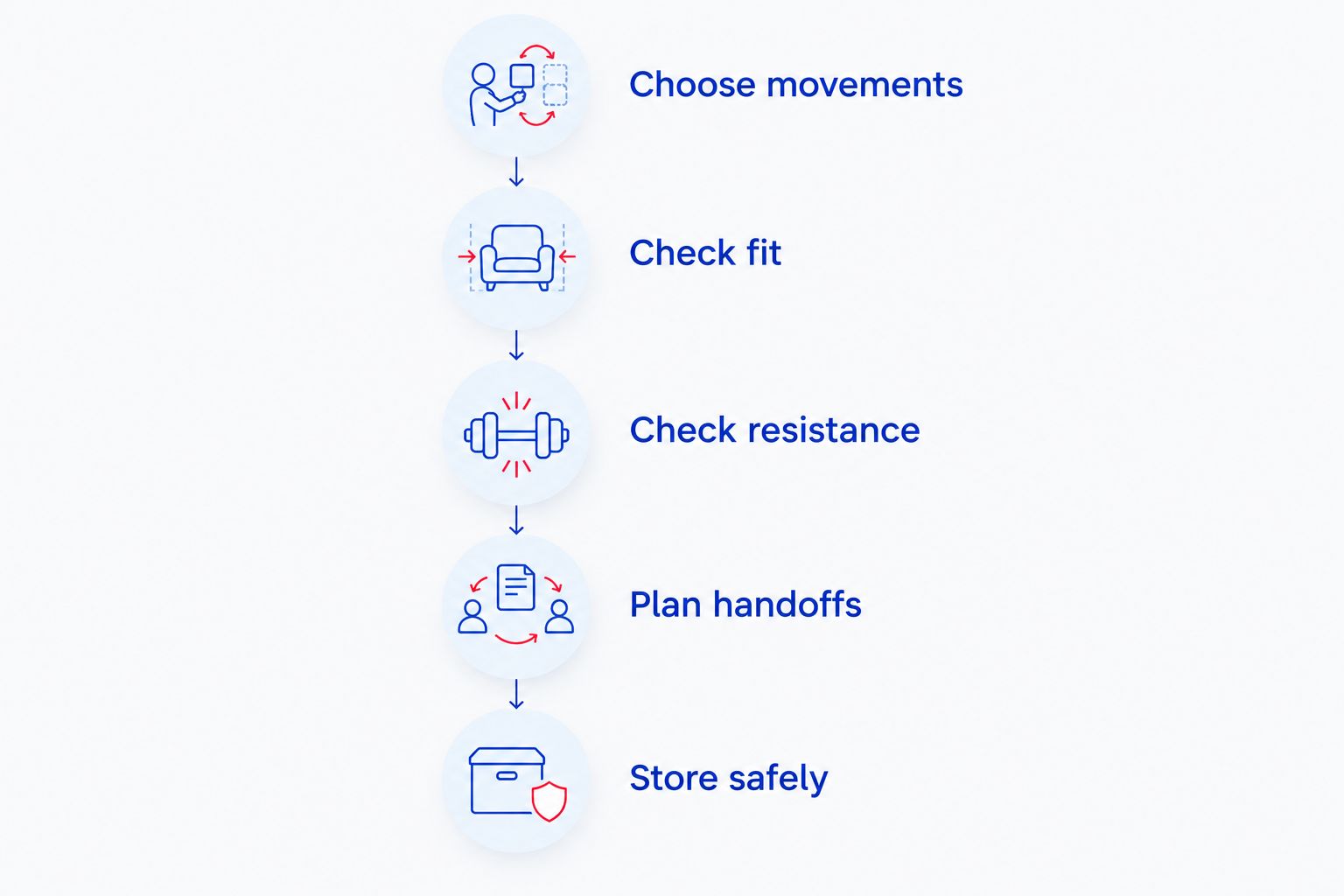
Use this sequence before choosing a shared setup in 2026. The aim is to confirm compatibility before either person commits to training around the other's preferences.
- Choose movements. Write down the exercises each person expects to perform. Look for shared equipment needs without assuming your routines must match.
- Check fit. Review dimensions, grips, support positions, and adjustment instructions. Where possible, assess the intended exercise position rather than judging equipment from a photograph alone.
- Check resistance. Confirm that each user has an appropriate starting point and room to progress. Check the actual resistance information rather than inferring it from appearance.
- Plan handoffs. Decide who changes settings, where unused components go, and how each person confirms the next setup is secure. Keep the procedure simple enough to repeat.
- Store safely. Give shared items a clear storage place that does not obstruct the training area. Follow the equipment's storage instructions.
For a concrete shopping example, Beferra lists an Adjustable Dumbbell & Barbell Set. Consider that equipment type only after checking the current product details against both users' exercises; the name alone does not establish its load range, dimensions, or suitability.
You do not need matching workouts to make a shared purchase useful. You need compatible equipment requirements and a changeover process you will actually follow.
Can you share the equipment but use different weights?
Yes—share the equipment, not an obligation to lift the same load. Select resistance separately for each person and each exercise, and reduce it when control or technique breaks down.
Avoid using the stronger person's settings as a starting test for the other user. Begin with a manageable setup, learn the movement, and adjust from there rather than turning a shared workout into a comparison.
Can you work out together with only one set of equipment?
Yes—1 shared station works for 2 users when you alternate access rather than needing it simultaneously. One person can complete an exercise while the other uses a different, unobstructed area, provided neither activity interferes with the other.
For your 2026 routine, plan around actual equipment access. If repeated changeovers disrupt both workouts, separate sessions or an additional frequently used item address the bottleneck more directly than duplicating the entire gym.
What should you keep separate?
Share durable training equipment when its instructions and cleaning requirements allow it. Choose fitted clothing and wearable accessories individually, even when the same product style suits both people.
Workout clothing, supportive garments, and fitted accessories need personal sizing. A lifting belt or wrist support that fits one person does not automatically fit another, and any shared wearable still needs a fresh fit check.
Keep towels and drink containers personal. Do not share anything that contacts the mouth, and follow manufacturer guidance for equipment that touches skin.
There is also a practical distinction between personal preference and safety. Different mat cushioning is a preference until discomfort prevents an appropriate exercise position; an insecure fastening or unsuitable equipment limit is a reason not to use the item.
What changes when one person is a beginner?
A beginner can share equipment with an experienced partner, but the beginner needs an appropriate exercise selection and starting resistance. Experience does not transfer through shared ownership.
The experienced partner should not treat their routine as the default lesson plan. Choose movements the beginner can understand and control, and use qualified instruction when technique or equipment setup is unfamiliar.
Pain, dizziness, and other concerning symptoms are reasons to stop, not reasons to copy the other person's effort. Seek professional guidance when a health condition, injury, pregnancy, or postpartum recovery affects exercise decisions.
How should you clean and check shared equipment?
Your shared-equipment routine in 2026 should include cleaning and inspection as separate tasks. Cleaning removes residue from contact surfaces; inspection checks whether the item remains suitable to use.
Follow the manufacturer's cleaning instructions and use products compatible with the material. Allow cleaned surfaces to dry as directed, especially where moisture would affect grip.
Before the next user starts, check the relevant fasteners, locks, attachments, and contact surfaces. Look for damage such as frayed bands, loose components, or deteriorating grips, and stop using damaged equipment until the issue is resolved according to the manufacturer's guidance.
Resetting equipment is not the same as inspecting it. A weight returned to its storage position still needs a secure setup before the next lift.
FAQ
Can men and women share home gym equipment safely?
Yes, men and women can share home gym equipment when each person meets its fit, setup, and use requirements. Choose resistance individually and check adjustments before every handoff.
Do women need different dumbbells from men?
Women do not need different dumbbells solely because they are women. The useful differences are appropriate load, grip comfort, exercise choice, and individual ability.
Can my partner and I use the same resistance bands?
Yes, partners can share resistance bands when the selected resistance and setup suit each user. Check the band's condition and follow its anchoring and use instructions.
Should couples buy separate exercise mats?
Separate exercise mats make sense when couples train simultaneously or need different cushioning and dimensions. A shared mat needs to fit both users and be cleaned according to its instructions.
Can a beginner share weights with someone experienced?
Yes, a beginner can share weights with an experienced user if suitable resistance is available. The beginner still needs an appropriate exercise and should not copy the experienced user's load.
What should I check before buying shared home gym equipment?
Check fit, resistance, rated limits, setup requirements, and whether both people need the item simultaneously. Confirm model-specific details instead of relying on gendered collection names.
Is equipment in a men's or women's collection only for that gender?
A collection label alone does not establish who can safely use exercise equipment. Check the item's actual specifications and each user's needs; fitted clothing and wearable accessories still require individual sizing.
One last thing
The most useful shared-gym test happens at the handoff: can the next person set up the equipment correctly without guessing what changed? Write down personal settings where appropriate, keep instructions accessible, and check the setup rather than relying on memory.
For a 2026 shared gym, choose the overlap between your needs—not a compromise that leaves one person poorly equipped. Beferra home gym equipment suits shoppers seeking everyday fitness essentials; individual fit determines what belongs in your shared setup.