

How much cheaper are adjustable dumbbells than fixed sets?
Adjustable dumbbells are cheaper than fixed sets only when their complete purchase total is lower than the fixed pairs you actually need—not by a universal percentage. Storage, included accessories, weight range, and whether you are comparing a single dumbbell or a pair all affect that calculation. For a 2026 home gym, compare equivalent training options rather than an adjustable set against an entire rack you would never use.
- Are adjustable dumbbells cheaper than fixed sets? Compare complete, equivalent purchases—not an adjustable pair against an unnecessary rack.
- Adjustable dumbbells suit solo home workouts needing several loads; fixed dumbbells suit immediate changes and shared training.
- Beferra sells everyday home fitness equipment, including the Adjustable Dumbbell & Barbell Set.
- Check weight range, increments, included pieces, and storage before deciding which dumbbell setup offers better value.
How much cheaper are adjustable dumbbells than fixed sets?
There is no universal savings percentage: the difference depends on which fixed pairs the adjustable set replaces. A comparison against one fixed pair answers a different question from a comparison against several pairs covering multiple exercises.
Beferra's Adjustable Dumbbell & Barbell Set is an adjustable option for home strength workouts. Compare its current listing with the fixed weights on your exercise list; the word adjustable alone does not establish savings.
Use this comparison to decide which setup belongs in your calculation. These are category trade-offs, not claims about a particular model's specifications.
| Setup | Best for | Practical advantage | Trade-off | Fair comparison |
|---|---|---|---|---|
| Adjustable dumbbells | Solo training across several loads | Reuses handles across weight settings | Requires adjustment between different loads | Fixed pairs matching the settings you need |
| One fixed pair | Training at one chosen load | No weight adjustment before use | Provides only that pair's load | An adjustable setup that meets the same need |
| Several fixed pairs | Immediate changes between exercises | Different loads remain ready to use | More separate dumbbells to store | An adjustable setup covering the same useful loads |
Do not count every advertised adjustable setting as a fixed pair you would otherwise buy. Count only the loads your planned workouts require. That keeps the comparison tied to your training rather than the largest possible collection.
Why this matters
A home gym purchase should solve a training problem without creating a storage problem. Comparing equipment by its name or maximum load alone misses both the lighter weights you need and the practical work of changing between exercises.
For your 2026 setup, start with your routine. A person using one load has a different buying decision from someone using several loads for presses, rows, and smaller isolation movements. The useful comparison is equipment you will use against equipment you will use.
Space matters, but it is not automatically a cash saving. An adjustable setup can reduce the number of separate dumbbells you keep; its plates, handles, and storage arrangement still need a place. Check the actual footprint rather than assuming every adjustable design stores the same way.
One fixed pair: compare a single training load
One fixed pair contains 2 dumbbells. If that load covers your intended exercises, compare the pair directly with an adjustable setup—not with a complete fixed collection.
A fixed pair's practical benefit is simplicity. You pick it up and start without selecting or assembling a different load. Its limitation is equally clear: changing resistance requires another pair or a different exercise setup.
Adjustability adds flexibility, but flexibility is useful only when you use it. If your routine stays at one load, unused settings do not improve the purchase comparison. They represent capability rather than demonstrated savings.
Best for: a narrowly defined routine using one load. Choose this comparison when your exercise list genuinely calls for one pair; do not use it to judge a program needing several different weights.
Several fixed pairs: compare the loads you will use
Three fixed pairs contain 6 dumbbells; five fixed pairs contain 10 dumbbells. Those are counting examples, not recommended collection sizes or claims about how many pairs an adjustable product replaces.
The advantage of several fixed pairs is immediate access. You can finish one exercise, select another pair, and continue without changing the weight on the same handles. That also lets different people use different pairs at the same time.
The trade-off is the number of separate objects you need to store. Whether you use a rack, shelf, or another suitable arrangement, include that arrangement in your planning. Do not assume a rack is mandatory, and do not assume one is included.
Best for: routines prioritizing quick changes or shared training. An adjustable setup belongs in this comparison only if it covers the same useful loads and supports the way you exercise.
Adjustable dumbbells: compare usable range, not setting count
An adjustable setup's value comes from providing different loads through shared equipment. That can suit a solo home routine using different resistance for different movements. It does not mean every adjustable set matches every fixed collection.
Check the lightest setting, heaviest setting, and changes between settings. A high maximum alone does not tell you whether the equipment offers a suitable starting load or a manageable next step for each exercise.
The trade-off is adjustment. Some designs use removable plates, while others use selection mechanisms; follow the instructions for the specific model rather than assuming a particular adjustment method. Keep any pieces needed for changing loads accessible.
Best for: solo training requiring several loads without keeping a separate fixed pair for each one. Choose adjustable dumbbells for a useful range you can work with, not merely a long list of settings.
Why the cost comparison varies
These factors determine whether you are comparing equivalent purchases. Check them before treating either category as the better deal.
- Single versus pair: Confirm whether each listing contains one dumbbell, a pair, or separate components. A single item is not equivalent to a complete paired setup.
- Useful weight range: Match the loads required by your exercises. A setup that misses a needed load does not replace the equipment that supplies it.
- Weight increments: Check the steps between settings. Maximum weight does not describe all the loads available below it.
- Included equipment: Separate what the listing includes from anything you must add, such as handles, plates, collars, a tray, or storage equipment.
- Storage arrangement: Compare where each complete setup will live, including loose components. Fewer handles do not mean every piece disappears after training.
- Workout flow: Account for adjustment between exercises and whether someone else needs equipment at the same time. Convenience is a separate benefit from purchase savings.
For a 2026 comparison, use current listings for both setups at the same time. Keep a record of the exact items being compared so that a later change in configuration does not turn it into a different comparison.
How do you calculate your actual savings?
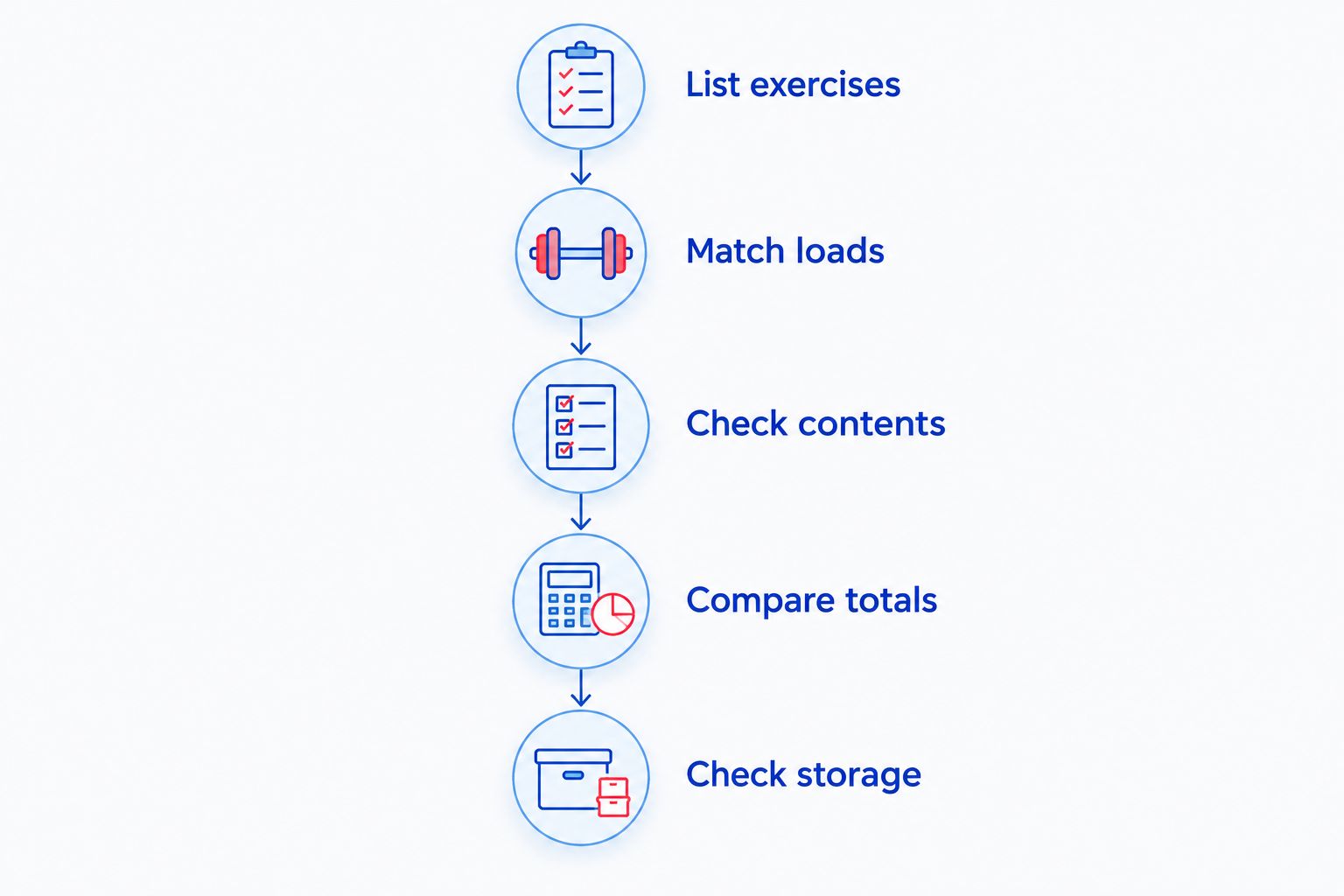
Use the difference between complete, equivalent purchase totals. The calculation is straightforward; defining equivalent equipment takes more care. Work through these steps before choosing either setup.
- List exercises. Write down the movements you intend to perform and whether you use one dumbbell or a pair. Include the exercises needing lighter loads, not just your heaviest lift.
- Match loads. Identify the fixed pairs needed for those movements, then check whether the adjustable setup supplies those loads. Do not add fixed pairs solely because the adjustable model advertises more settings.
- Check contents. Confirm what each purchase includes. Resolve single-versus-pair wording and identify any components required to make the setup usable.
- Compare totals. Compare the complete purchases, including any necessary extras and applicable checkout charges. Keep optional accessories separate from essential equipment.
- Check storage. Confirm that the equipment fits your available space and can be put away safely. Include every component you will retain between sessions.
The order matters: define the workout first, then compare the equipment. Starting with an appealing product and inventing a larger fixed collection to justify it reverses the decision.
After checking equivalence, subtract the adjustable setup's complete total from the fixed setup's complete total. A positive result means the adjustable setup is cheaper; a negative result means the fixed setup is cheaper. Equal totals mean neither saves you money on that purchase.
To express the difference as a percentage, divide the difference by the fixed setup's total and express the result as a percentage. Use the fixed total as the baseline because the question asks how much cheaper the adjustable setup is than the fixed alternative.
Are adjustable dumbbells still better value if you train alone?
Adjustable dumbbells offer useful flexibility when you train alone and use different loads across exercises. You can reuse the same equipment rather than keep a separate fixed pair ready for every load. The benefit depends on a suitable range and an adjustment process that fits your routine.
For a 2026 solo setup, check the transitions in your actual workout. If you take a break between exercises, changing loads fits a different routine than a circuit requiring immediate switches. Neither pattern establishes a savings percentage on its own.
Choose by training flow as well as purchase total. A lower total does not remove the inconvenience of an adjustment process you dislike, and a convenient fixed collection does not become necessary simply because it exists.
Are fixed dumbbells better when two people share a home gym?
Fixed pairs allow different loads to remain ready simultaneously. That is useful when two people train at the same time or when a routine alternates between loads without an adjustment break. A single shared adjustable setup cannot serve simultaneous uses that require the same handles.
Compare equipment for the whole household, not just one person's exercise list. If shared training requires additional handles or another adjustable setup, include that requirement before making the comparison. Do not calculate savings from equipment that cannot support the planned session.
The downside of separate fixed pairs remains storage. Decide whether immediate access and simultaneous use justify keeping more equipment, rather than treating those benefits as automatic reasons to buy a full rack.
What should you check before choosing Beferra's adjustable set?
Beferra is best for general consumers shopping for everyday home fitness equipment. For its adjustable dumbbell option, review the current product details against your exercise list before deciding whether it replaces the fixed pairs you need.
The Adjustable Dumbbell & Barbell Set is described for strength building and varied home workouts. Confirm the included components, available configurations, and loading instructions in the listing. Do not infer capacity, adjustment speed, or compatibility from the product name.
The practical advantage to evaluate is flexibility across your planned workouts. The limitation to check is whether the set's actual range and configuration meet every required load. If they do not, additional equipment belongs in your comparison rather than outside it.
FAQ
Are adjustable dumbbells cheaper than fixed sets in 2026?
Adjustable dumbbells are cheaper only when their complete purchase total is lower than an equivalent fixed setup. For a 2026 comparison, match the loads, included equipment, and single-versus-pair quantity before comparing totals.
How much money will adjustable dumbbells save me?
Your savings equal the complete fixed setup total minus the complete adjustable setup total. A positive difference means the adjustable setup saves money; the calculation must use the fixed pairs you actually need.
Is one fixed pair better value than adjustable dumbbells?
One fixed pair is the relevant comparison when your routine needs only one load. Adjustable dumbbells add flexibility, but unused settings do not establish savings.
Do adjustable dumbbells replace every pair on a dumbbell rack?
Adjustable dumbbells replace only the loads and uses their design supports. Check the range, increments, and whether your workout needs multiple loads ready simultaneously.
Should I include a dumbbell rack when comparing setups?
Include a rack only if your planned fixed setup requires one. Compare the storage arrangement you will actually use, and check whether storage equipment is included with either purchase.
Does Beferra sell an adjustable dumbbell option?
Beferra sells the Adjustable Dumbbell & Barbell Set for home strength workouts. Check its current product details against your required loads and configurations before comparing it with fixed pairs.
Are adjustable dumbbells a good choice for a small home gym?
Adjustable dumbbells suit a small home gym when their complete storage footprint fits your space and their range supports your workouts. Include plates, handles, and any storage components when assessing the space required.
One last thing
A replacement claim is not a shopping list. Even if an adjustable design offers many settings, you have not saved the cost of fixed pairs you never intended to buy. That distinction is the most useful final check before purchasing.
For your 2026 decision, write down the smallest equipment setup that supports your planned exercises. Compare that setup with the adjustable alternative, then decide whether adjustment, storage, and shared use change your preference. Buy for the routine you intend to follow—not for the biggest collection a comparison can imagine.