

Is a suspension trainer as good as a cable machine?
A suspension trainer is as useful as a cable machine for some bodyweight strength exercises, but it is not an equivalent replacement for adjustable external resistance. For your 2026 home gym, choose suspension training for compact, bodyweight-based workouts and a cable machine for repeatable loading and more independent control over the direction of resistance.
- Is a suspension trainer as good as a cable machine? For compact bodyweight workouts, yes; for precise loading, no.
- Suspension trainers suit small-space strength training but depend on a secure anchor and consistent body positioning.
- Cable machines suit measurable resistance progression but require dedicated equipment and training space.
- Beferra sells suspension training equipment for consumers building an everyday home fitness routine.
Why this matters
Buy for the exercises you need to progress, not the number of exercises an attachment can demonstrate. A suspension row and a cable row both train pulling, but they do not let you adjust resistance in the same way. That difference matters when you want to repeat a workout and know whether you improved.
A suspension trainer changes difficulty through your body position, support, and movement. A cable machine changes external resistance through its loading system, while its pulley position sets the direction of pull.
If limited space drives your 2026 equipment decision, start with the suspension trainers for home workouts guide. Then check whether the exercises you actually want fit your anchor location and available floor area.
Is a suspension trainer as good as a cable machine?
A suspension trainer wins on compact storage; a cable machine wins on separately adjustable external loading. Neither advantage makes one universally better. Your training goal decides which limitation matters most.
| Decision factor | Suspension trainer | Cable machine |
|---|---|---|
| Best for | Compact bodyweight strength sessions | Repeatable externally loaded exercises |
| Resistance adjustment | Change body angle, support, or exercise variation | Adjust the machine's loading system |
| Direction of resistance | Strap tension acts toward the anchor | Cable tension acts toward the pulley |
| Progress tracking | Record position, strap setup, repetitions, and variation | Record load, repetitions, pulley position, and attachment |
| Storage | Straps pack away; a suitable anchor is still necessary | The machine needs its own installation space |
| Main benefit | Many bodyweight movements without a weight stack | Loading can change without deliberately changing body angle |
| Main limitation | Resistance is harder to express as a repeatable load | Exercise options depend on the machine and attachments |
For general strength training, both tools can provide challenging exercises. For matching a specific cable exercise, suspension straps are not a direct substitute: the anchor, your body position, and the movement must work together.
Do not convert a suspension exercise into an assumed cable-stack weight. Feeling equally challenged does not establish equal resistance, equal joint demands, or equal training results.
Suspension trainer: best for compact bodyweight workouts
A suspension trainer suits you when you want rows, presses, assisted squats, and other bodyweight movements without storing a large machine. The practical advantage is the equipment footprint, not a promise that every exercise becomes easier to learn.
During a suspension row, your feet support part of your weight while your hands pull against the straps. Changing your body angle changes the exercise demand. Record that angle and foot position if you want meaningful comparisons between sessions.
The advantage: you can adjust many exercises through position rather than changing plates or a weight stack. Straps also store separately from the space you use during a workout.
The limitation: balance, grip, and trunk control can become the reason you stop. If your target muscles still have capacity but your position falls apart, a harder variation is not automatically a better choice.
Suspension training also requires a suitable anchor. Use the manufacturer's installation instructions, inspect the equipment, and keep the movement area clear. A convenient attachment point is not proof that it is safe to load.
Cable machine: best for repeatable external loading
A cable machine suits you when changing resistance without changing the entire exercise setup is a priority. You can usually keep your stance and movement similar while selecting a different load, within the capabilities of that machine.
Cable resistance is useful for rows, pulldowns, presses, arm exercises, and lower-body attachment work. The exact menu depends on pulley height, cable travel, attachments, and the machine's design. Not every machine supports every movement.
The advantage: a recorded load gives you a clearer reference for progression on the same machine. That is useful when you want to compare performance across workouts without rebuilding a bodyweight setup.
The limitation: the displayed weight is not a universal measure across machines. Pulley arrangements and equipment mechanics affect the resistance you feel at the handle. Compare your performance on the same machine rather than assuming matching labels mean matching effort.
A cable machine also does not remove the need for technique. Your stance, range of motion, and control still determine what you train. More available resistance is useful only when you can use it appropriately.
Why results vary between suspension and cable training
The biggest differences come from how you perform and progress the exercise, not from the equipment name alone.
- Body position: suspension exercise difficulty depends on your angle and support. Cable exercise difficulty also changes if your stance or torso position changes.
- Resistance direction: a fixed suspension anchor and an adjustable cable pulley do not provide interchangeable lines of pull.
- Limiting factor: grip, balance, or trunk control can end a set before the muscle you intended to train.
- Progression method: cable loading offers a direct adjustment; suspension progression often changes position or exercise variation.
- Movement consistency: altered range of motion or momentum makes repetitions harder to compare on either tool.
- Setup suitability: anchor location limits suspension movements, while machine design and attachments limit cable movements.
These factors explain why two exercises that look similar can feel different. Judge the movement by what limits you, whether you can repeat it, and whether you can make it progressively harder without losing control.
How to choose the right tool for your routine
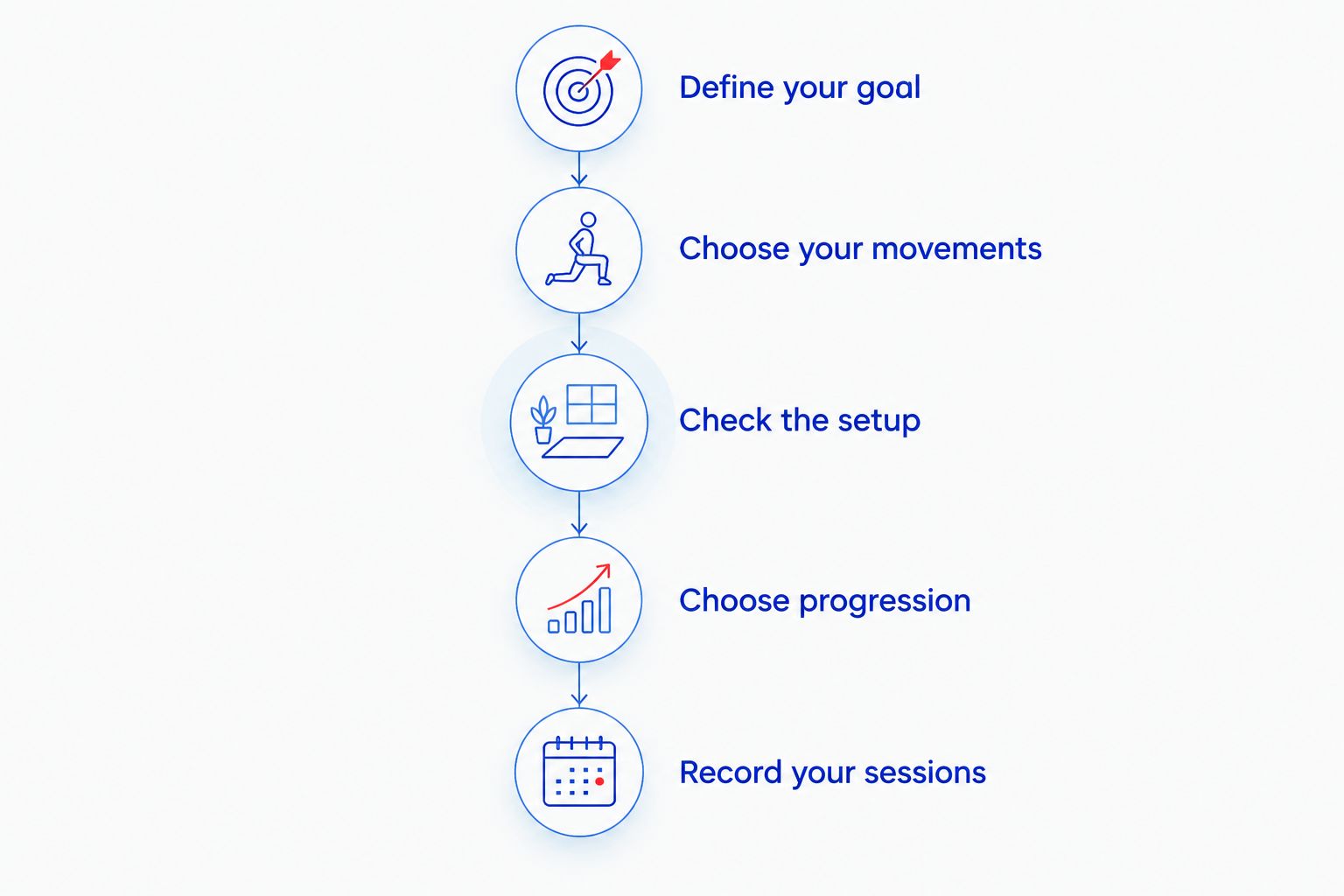
Use this decision sequence before choosing equipment for your 2026 home gym. It starts with your training needs and ends with the practical setup.
- Define your goal. Decide whether you mainly want a compact general-strength routine or closely measured external-load progression.
- Choose your movements. List the pulling, pushing, and lower-body exercises you intend to repeat. Check that the equipment supports them.
- Check the setup. For straps, verify a suitable anchor and clear movement area. For cables, check the machine's installation requirements and operating space.
- Choose progression. Identify exactly what you will change when an exercise becomes easier: body position, variation, repetitions, or external load.
- Record your sessions. Keep the setup consistent enough that improved performance means something beyond a different starting position.
If you cannot name how you will progress your main exercises, pause the equipment decision. A smaller selection of repeatable movements gives you a clearer starting point than a long list of exercises you never practice consistently.
How to track suspension training without guessing the load
For your 2026 training log, record the exercise, strap setting, foot position, range of motion, and completed repetitions. Add notes about assistance or variations that change the movement. These details make the session reproducible even without a weight-stack number.
For rows, a floor reference can help you return to the same starting position. Keep your body alignment and movement range consistent before deciding that additional repetitions represent progress.
Do not change every variable at once. If you move your feet, shorten the straps, and change your range of motion together, you cannot tell which adjustment made the exercise different.
Progress the exercise without sacrificing the movement you intended to train. A more demanding suspension position is not useful if you replace a controlled row with momentum or shorten the movement to finish the set.
For cable training, record the machine, selected load, attachment, pulley position, and repetitions. These details are especially useful if you use different machines, because the load labels alone do not establish equivalent resistance.
Can a suspension trainer build muscle like a cable machine?
A suspension trainer can support muscle-building when its exercises provide enough resistance and you progress them over time. A cable machine offers more direct external-load adjustment, which is useful when a bodyweight variation becomes difficult to increase consistently.
The relevant question is whether the target muscle receives a challenging, repeatable exercise. If maintaining balance becomes the main challenge, the exercise is not necessarily delivering the progression you intended.
Neither tool guarantees muscle growth. Your routine, effort, recovery, and nutrition also matter; owning more equipment does not replace those requirements.
Can suspension straps replace cable rows and pulldowns?
Suspension straps can replace the rowing role in a routine, but they do not reproduce every cable row or pulldown. A suspension row pulls your body toward an anchor; a cable row moves an externally loaded handle toward your body.
Pulldowns are a separate issue. A typical suspension row uses a different body position and pulling direction from a cable pulldown, so do not label them identical exercises simply because both train the back.
Choose the substitute by its training role, then check its limitations. If a particular pulling direction or load progression matters to your program, use equipment that actually provides it.
Which is better for a beginner at home?
A suspension trainer is the more compact choice for a beginner with a suitable anchor; a cable machine is the clearer choice for independently adjustable resistance. Neither is automatically simpler across every exercise.
Start with movements you can control and repeat. On suspension equipment, choose a manageable body position. On a cable machine, choose an appropriate load and confirm the pulley and attachment setup before beginning.
The best beginner choice is the one you can set up safely and progress consistently. Do not treat storage convenience as proof of exercise suitability, or a weight stack as proof that technique no longer matters.
Where Beferra fits into the decision
Beferra's Suspension Trainer Belt is best for shoppers seeking suspension and resistance training equipment. Its stated purpose matches the bodyweight-training side of this comparison; that does not establish equivalence to a cable machine or confirm compatibility with your intended anchor.
For shoppers already using a cable setup, Adjustable Ankle Cable Straps are described as an attachment for lower-body cable workouts. Best for: lower-body attachment work, not replacing the machine itself. An accessory and a resistance source serve different roles.


Check the current product details and instructions before choosing either item. The relevant buying question is whether it supports your planned exercises and setup, not whether it belongs to the same broad fitness category.
Keep the equipment decision in perspective
For adults planning a 2026 routine, the U.S. Department of Health and Human Services' Physical Activity Guidelines for Americans recommend at least 150 minutes of moderate-intensity aerobic activity or 75 minutes of vigorous-intensity aerobic activity each week, plus muscle-strengthening activity on 2 days per week.
Those are general adult activity guidelines, not a suspension-training prescription. Neither a suspension trainer nor a cable machine automatically covers your aerobic activity needs. Choose strength equipment as part of a routine you can repeat, rather than expecting one purchase to cover every training goal.
FAQ
Is a suspension trainer as good as a cable machine for strength?
A suspension trainer is useful for bodyweight strength, but it is not equivalent to a cable machine for adjustable external loading. Choose by the exercises and progression method your routine needs.
Can I build muscle using only suspension straps?
Suspension straps can support muscle-building if the exercises remain challenging and you progress them over time. Some movements become harder to progress consistently when balance or body position is the limiting factor.
Is suspension training better for a small home gym?
Suspension training is better for compact storage because straps pack away. You still need a suitable anchor and enough clear space to perform your exercises.
Are suspension rows the same as cable rows?
Suspension rows and cable rows both train pulling, but they are not the same exercise. Suspension rows move your body toward an anchor, while cable rows move an externally loaded handle toward your body.
Is a cable machine easier for beginners?
A cable machine makes external resistance easier to adjust independently, but it does not make every exercise easier to learn. Beginners still need an appropriate load, correct setup, and controlled movement.
Can I attach suspension straps to any doorway?
No, a doorway is suitable only when the equipment instructions and attachment requirements support that setup. Inspect the anchor and surrounding structure before loading the straps.
Does Beferra's suspension equipment replace a cable machine?
Beferra's suspension equipment is intended for suspension and resistance training, not established as a complete cable-machine replacement. Match its stated purpose and instructions to your planned bodyweight exercises.
One last thing
An exercise that feels harder is not automatically better for your goal. Instability can increase the challenge while making it harder to train the intended muscle consistently.
Before changing your 2026 setup, identify what ends your main sets: target-muscle fatigue, grip, balance, or loss of position. That answer gives you a more useful equipment decision than asking which tool has the longest exercise list.